
Nationwide · Official crash records
Car accident report, vehicle crash investigation reports
The official record a law enforcement officer prepares after investigating a traffic collision. It holds driver information, vehicle damage notes, witness statements, and the officer's own observations.
Courts, insurance companies, and government safety agencies treat a car accident report as the baseline account of the crash, since it comes from a neutral party rather than either driver. Nationwide, 39,254 traffic deaths occurred in 2024, a decrease of 4.3 percent from the 41,025 deaths in 2023, according to the National Highway Traffic Safety Administration.
Whether a report becomes mandatory depends on the state and the dollar amount of the damage. California and Texas both set the threshold at 1,000 dollars in property damage. Florida requires a report for any injury or for damage above 500 dollars. New York matches Florida on the injury requirement but uses a 1,000 dollar damage threshold. Pennsylvania also uses 1,000 dollars, and gives drivers five days to file directly with the state if no officer responds to the scene. No uniform national standard sets these thresholds, so a driver crossing state lines cannot assume the same reporting rule applies on both sides of the border.
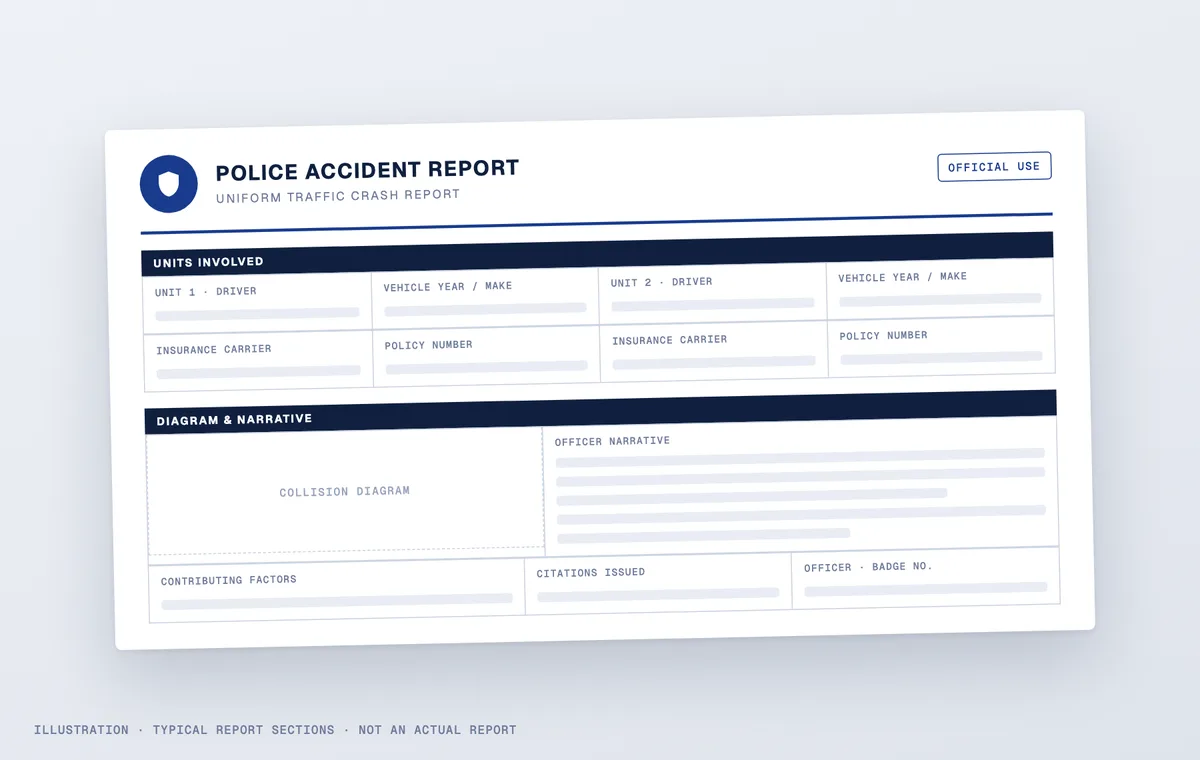
Get your free report
Fatal car accident investigation report from police.
This website is a pooled attorney advertisement. AccidentReports.com is not a law firm or a lawyer referral service, and nothing on this site is legal advice. Disclaimer
- NHTSA
- FARS
- MMUCC
Last updated
36,640Source: NHTSA, Early Estimate of Motor Vehicle Traffic Fatalities and Fatality Rate in 2025 (DOT HS 813 800, April 2026)
People killed in U.S. traffic crashes, 2025 (early estimate)
36,297Source: NHTSA, Overview of Motor Vehicle Traffic Crashes in 2024 (DOT HS 813 791, April 2026)
Fatal crashes on U.S. roads, 2024
1.10Source: NHTSA, Early Estimate of Motor Vehicle Traffic Fatalities and Fatality Rate in 2025 (DOT HS 813 800, April 2026)
Deaths per 100 million vehicle miles traveled, 2025 (early estimate)
100Source: Computed from NHTSA's 2025 early estimate: 36,640 deaths / 365 days (DOT HS 813 800)
Traffic deaths per day on average, 2025 (early estimate)
2025 figures are NHTSA’s early estimate (DOT HS 813 800, April 2026) and will be revised when the 2025 Annual Report File is released in early 2027. 2024 figures are from the FARS Annual Report File and may be revised when the 2024 Final File is released.
Why it matters
Benefits of obtaining a copy of your collision report
A collision report functions as an independent third party account of what happened. It is not written by either driver, and not controlled by either insurer. That independence is the source of its weight in a claim, since neither side had a reason to shade the account in its own favour.
Benefit 01
1. Provides official documentation through a car accident report for insurance claims
A car accident report changes an insurance claim from a bare accusation into documented fact, confirming the crash occurred, naming the parties involved, and recording the reported sequence of events. It carries this weight because a neutral officer wrote it, not either party to the claim. This neutral origin is what an adjuster is paying for when the adjuster requests a copy, since a driver’s own account carries an obvious motive an officer’s account does not. Consider two claims with identical damage: one includes a report describing the other driver running a red light, the other includes only the driver’s own written statement saying the same thing. An adjuster treats them differently because only one comes from a source without a stake in the outcome.
Benefit 02
2. Helps establish fault using a certified collision report
A certified collision report is where physical evidence about fault first gets written down, including right of way violations, the position of traffic control devices, and any citation issued at the scene. A certified collision report carries this evidence instead of opinion, since fault is decided by skid marks and vehicle positions, not by which driver argues more persuasively. A certified collision report sometimes states a fault conclusion outright, and sometimes lists only a code violation, leaving the reader to connect the violation to liability. Take a citation for failure to yield. That single code, entered on a certified collision report, can do more to establish fault than several paragraphs of conflicting driver testimony, because a citation reflects an officer’s independent judgment made at the scene, not a story assembled afterward for an insurer.
Benefit 03
3. Strengthens injury claims with details from the auto accident report
An auto accident report separates two identical sounding injury claims by documenting vehicle damage severity and whether emergency medical services responded at the time of the crash. An auto accident report showing a bumper scrape tells a different story than one showing a crushed door panel and an ambulance dispatched to the scene, even when both drivers describe the same injury afterward. An auto accident report also captures injury complaints made immediately afterward, which closes off any later argument about when the symptoms began. A driver who complains of neck pain at the scene, and whose auto accident report reflects that complaint, has already answered the question an insurer would otherwise raise six weeks later when a doctor finally diagnoses whiplash.
Benefit 04
4. Supports legal cases with an authoritative police car accident report
A police car accident report usually clears the hearsay bar that keeps most out of court statements from a courtroom, under a rule called the business record exception. A police car accident report clears that bar because the officer had a professional duty to record events accurately, not because the report looks official. The business record exception is a rule that allows a document into evidence without live testimony, when the document was created as part of a regular professional duty rather than assembled for litigation. That exception has a limit worth knowing. A bystander statement recorded inside a police car accident report does not automatically inherit the same reliability, since the bystander had no duty to report accurately, which creates what courts call a second layer of hearsay inside the same document. Picture a witness who tells an officer the light was red, and the officer writes that statement into a police car accident report. The officer’s own observation clears the hearsay bar. The witness’s quoted statement still needs its own separate justification to come in, which is why attorneys read this kind of report line by line rather than treating it as automatically admissible in full.
Benefit 05
5. Confirms accuracy of crash details in the traffic accident report
A traffic accident report written within hours or days of the collision preserves weather conditions, roadway defects, and traffic signal function before any of the detail fades. A traffic accident report sidesteps a problem most people underestimate, since memory is unreliable in the way a stressful crash distorts fastest. A driver can use a traffic accident report as an anchor, checking the driver’s own recollection against the report throughout months of claims handling. Suppose a driver later remembers the light as green, but the contemporaneous traffic accident report notes wet pavement and a malfunctioning signal. The report, not the fading memory, becomes the version an adjuster and eventually a jury believes.
Benefit 06
6. Assists attorneys in building claims using the motor vehicle accident report
A motor vehicle accident report is the foundation a claim gets built on, the way a structure needs a foundation before anything else goes up. A motor vehicle accident report lets attorneys identify liability issues, estimate the scope of damages, and plan additional evidence to pursue, often starting with the witness contact information the report already lists. This starting point matters because an attorney working from a thin file has to reconstruct facts from scratch, while an attorney working from a detailed motor vehicle accident report already has names, addresses, and a documented sequence of events to build on. The same motor vehicle accident report works in reverse for an attorney defending a claim, who reads the report for omissions, inconsistencies, or facts that support an affirmative defense. A single missing detail illustrates the stakes. A motor vehicle accident report that never lists a witness the driver remembers from the scene can mean that witness is never located, and the corroboration that witness could have provided is lost for good.
Benefit 07
7. Speeds up insurance processing with a complete car crash report
A complete car crash report speeds up insurance processing by eliminating the need for insurers to conduct independent investigations into basic accident facts. A complete car crash report allows adjusters to begin liability analysis and damage assessment without delay when filing a claim. Insurance companies often condition prompt claim resolution on receipt of a car crash report, because the report answers fundamental questions the insurer would otherwise have to chase down through phone calls and follow up letters. Two claims filed the same week show the difference plainly. The claim filed with a complete car crash report attached often gets a liability decision within days. The claim filed without one can sit for weeks while an adjuster tries to confirm facts the report would have settled immediately.
Benefit 08
8. Preserves evidence and timelines from the official accident report
An official accident report captures evidence that fades quickly, such as skid marks, fluid trails, and debris patterns. An official accident report also fixes a timestamp and sequence of events. This timestamp matters for statute of limitations deadlines and for showing what caused the crash, since a claim filed without a clear date can run into filing deadline disputes years later. Skid marks disappear within days on a busy road. A debris field gets swept up by the next city cleaning crew. An official accident report is often the only surviving record of what those marks and that debris looked like, which is why requesting a copy soon after the crash keeps this evidence available for the full life of the case.
Contents
What details does a car accident report have?
A car accident report documents the collision through the responding officer’s fixed fields, so the same categories appear on every report regardless of which agency produced it.
Field 01
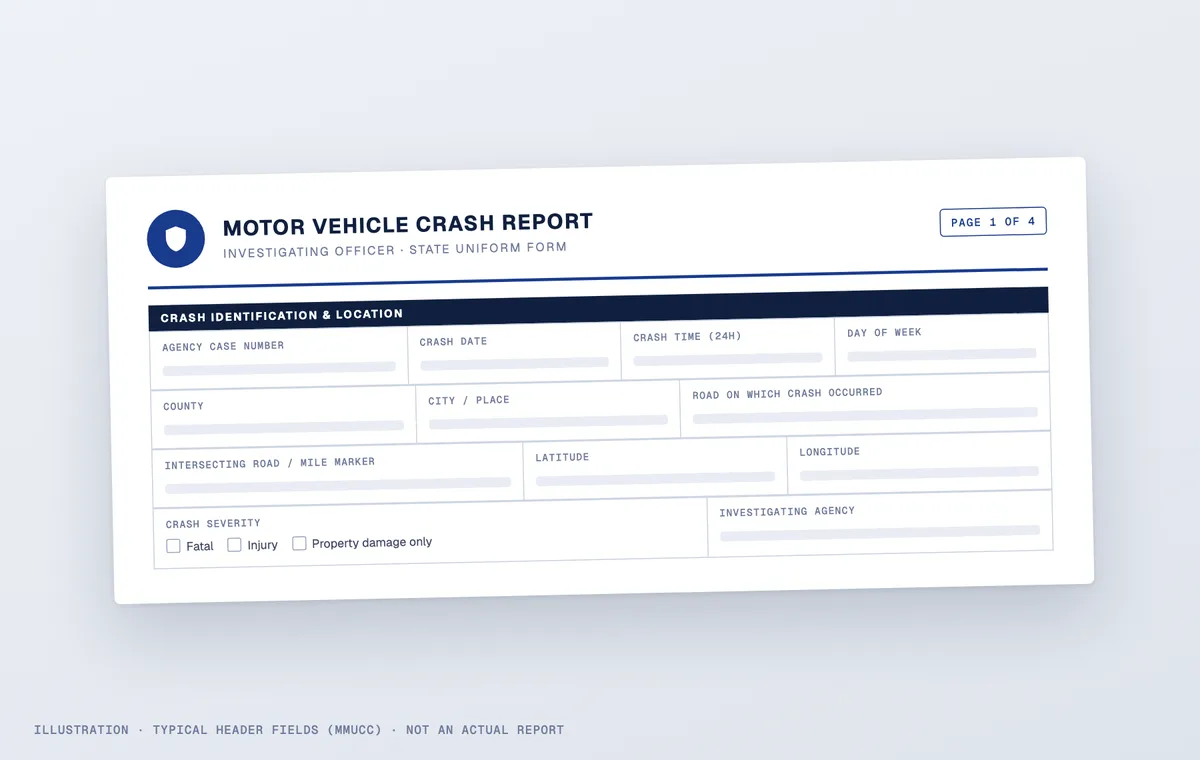
1. Date, time, and location listed in the car accident report
A car accident report fixes the when and where of the crash inside its header, including the street address or intersection, the nearest cross street, and the city, county, and state. A car accident report’s header data triggers statute of limitations deadlines, establishes jurisdiction, and can reveal conditions like rush hour traffic or reduced nighttime visibility. Jurisdiction matters more than it sounds like it should, since a crash recorded a few blocks off from where it happened can put the case in the wrong county’s court system entirely. Location data also points toward nearby traffic cameras or roadway features relevant to fault. A crash logged near a known intersection with a red light camera gives an attorney a second source of evidence the header data alone would never reveal. A wrong date, time, or location can be corrected through a written request to the reporting agency, supported by timestamped photographs, GPS records, or witness affidavits.
Field 02
2. Names and contact details of involved parties in the auto accident report
An auto accident report identifies every driver, passenger, and pedestrian touched by the crash, usually by full legal name, address, phone number, date of birth, and license number for drivers, with lighter detail for passengers and pedestrians. An auto accident report lets an injured person identify the right defendant, serve legal papers correctly, and reach parties for statements or settlement talks. Serving the right defendant matters more than it seems, because a lawsuit filed against a slightly misspelled name or an outdated address can be dismissed on procedural grounds long before a court ever reaches the facts of the crash. An auto accident report also flags whether a driver lives out of state, a detail that can affect venue. A driver who lives three states away changes where a lawsuit can even be filed, which is why this single field can reroute an entire case before it starts. Incorrect information can be fixed by submitting a government issued identification card, vehicle registration, or other official record to the agency.
Field 03
3. Vehicle information and damage descriptions in the car crash report
A car crash report lists each vehicle’s year, make, model, color, license plate, identification number, and registration state, alongside a description of where the vehicle was struck and how severely, ranked from minor to severe. A car crash report gives adjusters this section for early valuation. Early valuation matters because it sets a reserve, the amount an insurer sets aside for a claim, and a reserve set too low at this stage can shape every settlement offer that follows. A car crash report also helps reconstruct how the vehicles collided. A rear bumper listed as the point of impact tells a different story than a driver’s side door, and that single detail can shift a fault determination before any diagram or narrative is even read. A driver who disagrees with the recorded damage can submit registration papers, scene photographs, or an independent repair estimate to challenge the entry.
Field 04
4. Insurance and policy details recorded in the traffic accident report
A traffic accident report’s insurance and policy details section names each driver’s insurer, policy number, and coverage dates, sometimes noting whether a valid insurance card was shown or verified electronically at the scene. This section tells an injured person which company to contact, supplies the policy number needed to open a claim, and confirms whether the at fault driver carried the coverage required by law. Coverage confirmation matters early, because a driver who spends weeks negotiating with an insurer only to discover the policy had lapsed has lost time that could have gone toward the driver’s own uninsured motorist claim instead. This section also points toward an underinsured motorist claim if the policy limits look too low to cover the damages. Wrong entries can be corrected with a declarations page, insurance card, or written confirmation from the carrier.
Field 05
5. Officer observations and citations in the police car accident report
A police car accident report’s officer narrative describes what the officer saw on arrival, what each party said happened, and any physical evidence such as skid marks or final vehicle positions, along with citations issued for violations like following too closely or running a red light. This narrative often carries more weight than either driver’s own account, because many insurers and courts defer to a trained officer’s independent conclusions. That deference exists for a specific reason. An officer investigates crash scenes routinely and has no financial stake in which driver is found at fault, while both drivers have an obvious interest in shifting blame away from themselves. A citation can be challenged at a hearing. Factual errors in the officer’s narrative can be disputed with photographs, video, or contradicting witness statements, though the challenge has to overcome the same presumption of neutrality that gave the narrative its weight in the first place.
Field 06
6. Diagrams and scene descriptions within the collision report
A collision report’s diagram shows the roadway layout, lane markings, traffic signals, resting vehicle positions, and the point of impact. A collision report pairs that diagram with accompanying text describing the number of lanes, road surface, grade, and any hazards. Together the diagram and text let a reader picture the crash dynamics in a way narrative text alone cannot, including how sight lines or a roadway defect may have contributed. A blind curve or an obstructed stop sign, visible on a diagram but easy to miss in a paragraph of prose, can turn what looks like simple driver error into a roadway design issue an attorney would otherwise never think to investigate. Photographs, precise measurements, or an engineering survey can be used to correct a diagram that misrepresents the scene.
Field 07
7. Witness names and statements in the motor vehicle accident report
A motor vehicle accident report lists each witness with a name, address, phone number, and a summary, sometimes a direct quote, of what the witness told the officer about the crash sequence and driver behavior. A motor vehicle accident report’s witness section often carries real weight in establishing fault, because a witness has no stake in the outcome, whether the account corroborates one driver’s version or contradicts the other driver’s version. That lack of stake is precisely what makes a witness valuable in a way neither driver can be. A bystander who happened to be waiting at a crosswalk has nothing to gain from blaming either driver, so a bystander’s account of who ran the light tends to carry more persuasive force with an adjuster or a jury than either driver’s own version of the same moment. A witness who feels misquoted can submit a written affidavit or recorded statement to correct the record.
Field 08
8. Injury details and medical response noted in the accident report
An accident report notes visible injuries, which parties complained of pain, whether an ambulance responded, which facility received the injured party, and any paramedic observations recorded at the scene. An accident report creates a medical record tied to the crash from the first hour this way. That first hour record matters more than any note that comes later, because it connects a diagnosis back to the collision instead of leaving room for an insurer to argue the injury came from some other cause entirely. The level of emergency response documented in this section also signals how forceful the impact likely was. An ambulance dispatched to the scene, paired with a paramedic’s note about a patient’s disorientation, tells an adjuster the impact was serious before a single medical bill ever arrives. Emergency medical run reports, hospital records, or a paramedic’s own statement can correct an inaccurate entry.
Definition
What is an accident report?
Term
Accident report
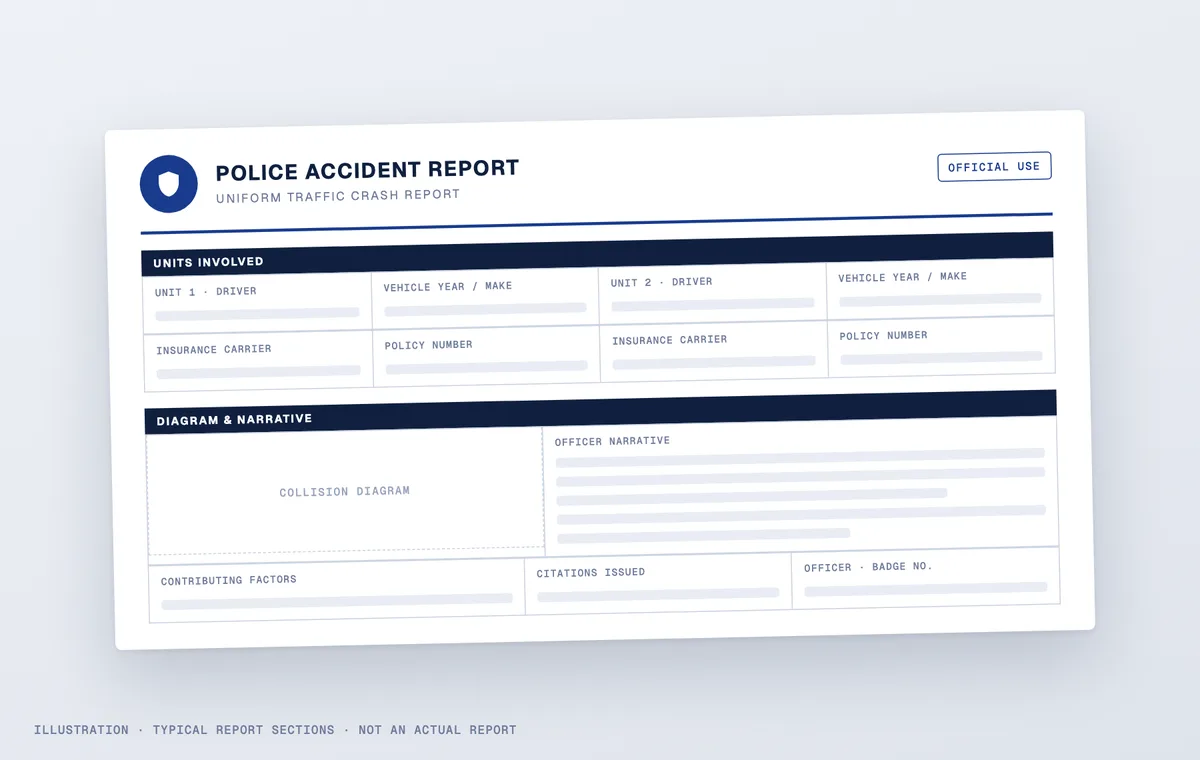
An accident report is an official document that records the circumstances of a collision, produced by whoever investigated or was involved in it. The term covers more than the police crash report most drivers picture.
Each of these carries different weight. Knowing which one you are holding, and which one your claim actually needs, is the difference between a file that moves and a file that stalls.
-
01Medical report
A hospital records the injuries
-
02Insurance report
An adjuster records the claim
-
03Self-reported form
A driver records their own account
Taxonomy
What are the types of accident reports?
Accident reports fall into distinct types, each created by a different party and each carrying different weight. The table below shows how they compare across the factors that matter to a claim.
| Report type | Who files | Issuing authority | When required | Primary use | Legal validity | Availability |
|---|---|---|---|---|---|---|
| Police report | Law enforcement officer | Police department | Injury, death, or property damage threshold | Official record for claims and litigation | High, admissible evidence | Police department records |
| Medical report | Medical provider | Hospital or clinic | When injuries require treatment | Document injuries and treatment | High, medical record | Medical records request |
| Insurance report | Insurance adjuster | Insurance company | When a claim is filed | Claims adjustment and settlement | Medium, internal document | From insurance company |
| Driver report | Driver | DMV or state agency | When police do not respond | State compliance requirement | Low, self reported | DMV records |
| Reconstruction report | Accident reconstructionist | Forensic analyst | Complex liability disputes | Engineering analysis | High, professional testimony | Retained by attorney |
| Witness statement | Witness | Self or attorney | When a witness observed the crash | Corroborate facts | Medium, testimonial | Obtained by parties |
Source: AccidentReports.com editorial summary of report types; requirements and admissibility vary by state
Each row shows a different report’s role in a claim, running from the officer’s official record down to a witness account obtained by the parties themselves.
Police accident reports
A police accident report follows a state mandated format built for departmental use, which is why it reads as a grid of coded fields rather than a narrative. It is the only report in this list produced by someone with no stake in the claim, and it is the document every other party will ask for first.
- Contact the law enforcement agency that responded to the accident through the agency’s records division.
- Provide the accident date, location, involved parties, and report number if available.
- Submit the request online through the agency portal, in person at the records window, or by mail.
- Pay the applicable fee.
- Wait 5 to 14 business days for processing, depending on agency workload.
- Establishes official documentation of the accident from a neutral authority.
- Documents citations and violations, creating negligence presumptions that support a liability claim.
- Provides contemporaneous injury and damage descriptions, preventing later disputes about causation timing.
- Contains officer observations and conclusions that insurance adjusters heavily weigh when assessing fault.
- Identifies witnesses for obtaining corroborating statements.
- Creates admissible evidence for litigation under the business records hearsay exception.
- Review the header confirming accident date, time, location, and reporting agency information.
- Examine party identification and contact details, verifying accuracy for all involved parties.
- Study vehicle information, including make, model, identification number, and damage description.
- Analyze the officer’s narrative describing the accident sequence, physical evidence, and contributing factors.
- Check for citations or violations indicating which party violated traffic law.
- Review the diagram showing vehicle positions, travel directions, and impact points.
- Note witness statements corroborating or contradicting each party’s account.
- Identify injury documentation linking medical complaints to the accident date.
106 data elements
The national MMUCC guideline (6th edition) lists the crash data elements a report can capture. An attorney comparing a police report against that list can spot what the officer left blank.
Source: NHTSA, MMUCC 6th Edition
Medical evaluation report
A medical evaluation report is the clinical documentation a healthcare provider creates while assessing and treating an injury from a motor vehicle collision, linking a diagnosis to the crash date. A medical evaluation report exists precisely because a claimed injury and a documented injury are not the same thing in the eyes of an insurer, describing the severity of the injury and estimating a prognosis for recovery. Timing matters here more than most people expect. Symptoms of a mild traumatic brain injury or concussion can appear right away or take hours or days to surface, and most people who experience a concussion feel better within a couple of weeks with proper care, according to the Centers for Disease Control and Prevention. An insurer reviewing a claim often treats a delayed evaluation as a sign the injury was minor or unrelated to the crash, even though a delayed onset is a documented medical pattern rather than evidence against the claim. A driver who feels fine at the scene but develops a headache two days later is not describing an exaggerated injury, the driver is describing what the Centers for Disease Control and Prevention says concussions often do. A medical evaluation report that tracks symptoms from the date of the crash through each follow up visit closes this gap, giving an adjuster or a court a timeline that explains the delay instead of leaving room to question it.
Common forms of this report:
- Emergency Medical Report. An emergency medical report documents the immediate assessment and treatment given at the accident scene or hospital, written by emergency medical services personnel and emergency department physicians.
- Medical and Injury Reports. Medical and injury reports track a crash injury’s ongoing assessment as physicians, consulting doctors, and physical therapists keep adding to the file while treatment continues.
- Contact the healthcare provider or clinic that evaluated the injury after the crash.
- Complete a HIPAA compliant authorization form to release the medical records.
- Specify the date range covering the crash date through the most recent visit.
- Pay the applicable copying fee.
- Allow 7 to 21 days for processing, depending on the provider’s practice.
- Links a diagnosis to the crash date, establishing the causation an insurer would otherwise dispute.
- Documents injury severity and a recovery prognosis that support the damages valuation.
- Explains a delayed symptom onset, closing the gap an adjuster uses to question a claim.
- Provides objective clinical findings that carry more weight than a driver’s own account of the injury.
- Creates a treatment record a defense can also mine for gaps or inconsistencies.
- Confirm the diagnosis and its stated connection to the collision.
- Trace the symptom timeline from the crash date through each follow up visit.
- Note the severity assessment and the prognosis for recovery.
- Check whether a delayed symptom onset is documented and explained.
- Identify any reference to a pre-existing condition an insurer could raise.
A medical provider who documents a delayed symptom onset explicitly, rather than leaving the gap unexplained, gives the injured client's claim a timeline an adjuster cannot easily dismiss.
Insurance accident reports
Insurance accident reports are the internal documents an insurer creates during the claims investigation and adjustment process to evaluate liability and quantify damages. Insurance accident reports stand apart from the rest of a claims file for a specific reason, not every report in that file comes from a neutral third party.
Common forms of this report:
- Insurance Claim Report. An insurance claim report pulls the liability analysis, coverage determinations, and settlement evaluations for a specific accident claim into a single document once the insurer finishes investigating.
- Adjuster Report. An adjuster report is the internal document tracking an adjuster’s investigation activities, findings, and recommendations on the claim assigned for evaluation.
- Request your own insurer’s report directly as the insured party.
- Use discovery or a subpoena when the opposing insurer will not release it voluntarily.
- Expect a redacted version that protects privileged material.
- Reveals how the insurer assessed liability and valued the damages.
- Exposes coverage defenses and settlement authority that guide the negotiation.
- Shows investigation gaps a claim or defense can exploit.
- Identify the liability percentage the adjuster assigned to each party.
- Review the damage valuation behind the settlement figure.
- Note coverage issues or investigation gaps the insurer recorded.
An attorney reading the claims notes section closely can often find the exact point where an adjuster's position shifted, and why.
Legal and forensic reports
Legal and forensic reports bring focused professional analysis of accident causation, liability, and damages to a legal claim or defense. Legal and forensic reports fill a gap a complex collision case often creates, one that an officer or a treating physician alone cannot close.
Common forms of this report:
- Accident Reconstruction Report. An accident reconstruction report is a certified engineer’s or reconstructionist’s scientific analysis built from vehicle dynamics and engineering principles.
- Attorney Case Report. An attorney case report pulls liability theories, damages calculations, settlement demands, and litigation strategy into one internal document summarizing the legal aspects of a case.
- Witness Statements. Witness statements document what an individual who observed the accident, or who has relevant knowledge about the circumstances, parties, or vehicles involved, saw.
- Written Witness Statement. A written witness statement captures a witness’s account of the accident in the witness’s own handwriting, or through a typed document the witness reviewed and signed for accuracy.
- Recorded or Affidavit Statements. Recorded or affidavit statements capture a witness account through audio or video recording, or through a sworn written declaration made under penalty of perjury.
- Retain a qualified reconstructionist or analyst through your attorney.
- Provide the police report, photographs, and discovery materials for review.
- Allow 30 to 90 days for the written analysis, depending on case complexity.
- Supplies independent technical analysis when the police report is contested.
- Contradicts a driver’s statement or a police estimate with engineering findings.
- Strengthens liability and damages arguments for negotiation or trial.
- Review the methodology and the principles the analysis applied.
- Examine the calculations behind the speed, trajectory, or fault conclusions.
- Assess whether the physical evidence cited supports those conclusions.
An injured client reading the risk analysis section can see, in plain terms, why an attorney recommends settling now instead of waiting for trial.
Driver or self-reported accident reports
Driver or self reported accident reports cover documentation of an involved party completed personally, rather than a neutral third party like law enforcement or a medical professional. Driver or self reported accident reports exist because not every account of a crash comes from someone with no stake in the outcome. That personal authorship cuts both ways. A self reported account can capture details an officer missed, but it can also reflect whatever version of events favors the person writing it, which is why a self reported form is read differently than a police report from the first line onward.
Common forms of this report:
- Driver Exchange and Accident Information Form. A driver exchange and accident information form records each driver’s contact information, insurance details, vehicle specifications, and basic accident facts.
- Online or Mail-In Accident Report. An online or mail-in accident report is a state mandated form, due to the Department of Motor Vehicles or state transportation department within a specified timeframe after a reportable accident.
- Request the report through discovery procedures during litigation.
- Obtain your own version from your insurance company and employer.
- Subpoena the report if not voluntarily provided by the opposing party.
- Access the report through public records when filed with a government agency.
- Anticipate a court order may be required for a protected document.
- Reveals the other party’s initial version before attorney coaching.
- Identifies an early admission or inconsistent statement.
- Demonstrates potential bias or self serving revision.
- Shows what information the party emphasized or omitted.
- Provides a comparison to a later litigation motivated account.
- Compare the driver’s account to objective evidence for discrepancies.
- Identify any admission of fault or violation.
- Note what information the driver emphasized or omitted.
- Assess whether the timing suggests independent creation or legal consultation.
- Evaluate consistency with other evidence and a later statement.
An insurance adjuster treats an early self reported account as a fixed point, since a party's story rarely improves for the other side once an attorney gets involved.
Specialized accident report
A specialized accident report is the documentation a truck crash, a fatality, or a government fleet incident demands beyond the routine police form. A specialized accident report exists because each of those situations breaks from the standard collision reporting playbook. Each circumstance pulls in a different outside authority, a federal regulator for trucks, a reconstruction team for fatalities, a risk management department for government vehicles, which is why a standard police report alone is never the whole story in any of them.
Common forms of this report:
- Commercial Vehicle Accident Report. A commercial vehicle accident report has to satisfy Federal Motor Carrier Safety Administration requirements alongside whatever the state demands.
- Fatal Accident Report. A fatal accident report reflects the added depth of a different level of investigation, one that often involves a dedicated crash reconstruction unit or a state highway patrol fatality team.
- Government or Fleet Accident Report. A government or fleet accident report documents a collision involving a vehicle owned by a government entity or a private company operating a vehicle fleet, requiring an internal reporting procedure on top of whatever the responding officer files.
- Request the standard police report from the responding agency first.
- Add the dedicated record for the case, a federal carrier file, a fatality investigation, or a fleet report.
- Use public records requests, discovery, or a subpoena depending on the holder.
- Reveals the second layer of evidence a routine police report never captures.
- Establishes employer or carrier liability beyond the driver’s own fault.
- Documents federal rule violations, autopsy findings, or fleet maintenance gaps.
- Identify which outside authority produced the added record.
- Check that record for violations, findings, or gaps the police report omitted.
- Compare it against the police report for agreement or contradiction.
An attorney who pulls the electronic logging device data alongside the police report can show a court two records that either agree or expose a fatigued driver.
Not sure which report your claim needs?
Send us the crash date and the responding agency. We will tell you which reports exist, which one your claim actually needs, and how to get it.
Defence
How to defend against a car accident claim with a car crash report
Defending against a claim means using the same crash report the other side is relying on, and reading it more carefully than they did.

-
Step 01
Obtain the report immediately
Get the car crash report before responding to allegations or making any statement. A defence built without the report is a defence built on the other side’s summary of it.
-
Step 02
Analyse the officer's findings
Study the observations and citations documented in the report to see which facts are actually established and which are simply asserted by the claimant.
-
Step 03
Compare damage to injuries
Match the damage descriptions in the report against the claimant’s injury claims. Damage that cannot produce the alleged injury is the strongest defence available.
Get the crash report.
Get the crash report in hand before you answer any claim, since a defence built on the other side's summary is a defence built on their reading of the facts.
Request your reportRecords
Recent Fatal Car Crashes on Record
The table below lists the 100 most recent fatal crashes in the National Highway Traffic Safety Administration’s Fatality Analysis Reporting System (FARS) for 2024, the most recent year NHTSA has published. The 2024 file is NHTSA’s annual report file and may be revised when the final file is released.
| Date and time | State | Location | Collision type | Fatalities |
|---|---|---|---|---|
| Dec 31, 2024 · 23:49 | North Carolina | SSR-1944 King Rd, Johnston County | Rollover/Overturn | 1 |
| Dec 31, 2024 · 23:45 | California | Century Blvd at Figueroa, Los Angeles, Los Angeles County | Pedestrian | 1 |
| Dec 31, 2024 · 23:40 | Nevada | E Flamingo Rd at Seville St, Clark County | Angle | 1 |
| Dec 31, 2024 · 23:34 | Tennessee | I-81, Bristol, Sullivan County | Pedestrian | 1 |
| Dec 31, 2024 · 23:30 | Alabama | US-278 SR-74, Calhoun County | Tree (Standing Only) | 1 |
| Dec 31, 2024 · 23:25 | Oklahoma | Riverside Dr, Tulsa, Tulsa County | Curb | 1 |
| Dec 31, 2024 · 23:20 | Washington | SR-7, Pierce County | Pedalcyclist | 1 |
| Dec 31, 2024 · 23:07 | Florida | Compass Lake Dr, Alford, Jackson County | Rollover/Overturn | 1 |
| Dec 31, 2024 · 23:05 | South Carolina | SSR-35, Berkeley County | Live Animal | 1 |
| Dec 31, 2024 · 23:05 | Pennsylvania | Ogontz Ave at Nodro Ave, Philadelphia, Philadelphia County | Sideswipe - Same Direction | 1 |
| Dec 31, 2024 · 22:47 | New Jersey | US-30 Absecon Blvd at Pennsylvania Ave, Atlantic City, Atlantic County | Pedestrian | 1 |
| Dec 31, 2024 · 22:43 | Nebraska | US-30, Merrick County | Front-to-Front | 1 |
| Dec 31, 2024 · 22:22 | Texas | Cr-1016A, Johnson County | Front-to-Front | 1 |
| Dec 31, 2024 · 22:20 | Florida | Copans Rd, Pompano Beach, Broward County | Non-Motorist on Personal Conveyance | 1 |
| Dec 31, 2024 · 22:08 | North Carolina | I-95 N, Northampton County | Tree (Standing Only) | 1 |
| Dec 31, 2024 · 21:24 | Tennessee | SR-268 Compton Rd, Rutherford County | Culvert | 1 |
| Dec 31, 2024 · 21:10 | South Carolina | SR-247 Cooley Bridge Rd, Greenville County | Front-to-Rear | 4 |
| Dec 31, 2024 · 21:07 | Texas | Fm 85, Henderson County | Front-to-Front | 1 |
| Dec 31, 2024 · 21:00 | Texas | Fm 1925, Edinburg, Hidalgo County | Front-to-Front | 1 |
| Dec 31, 2024 · 20:57 | Virginia | US-29 Wards Rd, Campbell County | Ditch | 1 |
| Dec 31, 2024 · 20:50 | Florida | US-90 at St Johns Bluff, Jacksonville, Duval County | Pedestrian | 1 |
| Dec 31, 2024 · 20:43 | Texas | Fm 1427/Abram Rd, Hidalgo County | Pedestrian | 1 |
| Dec 31, 2024 · 20:33 | Texas | I-10, Jefferson County | Front-to-Rear | 1 |
| Dec 31, 2024 · 20:17 | Florida | US-192 Space Coast Pkwy at Georgia Ave, Saint Cloud, Osceola County | Pedestrian | 1 |
| Dec 31, 2024 · 20:11 | Idaho | 2900 South Rd, Gooding County | Rollover/Overturn | 1 |
| Dec 31, 2024 · 19:53 | Massachusetts | SR-81 Plymouth Ave, Fall River, Bristol County | Pedestrian | 1 |
| Dec 31, 2024 · 19:48 | New Jersey | Hand Ave at Hudson Ave, Wildwood, Cape May County | Pedestrian | 1 |
| Dec 31, 2024 · 19:41 | Michigan | Lincoln Lake Ave at 17 Mile Rd, Kent County | Angle | 1 |
| Dec 31, 2024 · 19:31 | Arizona | SR-87, Dilkon, Navajo County | Rollover/Overturn | 1 |
| Dec 31, 2024 · 18:57 | Washington | Cr-E Appleway Ave, Spokane Valley, Spokane County | Pedestrian | 1 |
| Dec 31, 2024 · 18:48 | North Carolina | SR-86, Creedmoor, Granville County | Culvert | 1 |
| Dec 31, 2024 · 18:42 | Virginia | US-1, Chesterfield County | Pedalcyclist | 1 |
| Dec 31, 2024 · 18:30 | Florida | Mu-61St St N, Pinellas Park, Pinellas County | Traffic Sign Support | 1 |
| Dec 31, 2024 · 18:25 | Texas | I-45, Houston, Harris County | Angle | 1 |
| Dec 31, 2024 · 18:24 | Pennsylvania | Butler Pke, Montgomery County | Pedestrian | 2 |
| Dec 31, 2024 · 18:06 | Florida | I-95, Fort Lauderdale, Broward County | Pedestrian | 1 |
| Dec 31, 2024 · 18:01 | Texas | Rm 620, Travis County | Angle | 1 |
| Dec 31, 2024 · 17:56 | Arizona | SR-69, Prescott Valley, Yavapai County | Front-to-Rear | 1 |
| Dec 31, 2024 · 17:40 | New York | SR-27 Caton Ave, New York City, Kings County | Pedestrian | 1 |
| Dec 31, 2024 · 17:29 | North Carolina | SSR-1317 Bethel Church Rd, Northampton County | Front-to-Front | 1 |
| Dec 31, 2024 · 17:20 | Georgia | SR-22 at Box Springs Highway, Talbot County | Angle | 1 |
| Dec 31, 2024 · 16:57 | Louisiana | US-171 at Bert Kouns Loop, Shreveport, Caddo Parish | Front-to-Front | 1 |
| Dec 31, 2024 · 16:51 | Texas | Mu-Prewett Rd, Fort Worth, Tarrant County | Angle | 1 |
| Dec 31, 2024 · 15:39 | Arizona | SR-68 at Landon Dr, Bullhead City, Mohave County | Angle | 1 |
| Dec 31, 2024 · 15:07 | California | E Santa Barbara St at N Davis St, Santa Paula, Ventura County | Pedestrian | 1 |
| Dec 31, 2024 · 14:52 | Alabama | SR-139, Bibb County | Ditch | 2 |
| Dec 31, 2024 · 13:18 | West Virginia | US-52, Glenhayes, Wayne County | Angle | 1 |
| Dec 31, 2024 · 12:40 | Nevada | SR-233, Elko County | Rollover/Overturn | 1 |
| Dec 31, 2024 · 12:38 | Florida | US-17 at Avent Dr, Jacksonville, Duval County | Front-to-Rear | 1 |
| Dec 31, 2024 · 12:12 | West Virginia | US-50 Robert C Byrd Hwy, Wood County | Guardrail Face | 1 |
| Dec 31, 2024 · 12:02 | California | W Cameron Ave at S Stonebrook St, Visalia, Tulare County | Angle | 1 |
| Dec 31, 2024 · 11:55 | Florida | SR-39 Alexander St at US-92 Thonotosassa Rd, Plant City, Hillsborough County | Pedalcyclist | 1 |
| Dec 31, 2024 · 11:35 | Illinois | Sr- 1, Lawrence County | Culvert | 2 |
| Dec 31, 2024 · 11:17 | Arizona | Fremont Dr, Lake Havasu City, Mohave County | Mail Box | 1 |
| Dec 31, 2024 · 11:07 | North Carolina | SSR-1101 Cornwallis Rd at SSR-1135 Providence Church Rd, Duplin County | Angle | 1 |
| Dec 31, 2024 · 11:05 | Maine | I-95, Pittsfield, Somerset County | Front-to-Front | 1 |
| Dec 31, 2024 · 11:04 | Connecticut | SR-63 Straits Tpke, Middlebury, New Haven County | Front-to-Rear | 1 |
| Dec 31, 2024 · 10:30 | Texas | Mu-neal St at Mu-glenview, Houston, Harris County | Angle | 1 |
| Dec 31, 2024 · 10:17 | New York | Hooker Ave at Austin Ct, Poughkeepsie, Dutchess County | Pedestrian | 1 |
| Dec 31, 2024 · 08:58 | Michigan | I-94, Portage, Kalamazoo County | Concrete Traffic Barrier | 1 |
| Dec 31, 2024 · 07:26 | Massachusetts | SR-24 Amvets Memorial Hwy, Fall River, Bristol County | Guardrail Face | 1 |
| Dec 31, 2024 · 07:06 | North Carolina | SSR-1486 Lexington Ave at Cook St, High Point, Guilford County | Angle | 1 |
| Dec 31, 2024 · 06:53 | New York | Pennsylvania Ave at Pitkin Ave, New York City, Kings County | Front-to-Front | 1 |
| Dec 31, 2024 · 06:39 | Kentucky | SR-1973 Iron Works Pike, Lexington-Fayette, Fayette County | Angle | 1 |
| Dec 31, 2024 · 06:34 | Washington | US-2, Snohomish County | Front-to-Front | 2 |
| Dec 31, 2024 · 06:30 | South Carolina | US-29 at Cr-travis Rd, Anderson County | Angle | 1 |
| Dec 31, 2024 · 05:47 | Massachusetts | US-5 Brattleboro Rd, Bernardston, Franklin County | Utility Pole/Light Support | 1 |
| Dec 31, 2024 · 04:38 | North Carolina | I-40 E, Orange County | Pedestrian | 1 |
| Dec 31, 2024 · 03:36 | North Carolina | SR-43, Greenville, Pitt County | Curb | 1 |
| Dec 31, 2024 · 02:17 | Maine | US-1, Falmouth, Cumberland County | Utility Pole/Light Support | 1 |
| Dec 31, 2024 · 02:09 | Mississippi | SR-182, Oktibbeha County | Front-to-Front | 1 |
| Dec 31, 2024 · 01:36 | New York | SR-9A, Tarrytown, Westchester County | Pedestrian | 1 |
| Dec 31, 2024 · 01:31 | Tennessee | SR-319 Hixson Pk, Hamilton County | Embankment | 1 |
| Dec 31, 2024 · 01:31 | Maryland | I-695 Balto Beltway, Baltimore County | Concrete Traffic Barrier | 1 |
| Dec 31, 2024 · 00:58 | California | US-101, Camarillo, Ventura County | Angle | 1 |
| Dec 31, 2024 · 00:33 | Connecticut | SR-20, Windsor, Hartford County | Traffic Sign Support | 1 |
| Dec 31, 2024 · 00:33 | California | I-80, Richmond, Contra Costa County | Concrete Traffic Barrier | 1 |
| Dec 31, 2024 · Not reported | New Mexico | SR-96, Abiquiu, Rio Arriba County | Not Reported | 1 |
| Dec 31, 2024 · Not reported | California | SR-94 Ramp, San Diego, San Diego County | Pedestrian | 1 |
| Dec 30, 2024 · 23:05 | Arkansas | US-65, Boone County | Embankment | 1 |
| Dec 30, 2024 · 22:59 | Louisiana | US-90, New Orleans, Orleans Parish | Tree (Standing Only) | 1 |
| Dec 30, 2024 · 22:00 | Texas | US-281, Brownsville, Cameron County | Pedestrian | 1 |
| Dec 30, 2024 · 21:58 | Illinois | Mu- Avalon Ave, Chicago, Cook County | Utility Pole/Light Support | 1 |
| Dec 30, 2024 · 21:30 | Alabama | I-65, Conecuh County | Front-to-Rear | 1 |
| Dec 30, 2024 · 21:25 | Massachusetts | E Britannia St, Raynham Center, Bristol County | Traffic Sign Support | 2 |
| Dec 30, 2024 · 20:10 | Nebraska | Cr-N 230Th St, Douglas County | Tree (Standing Only) | 1 |
| Dec 30, 2024 · 19:57 | Hawaii | Cr- Kahakai Road, Pahoa, Hawaii | Pedalcyclist | 1 |
| Dec 30, 2024 · 19:52 | Nevada | N Lamb Blvd, Las Vegas, Clark County | Curb | 1 |
| Dec 30, 2024 · 19:36 | Louisiana | SR-1, Iberville Parish | Pedalcyclist | 1 |
| Dec 30, 2024 · 19:30 | Florida | SR-60 at CR-615, Indian River County | Front-to-Front | 1 |
| Dec 30, 2024 · 19:23 | Wisconsin | E Sunset Dr at Guthrie Rd, Waukesha, Waukesha County | Angle | 1 |
| Dec 30, 2024 · 19:18 | Georgia | SR-300, Thomas County | Pedestrian | 1 |
| Dec 30, 2024 · 19:12 | Missouri | SR-100 Manchester Rd at N Sappington Rd, Glendale, St Louis County | Pedestrian | 1 |
| Dec 30, 2024 · 19:07 | Texas | SR-29/Austin St at Mu-fuschsia St, Mason, Mason County | Pedestrian | 1 |
| Dec 30, 2024 · 18:55 | South Carolina | SSR-48 Bethel Rd, Mauldin, Greenville County | Front-to-Front | 1 |
| Dec 30, 2024 · 18:11 | Louisiana | Cr-Ormond Blvd, St. Charles Parish | Pedalcyclist | 1 |
| Dec 30, 2024 · 18:07 | Florida | Mu-n 26TH Ave at Johnson St, Hollywood, Broward County | Pedalcyclist | 1 |
| Dec 30, 2024 · 18:00 | Minnesota | Mu- Meadowbrook Rd, St. Louis Park, Hennepin County | Pedestrian | 1 |
| Dec 30, 2024 · 17:55 | Oregon | Jefferson Scio Dr Se, Marion County | Pedestrian | 1 |
| Dec 30, 2024 · 17:52 | New Mexico | SR-314, Valencia County | Front-to-Front | 1 |
Questions
Frequently asked questions
Before a driver can use a car accident report, the driver needs to understand what the report is, how it differs from other kinds of documentation, and what basic facts it does or does not cover. This section answers the foundational questions, what belongs in the report, how it compares to a general incident report, what role it plays once a claim is filed, and what a driver can expect to find inside it regarding injuries, damages, and applicable state law.
Car accident reports include standardized information with state specific variations in format and detail requirements across jurisdictions nationwide. Many states model their crash reports on MMUCC, a voluntary National Highway Traffic Safety Administration guideline, so the shared framework is a recommendation, not a federal requirement. Each state still applies its own emphasis to the same categories.
- Date, Time, and Location Information.
- Driver Information.
- Vehicle Details and Registration Information.
- Insurance Information. Verification methods vary by jurisdiction depending on database access and real time electronic verification systems.
- Officer Narrative and Observations. Some states allow officer opinions on fault, while other states restrict reports to factual observations only under evidence rules.
- Accident Diagrams and Scene Sketches. Some states use detailed scaled diagrams with measurements, while other states use simplified representations with basic directional arrows and impact points.
- Witness Contact Information and Statements. Some states mandate detailed statements, while other states allow brief summaries in the officer’s words.
- Injury Descriptions and Medical Responses. Most states grade injury severity on the KABCO scale that MMUCC recommends: fatal, suspected serious injury, suspected minor injury, possible injury, and no apparent injury.
An attorney comparing a state that requires scaled diagrams against a state that allows a simple sketch can gauge, before the report even arrives, how much supplemental evidence the case will likely need.
A car accident report is a specific type of incident report created by law enforcement documenting motor vehicle collisions, whereas an incident report is a broader category encompassing various types of events requiring documentation. A car accident report follows standardized state mandated formats prescribed by motor vehicle codes and transportation departments, containing specific data elements required for traffic safety analysis and Department of Motor Vehicles compliance. This standardization is what an incident report lacks, since an incident report may come from a private security guard or a property manager documenting a slip and fall, with no state form and no traffic safety database waiting on the other end. A slip and fall report and a car accident report both describe something that happened, but only one of them triggers Department of Motor Vehicles filing requirements, insurance notification mandates, and potential administrative license actions.
An insurance adjuster weighing whether to treat a document as a car accident report or a general incident report checks first whether a state licensing authority, not just a private party, ended up with a copy.
A police car accident report plays a foundational role in a case by establishing the accident occurrence, documenting the immediate post collision circumstances, and providing an independent third party account of the event. This foundational role exists because insurance adjusters, attorneys, and judges all need a starting point that neither party controls, and a police car accident report is usually the first document that fills that role. Insurance companies typically treat a police car accident report as authoritative on factual matters such as vehicle positions, road conditions, and traffic control device status, using the report to assign liability percentages and determine coverage applicability.
In legal proceedings, a police car accident report frequently qualifies for admission under business records or public records exceptions to hearsay rules, which allows the report’s contents to be considered by fact finders without requiring the responding officer to testify. That admissibility is worth something concrete. A trial that would otherwise need a busy officer to appear and testify from memory months or years later can instead rely on the officer’s own contemporaneous written account, saved as evidence the moment it was created.
Motor vehicle accident reports document injuries observed, reported, or medically addressed at the accident scene through officer observations and emergency medical services documentation. This scene level documentation exists because an officer is often the first person to see an injured party after the crash, before any hospital chart or physician’s note has even been created. Each injury type documented at the scene also carries its own weight in a compensation claim, since a visible fracture noted by an officer supports a far higher pain and suffering figure than an unwitnessed soft tissue complaint.
- Visible Lacerations and Bleeding. Officer observations note wound locations, sizes, and severity at the accident scene.
- Fractures and Suspected Bone Breaks. These get identified through victim complaints of pain, visible deformities, or documented inability to move.
- Head Injuries Including Concussions. These get noted when victims report loss of consciousness, confusion, disorientation, or visible head trauma.
- Soft Tissue Injuries. Contusions and abrasions get recorded when bruising or skin damage appears clearly visible.
- Complaints of Pain in Neck, Back, or Extremities. These get documented even without visible injuries, to support later diagnoses.
- Burns From Airbag Deployment or Vehicle Fires. These get noted with descriptions of burn locations and apparent severity classifications.
- Internal Injuries. These get suspected based on victim symptoms like difficulty breathing, abdominal pain, or signs of bleeding.
- Psychological Distress. Shock, panic attacks, or emotional distress get observed by officers or emergency personnel.
A medical provider reviewing this scene level list later cross checks each item against the emergency room chart, since a gap between the two lists is often the first thing an insurer questions.
The damages that are reflected in a car accident report are listed below. Each item reflects something an officer could directly observe at the scene, which is why the list stops well short of the full financial picture a claim eventually requires.
- Vehicle Body Damage. Dents, scratches, and deformations get described by location such as front end, side panels, or rear.
- Mechanical Damage. Engines, transmissions, or suspension systems get noted when vehicles are undrivable or leaking fluids extensively.
- Glass Breakage. Windshields, windows, and mirrors get documented when safety glass is shattered or cracked from impact.
- Airbag Deployment Status. This gets recorded for each vehicle, indicating the force of impact and potential occupant injury mechanisms.
- Tire and Wheel Damage. This gets documented when impact causes flat tires, bent rims, or alignment issues affecting vehicle drivability.
- Interior Damage. Dashboards, seats, and consoles get noted when passenger compartment intrusion occurs from severe impacts.
- Property Damage Beyond Vehicles. Guardrails, signs, or structures struck during the collision sequence and aftermath get recorded too.
- Total Loss Determinations. These get made when damage severity renders vehicles economically unfeasible to repair under insurance industry standards.
An insurance adjuster reading the airbag deployment line often treats it as a proxy for impact force before any repair estimate is even in hand.
The documents that supplement an accident report are listed below. Each one fills a gap the report itself was never designed to cover, since an officer’s job ends at the scene while a claim’s documentation needs continue for months afterward.
- Photographs. These get taken at the scene, showing vehicle positions, damage extent, road conditions, and environmental factors from multiple angles.
- Medical Records. Emergency room reports, diagnostic imaging, treatment notes, and billing statements document injury severity and treatment.
- Repair Estimates. Licensed auto body shops provide detailed itemizations of necessary repairs and associated parts and labor costs.
- Witness Statements. These get obtained independently from parties who observed the accident, providing corroboration or contradicting official report contents.
- Video Footage. Traffic cameras, dashboard cameras, or security systems capture the actual collision sequence and driver actions.
- Professional Reports. Accident reconstructionists or medical consultants provide technical analysis beyond the responding officer’s investigation and observations.
- Employment Records. These document lost wages, reduced earning capacity, or disability periods resulting from accident related injuries requiring extended recovery.
- Insurance Correspondence. Claim numbers, adjuster contacts, coverage confirmations, and settlement offers document the claims process progression.
An injured client building a file treats these eight document types as a checklist, since a gap in any one of them tends to surface later as an insurer’s objection.
A car accident report does include insurance details for all vehicles involved, documenting each driver’s insurance company name, policy number, and policy effective dates verified at the scene. Officers typically request insurance cards from drivers and record the information directly from these documents, and many jurisdictions now use electronic verification systems that instantly confirm active coverage through state insurance databases. That electronic verification matters because a driver’s insurance card alone cannot show whether a policy lapsed the week before the crash, while a database check can, which is why some states now flag a driver at the scene the moment coverage cannot be confirmed electronically.
An insurance adjuster checking this section first confirms coverage was active, since a lapsed policy noted at the scene changes the entire claim strategy.
Multiple reports can exist for one car accident when different agencies respond, supplemental investigations occur, or parties file self reports in addition to police documentation. This multiplicity happens because different institutions track different things for different reasons, a police department tracks liability, an insurer tracks exposure, a hospital tracks treatment, and none of the three has a reason to defer entirely to the other two. A single fender bender involving a commercial truck can generate a city police report, a driver’s own state filed self report, and a federal motor carrier report, all describing the identical five seconds from three separate institutional angles.
Getting a copy of a car accident report is rarely instant, and the process changes depending on the agency, the state, and how serious the crash was. This section covers how to request a report, how long processing typically takes, what fees apply, and what a driver’s options look like when the report is delayed or when no report was filed at all.
Obtaining a car accident report requires following specific procedures established by the law enforcement agency that investigated the collision. Those procedures exist because a records division processes requests for dozens of reports at once, and a driver who skips a step, like leaving out the report number, usually adds days to a process that could otherwise take less than a week.
- Contact the Agency. Reach the police department or sheriff’s office that responded to the accident to determine the agency’s specific report request procedures and applicable fees.
- Provide the Accident Details. Give the accident date, location, and parties involved along with the report number if available when requesting the report from the records department.
- Complete the Request Form. Submit it either online through the agency’s website, in person at the agency’s records window, or by mail using the agency’s standard forms.
- Pay the Applicable Fee. Fees vary by agency, paid by cash, check, or credit card depending on the agency’s accepted methods.
- Wait for Processing. Processing generally takes 5 to 14 business days depending on agency workload and whether the requester paid for expedited processing.
An injured client who calls the records division before submitting a form can often confirm the exact fee and timeline instead of guessing.
How long it takes to receive a car accident report depends on the requesting method, agency workload, and report complexity, with timeframes ranging from immediate for online requests to several weeks for complex fatal accident investigations. Simple property damage accident reports are typically available within 5 to 10 business days after the accident date, since officers must complete a narrative, have supervisors review it, and upload it into records management systems before it becomes available at all. Injury accident reports generally take longer than property damage reports for a related reason, officers conduct more thorough investigations and interview additional witnesses, which takes more time to write up and review.
An attorney working toward a filing deadline should plan for the slowest realistic timeline, since a fatal accident report can take 60 to 90 days to complete when a crash reconstruction professional and toxicology testing are both involved.
Timelines for obtaining a car accident report vary by jurisdiction and agency, with availability ranging from immediate online access to 90 day waits for complex investigation completions. Most police departments make simple accident reports available within 5 to 14 business days after the accident date, allowing time for officer narrative completion, supervisory review, and system entry. Some progressive agencies with modern online records systems cut that wait dramatically, providing instant report access through web portals where a requester can search by date and parties and download a PDF copy immediately upon payment.
Fees for requesting a car accident report vary by jurisdiction and agency, depending on the state’s public records fee schedule. Most police departments charge flat fees per report regardless of length, established by state law or local ordinance. Certification fees add to that base cost, and that extra charge matters specifically for court proceedings, since a certified copy, not an ordinary print out, is usually what a judge requires before admitting the report as evidence.
A driver can still file insurance claims using other documentation while following up with the agency about report status, if an accident report is delayed beyond standard processing times. Insurance companies understand that police reports take time to process and typically begin investigating a claim based on the driver’s statement, photographs, and other available evidence while awaiting official documentation. When delays threaten statute of limitations deadlines, a driver has a specific fallback available. A driver can request a report status letter from the agency confirming the report exists and is pending completion, which satisfies many documentation requirements temporarily until the finished report arrives.
An injured client watching a delay pass 30 days for a routine accident should escalate through supervisor contact or a formal complaint, since unreasonable delays may violate public records disclosure obligations.
An accident report can be delayed for various legitimate reasons including complex investigations, officer workload, supervisory review requirements, and administrative backlogs affecting processing times. Serious injury or fatal accidents typically take longer to investigate and document, since officers must conduct detailed scene examinations, interview numerous witnesses, obtain medical records, and consult with accident reconstruction professionals before completing a report. A high volume period compounds the problem further. A major weather event or a holiday weekend can create a backlog of dozens of crashes at once, overwhelming a department’s records staff and delaying even routine reports that would otherwise be finished within days.
Whether an attorney obtains a car accident report depends on whether the driver has retained legal services to represent the driver in the accident claim or lawsuit. When a driver hires an attorney to handle the driver’s accident case, obtaining the police report is one of the first steps the attorney takes to evaluate the claim and understand the accident circumstances documented by law enforcement.
An attorney routinely requests accident reports directly from police departments on behalf of clients, using established agency relationships and knowledge of local procedures that often expedites the process beyond what a driver could achieve alone.
Fault in a car accident case rarely comes down to one person’s word against another’s. This section covers how the physical evidence, officer observations, and citations inside a report combine to prove or dispute fault, how weather and multiple vehicles complicate that picture, and how a driver can challenge or supplement a report when the evidence tells a different story.
A police accident report is not strictly required for filing an insurance claim, but the absence of a police accident report significantly complicates the claims process and increases the likelihood of disputes about accident facts and liability. Insurance companies strongly prefer a police accident report, because the report provides independent third party documentation of the accident from trained professionals without financial interest in the outcome. A driver’s own insurance company’s collision coverage claim typically proceeds without one, but a third party claim against the at fault driver’s insurer faces greater challenges, since liability insurers more readily dispute fault when no official documentation supports the claimant’s version of events.
A driver can file a claim without an accident report, though the absence of official documentation requires providing more extensive alternative evidence to support the claim and establish liability. A driver’s own insurance company must process the driver’s collision coverage claim regardless of whether a police report exists, though the insurer may require detailed written statements, photographs, and possibly examinations under oath to verify the claim’s legitimacy. To strengthen a claim without a report, a driver should immediately photograph all vehicle damage from multiple angles, document the accident scene showing road conditions and traffic controls, obtain written witness statements, and create a detailed written account while the facts remain fresh. Each of these steps substitutes for a piece of what a police report would otherwise have documented automatically.
A traffic accident report proves fault through multiple information elements including officer observations, citation documentation, physical evidence descriptions, and witness corroboration that collectively establish which party violated traffic laws or exercised inadequate care. Each element supports fault in a different way. Officer narratives describing vehicle positions, impact points, skid mark patterns, and debris fields provide factual evidence showing which vehicle violated right of way rules or failed to maintain proper control. Citations issued for violations such as following too closely, failure to yield, running red lights, or speeding go a step further, creating strong presumptions of negligence that a defendant must overcome with substantial contrary evidence just to keep the citation from deciding the case.
How a driver can use a police accident report to prove fault is listed below.
- Identify Citations and Traffic Violations. These establish negligence per se when a driver violated specific traffic laws designed to prevent the type of accident that occurred, creating presumptions of fault a defendant must rebut with compelling contrary evidence.
- Highlight the Officer’s Fault Determination. When the report explicitly assigns responsibility, cite the officer’s training and neutral status to show a trained investigator independently concluded the other party caused the accident.
- Reference Physical Evidence Descriptions. Skid marks, vehicle positions, and debris patterns documented in the report corroborate a driver’s version of events and contradict the other driver’s account, using objective proof over subjective statements.
- Quote Witness Statements. Where neutral third party observers corroborate a driver’s description of driver actions, signal compliance, or speed differentials, this shows independent parties support the driver’s liability narrative without financial interest in the outcome.
- Use the Accident Diagram. Present it to adjusters and juries as an easy to understand visual representation of vehicle positions, travel directions, and impact points supporting a driver’s fault theory.
- Compare Damage Descriptions. Showing inconsistencies where the other party’s claimed impact scenario would produce different damage patterns than what the officer documented undermines the other party’s credibility through physical evidence contradictions.
An attorney building this six step argument typically leads with the citation, since a documented traffic violation carries more early weight than any other item on the list.
A car accident report does not legally determine fault in the sense of being binding on insurance companies or courts, but a car accident report carries substantial persuasive weight, influencing liability assessments by adjusters, attorneys, and fact finders. Insurance adjusters treat a police report as a highly authoritative document when assessing liability, often adopting the officer’s fault determination as the adjuster’s starting position, subject to modification based on additional evidence parties present. That starting position matters more than a strict legal rule might suggest, since most accident cases settle without trial, which means the adjuster’s report based assessment often becomes the actual liability determination in practice, whatever the formal evidentiary rules say about the report’s non-binding status.
Partial fault does appear in a police report when officers determine that multiple parties contributed to the accident causation through various unsafe actions or rule violations. Some jurisdictions encourage or require officers to assign fault percentages to each party reflecting the party’s relative contribution to the accident, such as 60 percent to the speeding driver and 40 percent to the driver who failed to signal before lane changes. That split matters directly to recovery, since the presence of partial fault in a report significantly affects potential recovery under the applicable state’s comparative or contributory negligence laws, and an assigned fault percentage may reduce a driver’s damages or completely bar recovery depending on which legal standard the state follows.
Weather details in a police report affect liability by establishing whether environmental conditions contributed to accident causation, required special driving precautions, or imposed heightened duties of care on drivers operating in challenging conditions. Rain, snow, ice, fog, or other adverse weather documented in a report may support comparative fault arguments when drivers failed to reduce speed, increase following distance, or exercise appropriate caution given the known hazardous conditions. This standard exists because drivers have legal duties to operate safely given known weather conditions, which means rain or snow documentation in a report does not excuse an accident, it instead establishes that a reasonable driver should have anticipated reduced traction and visibility and adjusted accordingly.
A court considers whether weather conditions were reasonably foreseeable and whether a driver’s response was appropriate given the conditions the driver encountered, not merely whether weather contributed to the accident occurrence.
Witness statements impact an incident report by providing independent corroboration or contradiction of party accounts, influencing the officer’s conclusions about how the accident occurred and who bears responsibility. Strong consistent witness testimony confirming a driver’s version of events lends credibility to the driver’s account and may lead officers to assign fault against the other party based on this independent verification. The weight officers assign to a witness statement varies with how well positioned that witness was, since a witness standing at a crosswalk with a clear line of sight carries more credibility than a witness who glanced over only after hearing the impact.
Multiple vehicles affect a collision report by increasing complexity as officers must document each vehicle’s involvement, contribution to causation, and relative fault for liability allocation purposes. Chain reaction accidents involving three or more vehicles require detailed analysis of which driver initiated the collision sequence and whether subsequent impacts resulted from unavoidable momentum or additional driver negligence. A five car pileup on a highway illustrates why this gets complicated fast. The driver who caused the first impact may bear primary fault, but a following driver who was tailgating and made the third impact worse can still carry independent liability for the damage that driver’s own negligence added on top.
How a driver can challenge errors in an incident report is listed below.
- Document the Error Thoroughly. Identify the specific inaccurate information in the report and gather evidence proving the correct facts through photographs, official documents, witness statements, or video footage that contradicts the report’s contents.
- Submit a Formal Correction Request. Send a written request to the law enforcement agency’s records division explaining the error, providing supporting evidence, and requesting a supplemental report amendment while preserving the original document’s integrity.
- Request a Meeting With the Officer. Meet with the investigating officer or the officer’s supervisor to discuss the error and present the driver’s evidence, since face to face explanation can be more persuasive than written submissions alone.
- Obtain Independent Evidence. Surveillance footage, additional witness statements, or professional analysis can establish the report’s error and provide alternative documentation for claims and legal proceedings.
- Use the Error Strategically. Pointing out the inaccuracy diminishes the report’s overall credibility, since an officer who erred on documented facts may likewise have unreliable conclusions about fault.
- Pursue Legal Remedies. If the error is substantial and the agency refuses correction, seek court orders compelling amendment or introduce evidence at trial demonstrating the error and requesting juries disregard the inaccurate report sections.
An attorney working through this six step process usually starts building the evidence file in step one long before submitting the formal request in step two.
A driver can supplement a collision report with evidence by taking photographs, obtaining witness statements, and collecting medical records. Other ways a driver can supplement a collision report with evidence are listed below.
- Photograph the Vehicle Damage. Capture the damage from multiple angles showing specific impact locations, severity, and vehicle positions to supplement the officer’s written descriptions and support reconstruction of impact dynamics.
- Collect Independent Witness Statements. Interview individuals who observed the accident, documenting their vantage points, observations, and recollections in detail through written or recorded statements that corroborate the report.
- Secure Surveillance Footage. Pull footage from traffic cameras, business security systems, or dashboard cameras that captured the crash, providing objective video of how the collision occurred beyond witness recollections or party statements.
- Collect Medical Records. Gather records documenting injury evaluations, diagnoses, and treatments that link a driver’s injuries causally to the accident and establish severity beyond the brief emergency scene notes in a police report.
- Retain Professional Witnesses. Bring in accident reconstructionists, biomechanical engineers, or medical consultants who can analyze the evidence and provide independent opinions supporting a driver’s liability and damages claims.
- Document Scene Conditions. Return to photograph roadway configurations, sight distances, traffic controls, and environmental factors that a police report’s diagrams or descriptions may not capture but that support the driver’s version.
- Obtain Repair Estimates. Collect itemized estimates from multiple licensed facilities, giving specific damage quantification beyond a police report’s general severity descriptions for settlement and litigation.
An attorney prioritizes surveillance footage first among these seven items, since video evidence is the most likely to disappear if not requested within days of the crash.
A driver can proceed by gathering evidence, obtaining professional reconstruction analysis, and stressing physical evidence, if an accident report favors the other driver. Other ways a driver can proceed if a report favors the other driver are listed below.
- Analyze the Report Critically. Identify factual errors, incomplete investigation, or alternative readings of the evidence that support the driver’s version, looking for weaknesses in the report’s reasoning to raise in negotiations or litigation.
- Gather Contradictory Evidence. Assemble photographs, witness statements, surveillance footage, or professional analysis showing the officer’s conclusions were incorrect, building a file strong enough to overcome the report’s presumptive authority with adjusters and juries.
- Obtain Reconstruction Analysis. Retain certified accident reconstructionists who can evaluate the physical evidence and demonstrate that the collision dynamics contradict the officer’s conclusions, providing authoritative independent opinions that counter the report’s weight.
- Emphasize Physical Evidence. Point to inconsistencies between what the officer concluded and what vehicle damage, skid marks, or debris patterns show, using objective proof to argue the report’s narrative is physically impossible given the evidence.
- Highlight Investigation Gaps. Show failures to interview available witnesses, inadequate scene documentation, or premature conclusions, arguing the officer’s limited investigation does not warrant deference to those conclusions.
- Present the Case Fully. Lay out the driver’s case comprehensively to adjusters and opposing counsel, overwhelming them with evidence that the report is wrong to push a favorable settlement or a reasonable compromise.
An attorney facing an unfavorable report treats step three, the professional reconstruction analysis, as the item most likely to change an adjuster’s position, since it substitutes one trained opinion for another.
A car accident report follows a case from the first phone call to an insurer all the way through trial, if the case gets that far. This section covers how attorneys use the report to build a strategy, how it holds up as evidence in court, and what steps close out a case once every piece of documentation is finalized.
Using a car accident report at trial requires strategic introduction, authentication, and explanation to maximize the report’s evidentiary value and impact on jury deliberations.
- Authenticate the Report. The testifying officer or records custodian verifies the report as an official business record created in the ordinary course of law enforcement duties, satisfying foundational requirements for admissibility.
- Introduce Admissible Portions. Business records or public records hearsay exceptions allow certain sections in while excluding inadmissible opinions, depending on jurisdiction rules.
- Use Report Facts to Impeach Contrary Testimony. Inconsistencies between witness statements at the scene versus trial testimony show that earlier contemporaneous accounts contradict current litigation motivated statements.
- Display Report Diagrams and Photographs. These give the jury demonstrative evidence, helping the jury visualize the accident scene, vehicle positions, and impact dynamics that narrative testimony alone cannot adequately convey.
- Cross Examine Adverse Parties. Report contents lock parties into prior inconsistent statements and undermine their credibility when trial testimony differs from what they told officers at the scene.
- Corroborate a Driver’s Witnesses. Consistency between a witness’s trial statements and the witness’s report documentation shows the witness has remained truthful throughout rather than changing stories.
An attorney typically completes step one, authentication, before any of the remaining five steps become usable in front of a jury.
An auto accident report is used in court subject to jurisdiction specific evidence rules governing the report’s admissibility, with factual observations generally admissible while officer opinions may be excluded as inadmissible hearsay. Most courts admit an accident report under business records or public records hearsay exceptions, recognizing that government documents created in the ordinary course of official duties carry reliability presumptions justifying their admission. That admissibility has a real ceiling worth knowing. Officer opinions about fault causation face admissibility challenges in many jurisdictions as inadmissible hearsay, which means the same report that comes in fully in one state might arrive in a second state with its most persuasive lines, the officer’s own fault conclusion, stripped out entirely.
A car accident case can go to trial if settlement negotiations fail to produce an acceptable resolution, with a trial providing jury determinations of liability and damages when parties cannot agree. Most accident cases settle without trial through negotiated agreements between parties and insurers, since a trial involves substantial expense, time investment, and outcome uncertainty that both sides prefer to avoid when a reasonable settlement is achievable. The strength of the accident report itself often decides which path a case takes. An unfavorable report makes a defendant more willing to try the case, believing a jury will credit the official documentation, while a favorable report pushes the same defendant toward settlement to avoid that exact same risk.
An injured client should expect time to trial to vary by jurisdiction from 12 months to 36 months or longer, a delay worth weighing against a prompt settlement offer already on the table.
To effectively explain a police report to clients, follow the steps below.
- Review the Report Systematically. Go section by section, explaining what each portion documents, including party information, vehicle details, officer observations, witness statements, and diagrams, so clients understand the report’s comprehensive scope.
- Identify Favorable Report Elements. Citations against the other party, witness corroboration, or officer conclusions assigning fault strengthen the client’s negotiation position and litigation prospects.
- Address Unfavorable Report Portions Honestly. Explain inaccuracies, investigation deficiencies, or damaging conclusions, preparing clients for insurance company arguments while developing strategies to overcome these weaknesses through additional evidence.
- Explain the Report’s Legal Impact. Describe how adjusters interpret contents, what weight courts give to various sections, and how report conclusions affect settlement values and litigation outcomes.
- Outline Correction Procedures if Errors Exist. Explain how to request report amendments, what documentation supports correction requests, and realistic expectations about which errors agencies will correct versus which errors require alternative evidence.
- Discuss Strategic Use of the Report. Explain when to provide copies to insurers, how to emphasize favorable portions while minimizing unfavorable sections, and how the report affects settlement timing and demand formulation.
An attorney walking a client through this six step review usually spends the most time on step three, since honest treatment of the weak points builds more trust than a purely favorable summary.
An attorney explains an accident report before negotiations by conducting thorough review meetings where the attorney analyzes report contents, assesses strengths and weaknesses, and develops negotiation strategies based on official documentation. Understanding a report’s contents is essential before entering settlement discussions, because the report inevitably influences insurer positions, demand justifications, and realistic settlement ranges achievable given documented facts. Timing is part of that strategy, not just content. An attorney has to decide whether immediate disclosure of a strong report best serves the client by establishing liability early, or whether delaying disclosure of a weaker report while gathering contrary evidence better positions the case first.
An injured client leaves this review understanding what settlement ranges are realistic given the report’s contents, and what additional evidence might still improve the outcome.
Handling conflicting car crash reports follows the same next steps as reviewing any accident report, applied with extra attention to reconciling the inconsistencies between documents.
- Identify and Correct Errors Immediately. Request report amendments from the issuing agency when factual inaccuracies exist, submitting supporting documentation before the report influences insurance and legal proceedings.
- Supplement Each Conflicting Report. Photographs, witness statements, medical records, and professional analyses fill gaps the reports left and create a comprehensive evidence file stronger than any single report alone.
- Formulate Settlement Demands. Base these on the report’s supported liability and damages that best reflect the corroborated facts, using favorable content to justify valuation while addressing conflicting portions directly.
- Consult With an Attorney. An attorney can assess which report, or which portions of each report, the case should be built around, since conflicting agency reports rarely carry equal weight.
An attorney treats conflicting reports as a reconciliation problem, not a fatal flaw, and works through the supporting evidence until one version of events becomes clearly better supported.
Delays in an accident report affect a case by creating uncertainties about official documentation that influence settlement timing, evidence preservation, and claim valuation during the gap before a report becomes available. Insurance companies often delay substantive claim evaluations and settlement offers until receiving a police report, extending the claims process and postponing compensation when a report is significantly delayed beyond standard processing times. That delay is not just an inconvenience, it actively erodes evidence. Witness memories fade during the gap, and physical evidence like skid marks and debris deteriorates or disappears entirely while a driver is still waiting on paperwork.
An attorney facing a lengthy delay should gather alternative documentation proactively, follow up persistently with the agency to expedite processing, and make insurance demands based on available evidence while noting that an official report remains forthcoming.
Once a report has been reviewed for accuracy, a case generally moves through evidence supplementation, demand preparation, insurance notification, and, if needed, litigation.
- Correct Any Factual Errors. Do this with the issuing agency before the report influences insurance and legal proceedings further.
- Supplement the Report. Photographs, witness statements, medical records, and professional analysis build a file stronger than the report alone.
- Formulate a Settlement Demand. Use the report supported liability and damages picture, addressing any unfavorable portions directly.
- Provide the Report to Both Insurers. This triggers formal claim evaluations and begins negotiation.
- Consult an Attorney. Bring the report to the first meeting for review, if one has not already been retained.
- Develop a Litigation Strategy. Identify what discovery or professional testimony would strengthen the case if settlement looks unlikely.
- Preserve Every Document. Nothing should be lost before the claim resolves through settlement or verdict.
An injured client treats this seven item sequence as a checklist that repeats each time new evidence arrives, not a one time pass through the file.
To close a case after finalizing an accident report, a driver must confirm report accuracy, calculate final damages, prepare settlement demands, and negotiate with insurers. Other ways to close a case after finalizing an accident report are listed below.
- Confirm Report Accuracy and Completeness. A final review verifies all information is correct and confirms no additional amendments or supplemental reports are necessary before case resolution.
- Calculate Final Damages. Medical expenses, lost wages, property damage, and pain and suffering all get totaled, supported by the report’s documentation plus supplemental medical and repair records.
- Prepare Settlement Demands or Complaints. Use report contents to support liability arguments and damages valuations, presenting demand packages to insurers or filing lawsuits when offers are rejected or inadequate.
- Negotiate With Insurers. Use the report as the foundation document behind a driver’s position, leading with favorable portions while addressing unfavorable sections through supplemental evidence.
- Execute Settlement Agreements. Sign releases that close claims in exchange for agreed compensation once negotiations produce acceptable offers, and confirm funds are promptly disbursed.
- File Lawsuits if Settlement Fails. Draft complaints alleging negligence supported by report evidence, serve defendants, and initiate discovery toward trial or renewed negotiations.
- Close Files Systematically. Finalize all financial matters, satisfy liens, disburse client funds, and maintain closed file records for the required retention periods.
An attorney treats step one as non negotiable, since a case built on an unverified report can unravel later if an error surfaces after settlement.
A case can proceed today using the accident report whenever liability is clearly established and the damages are already well documented. When a report leaves fault unclear or only partially assigned, additional evidence gathering, such as witness statements or a professional reconstruction opinion, often needs to happen first. An attorney weighing this decision watches the statute of limitations closely, since a filing deadline can force action even before every piece of supplemental evidence is in hand.
An injured client should ask directly whether the case is strong enough to proceed now or whether a short investigation period would meaningfully improve the outcome, since that single question usually determines the next step.
A car accident report is not automatically correct just because a trained officer wrote it. Names get misspelled, damage gets understated, and two accounts of the same five seconds sometimes contradict each other. This section covers what to check for, what happens when details are missing or wrong, how to request a correction, and how a mistake in the report can help or hurt a claim depending on which side it favors.
Collision report errors should be checked carefully because inaccuracies can significantly impact insurance claims, liability determinations, and legal proceedings involving the accident. Each type of error below causes a different kind of downstream problem, which is why a general glance at the report is not enough to catch them all.
- Incorrect Party Identification. Wrong names, addresses, or driver’s license numbers could delay insurance claims or result in filing claims against wrong parties, requiring correction through official documentation like identification cards and registration.
- Wrong Vehicle Information. An incorrect VIN, license plate, make, model, or color description creates confusion about which vehicles were involved, and may affect insurance coverage determinations if the wrong vehicle is identified on policies.
- Inaccurate Damage Descriptions. These minimize or exaggerate actual vehicle damage severity, affecting initial loss valuations and creating disputes when repair estimates substantially differ from the officer’s documented observations at the scene.
- Incorrect Insurance Information. Wrong company names, policy numbers, or coverage status delay claims processing and may falsely indicate drivers were uninsured when coverage existed at the time of the accident.
- Factual Errors in the Accident Narrative. Wrong traffic control device status, incorrect vehicle positions, or a misidentified at fault party mischaracterize how the collision occurred, requiring photographic or witness evidence to support correction requests.
- Wrong Date, Time, or Location Information. This affects statute of limitations calculations or creates jurisdictional issues, and may impact which insurance policies were in effect at the actual time the collision occurred.
- Missing Witness Information. This fails to document individuals who observed the accident and could provide corroborating testimony, potentially eliminating critical evidence if witnesses cannot later be located.
- Omitted or Incorrect Injury Descriptions. These fail to document complaints made at the scene or mischaracterize injury severity, which can undermine later injury claims by creating the appearance that injuries were less serious or developed after the accident.
An insurance adjuster who runs this eight point checklist against a new report catches most correctable errors before relying on the mistake.
Missing details in an auto accident report can complicate insurance claims, weaken liability arguments, and necessitate additional investigation to reconstruct missing facts through alternative evidence sources. Each missing category forces a different workaround. Missing witness information eliminates the opportunity to contact neutral observers who could corroborate a driver’s version of events, so a driver has to fall back on photographs and repair estimates the insurer may question as potentially showing damage from other incidents. When injury documentation is missing, the report fails to establish contemporaneous medical complaints linking injuries causally to the accident, creating an opening for an insurer to argue the injuries were pre-existing or resulted from something else entirely.
An injured client whose report is missing witness information should not treat the gap as fatal, since supplemental report requests to the investigating agency can sometimes fill it, though officers may decline to add information not originally documented at the scene.
A conflict between the incident report and a witness statement creates a credibility dispute requiring evaluation of which account is more reliable based on the witness’s vantage point, consistency, and corroboration from physical evidence. This dispute exists because an officer reconstructs a crash after the fact from party statements and remaining evidence, while a witness watched the collision happen in real time, which means the two accounts start from fundamentally different vantage points even when both are given in good faith. When conflicts exist, physical evidence like vehicle damage patterns, skid marks, and debris fields often resolves the dispute by showing which account aligns with objective proof of vehicle positions and impact dynamics.
A court does not automatically favor the officer’s version over the witness’s version, so a driver’s case does not collapse just because the two accounts disagree.
Recovery of damages depends on the applicable state’s comparative negligence law and whether the assigned fault percentage exceeds the threshold for recovery, if a police report assigns partial fault. That threshold is where the real stakes live. Pure comparative negligence states allow recovery of reduced damages regardless of fault percentage, so a plaintiff who is 70 percent at fault can still recover 30 percent of the plaintiff’s damages from the 30 percent at fault defendant. Modified comparative negligence states bar recovery entirely once a plaintiff’s fault equals or exceeds 50 percent or 51 percent depending on the jurisdiction’s specific rule, which means the exact same 51 percent fault assignment that still allows partial recovery in a pure comparative state can end a claim completely in a modified comparative state.
A driver can still pursue insurance claims and legal action if no car accident report was filed, though the absence of official documentation makes establishing facts more challenging and increases dispute likelihood. Many accidents do not generate police reports because the accidents occur on private property, involve minor damage below reporting thresholds, or happen in jurisdictions where officers do not respond to non injury collisions. Without that neutral baseline, a driver has to rely on photographs, witness statements, self prepared accident reports, insurance adjuster investigations, and party admissions to prove the crash happened at all, which is a heavier burden than handing an insurer a completed report.
An injured client without a police report should still notify an insurer the same day, since some states allow delayed report filing directly with the Department of Motor Vehicles using driver self report forms.
Corrections can be made to an incident report through formal amendment request procedures with the law enforcement agency, though the scope and ease of corrections vary depending on the error type and the agency’s policies. Factual errors like wrong names, addresses, license numbers, vehicle identification numbers, and insurance policy numbers are typically correctable by submitting documentation proving the error, such as driver’s licenses, registrations, and insurance cards showing correct information. Officer opinions and conclusions about fault are a different matter entirely, since agencies generally defer to the responding officer’s professional judgment on those points, meaning a driver who disagrees with a fault conclusion has a far harder correction request than a driver pointing out a misspelled name.
An incident report can be corrected through administrative procedures with the issuing agency, though correction availability and procedures vary significantly across jurisdictions and agencies. Most law enforcement agencies maintain policies allowing report amendments when clear factual errors exist, requiring formal written requests with supporting documentation demonstrating the inaccuracy. Not every request succeeds, and the reason usually comes down to what kind of error is being challenged. Agencies distinguish between genuine factual errors, which tend to get corrected, and mere disagreements with an officer’s opinions or conclusions about fault, which tend to get denied.
Errors in a car crash report can hurt a driver’s case by creating inconsistencies between the report and the driver’s version of events, providing ammunition for opposing parties to attack credibility. That ammunition works both ways, which is worth remembering. Factual errors like incorrect vehicle positions, wrong traffic control device status, or mischaracterized vehicle damage can support the other party’s liability arguments when the errors favor the other party’s account. But errors can just as easily help a driver’s case when the errors undermine the other party’s claims instead, such as when a report fails to document the other party’s claimed injuries or contradicts the other party’s own liability narrative.
An attorney identifying errors early, before a report becomes entrenched in the case record, has a real chance at correction that becomes far harder to achieve later.
Witness statements can override an incident report when the witnesses provide more reliable accounts based on better vantage points, greater consistency, and corroboration from physical evidence. That override is not automatic, and the reason is worth understanding. Overriding a police report requires substantial witness credibility, since the officer’s training, neutrality, and official authority carry significant weight with adjusters and fact finders who might otherwise be skeptical of a witness’s motivations. A witness who is a friend or relative of one party faces greater credibility challenges than a completely neutral stranger, requiring corroboration from physical evidence or other witnesses to overcome a police report’s presumption of reliability.
A driver can request amendments to a police report by submitting written correction requests to the law enforcement agency that created the report, explaining errors and providing supporting documentation. The amendment process typically begins with contacting the agency’s records division or traffic unit to inquire about the agency’s specific correction procedures and required documentation. Most agencies require detailed written requests identifying the specific information a driver believes is incorrect, explaining why the information is wrong, and attaching evidence supporting the correction, since a bare assertion that the report is wrong rarely moves an agency to act on its own.
An insurer’s first move after a crash is almost always to read the report, and what it says shapes everything that follows. This section covers how adjusters interpret a report, how the report affects a settlement offer, and how a driver can negotiate when the report is unclear, incomplete, or points toward an uninsured or underinsured claim.
A collision report has a substantial impact on insurance by influencing liability determinations, settlement valuations, coverage decisions, and claims processing timelines for all parties involved. Insurance adjusters heavily weight a collision report when assigning fault percentages, because the report provides an independent third party account from trained investigators without financial interest in the outcome. That independent weight carries through to coverage itself, not just fault. A policy exclusion for intentional acts, drunk driving, or unlicensed operation can be triggered directly by a violation or observation documented in a report, which means the report can end up deciding whether coverage applies at all, not just how much fault gets assigned.
An insurance adjuster starting a new file treats the collision report as the single document most likely to set the tone for every decision that follows.
Insurers interpret an auto accident report as the most authoritative evidence regarding accident facts, officer conclusions, and liability determinations, though insurers conduct independent investigations rather than blindly accepting a report’s contents. Adjusters look first to citations and violations documented in a report as indicators of negligence per se, treating traffic law violations as strong evidence the cited party caused the accident. Insurers still know a police report can contain errors, which is why adjusters compare a report’s contents against photographs, repair estimates, medical records, and witness statements, looking specifically for inconsistencies that would call the report’s conclusions into question.
An insurance adjuster processes a favorable report faster, since the adjuster’s own liability exposure and the difficulty of defending against strong official documentation push toward expedited settlement, while an unfavorable report creates coverage denial risks requiring substantial contradictory evidence to overcome.
A collision report affects settlement amounts substantially by influencing liability percentage assessments, damage valuations, and injury causation determinations that directly impact final compensation figures. A report assigning clear fault to the other party supports a full recovery demand without comparative negligence reductions, raising settlement values when official documentation eliminates liability disputes. A report assigning a driver partial fault does the opposite, reducing settlement values by the assigned fault percentage under comparative negligence rules. A 30 percent fault assignment takes a 100,000 dollar case down to 70,000 dollars before negotiation even begins, which shows just how much a single percentage on the report can move the final number.
Insurers rely on a traffic accident report as a primary evidence source but supplement the report with independent investigations, statements, and documentation before making final coverage and settlement decisions. A report serves as the foundation document that adjusters consult first when evaluating claims, providing initial understanding of what happened, who was involved, and preliminary liability assessments. Insurers know that foundation is not perfect, since a report can contain officer errors, incomplete investigations, or one sided party statements, especially when an at fault driver fled or provided false information, which is why an adjuster’s own recorded interviews and photographs still get layered on top of the report rather than replacing it.
A traffic accident report affects settlement value through the report’s impact on liability certainty, documentation credibility, and litigation risk assessment, which collectively influence the dollar amounts insurers offer to resolve claims. A report clearly establishing the other party’s fault eliminates liability disputes, allowing settlement negotiations to focus solely on damage quantification, typically resulting in higher offers than disputed liability cases. Comprehensive damage and injury documentation compounds that effect further. A well documented report reduces the need for extensive independent investigation, which lets an insurer move to a settlement offer faster than it would for a thin, minimally detailed report that leaves basic questions unanswered.
The methods a driver can use to negotiate when an accident report is unclear are listed below.
- Emphasize the Report’s Ambiguity. Unclear conclusions provide no definitive liability determination, which supports an argument that settlement should reflect the uncertainty rather than either extreme position.
- Gather Additional Evidence. Witness statements, video footage, or professional analysis can resolve the ambiguity in the driver’s favor and fill gaps the report left.
- Highlight Favorable Report Portions. Emphasize facts supporting the driver’s case while marginalizing contradictory information as speculative or poorly investigated by the officer.
- Propose Compromise Settlements. Middle ground resolutions that reflect the report’s ambiguity, rather than insisting on full recovery, can achieve reasonable settlements while avoiding litigation expense and uncertainty.
- Emphasize Litigation Risks for the Insurer. Ambiguous reports create jury questions rather than summary judgment opportunities, meaning trials become necessary with their attendant costs and uncertain outcomes that settlement avoids.
An attorney negotiating an unclear report usually pairs step two, gathering resolving evidence, with step five, the litigation risk argument, since the two reinforce each other.
Uninsured claims rely on an incident report to establish the unidentified or uninsured motorist’s fault and the claim’s compensability under a driver’s own insurance policy’s uninsured motorist coverage. A report documents that another vehicle caused the accident even if that vehicle or driver cannot be identified, satisfying policy requirements that losses resulted from an uninsured motorist’s fault rather than the driver’s own actions. That requirement creates a real burden in a hit and run case specifically, since there is no driver to depose and no policy to check, which is why witness descriptions of the fleeing vehicle inside the report carry so much weight for an uninsured motorist claim.
An insurance adjuster handling an uninsured motorist claim scrutinizes a report carefully for evidence suggesting a driver bears fault, using report inconsistencies or investigation gaps as grounds to deny coverage.
An incident report is shared with insurers when involved parties or their attorneys request copies and provide the copies to insurance companies as part of the claims process. Insurance adjusters routinely request a police report from claimants, insureds, or directly from law enforcement agencies when investigating accident claims and assessing liability. Many insurance policies require this sharing as a contractual matter, since a policyholder’s duty to cooperate with an investigation typically includes providing the police report, which turns report sharing from a courtesy into an obligation tied to coverage eligibility itself.
Medical details appear in an incident report to the extent that injuries were visible, reported, or treated at the accident scene by emergency medical personnel responding to the collision. Officers document visible injuries like bleeding, lacerations, fractures, or obvious deformity observed when examining parties at the scene or hearing injury complaints during interviews. That documentation has real limits, though, and the limits matter for a claim. A report does not include detailed medical diagnoses, treatment plans, or prognoses, since those clinical determinations sit outside an officer’s scope entirely and only get made later by an actual healthcare professional.
Medical records align with an accident report when injury diagnoses, treatment timelines, and causation conclusions correspond with injuries and complaints documented at the accident scene by law enforcement. Emergency room records should reflect injuries consistent with the collision type, impact severity, and damage descriptions documented in a police report, with major injuries unexplained by minor accidents raising causation questions. Timing is where alignment gets tested hardest. A report documenting an immediate pain complaint, followed by prompt medical treatment, tells a clean story an insurer rarely disputes, while medical records showing a significant treatment delay after a report with no injury notation at all invite the kind of causation questions a driver’s attorney has to be ready to answer.
State laws that affect car accident reports are listed below. Each rule traces back to a different state legislature’s own priorities, which is why a rule that seems obvious in one state can be entirely absent in the next.
- Reporting Thresholds. These vary by state, with requirements ranging from any property damage to specific dollar amounts like 1,000 dollars.
- Filing Deadlines. These differ across jurisdictions, with some states requiring immediate reporting while other states allow up to ten days.
- Admissibility Rules. These determine whether officer opinions and fault determinations are allowed as evidence or excluded as hearsay.
- Public Records Access Laws. These govern who can obtain accident reports, with some states restricting access to involved parties.
- Report Content Requirements. These differ, with comprehensive states mandating extensive detail while minimal states require only basic identification information.
- Department of Motor Vehicles Notification Obligations. These vary, with some states automatically forwarding reports while other states require separate driver filed reports regardless.
- Statute of Limitations. This ranges from one year to six years for accident related lawsuits, depending on state law.
- Comparative Negligence Rules. These affect how fault percentages in a report impact ultimate recovery, with pure, modified, or contributory systems.
An attorney handling a multi state claim treats this list as a starting checklist, since one state’s ten day filing deadline can quietly conflict with another state’s one year statute of limitations.
A motor vehicle accident report is generally a public record accessible to involved parties, insurance companies, attorneys, and, in many states, members of the general public, though specific access rules vary substantially by jurisdiction. Most states classify a motor vehicle accident report as a public document under open records laws, because the report serves governmental functions of traffic safety analysis and regulatory compliance. That public classification comes with real consequences for a driver, not just for outside requesters. The same public record status means a motor vehicle accident report can affect insurance rates, employment background checks, and public reputation, which is why timely review and correction of errors matters as much for privacy as it does for the claim itself.
An injured client should note that some states redact personal information like social security numbers, phone numbers, and medical details before releasing a report to the public, balancing transparency with privacy protection.