
Alabama Car Accident Reports
An Alabama car accident report is the official written record a law enforcement officer creates after investigating a motor vehicle collision on a public road in the state.
The record is formally titled the Alabama Uniform Traffic Crash Report, and it captures the officer’s findings on the parties, the vehicles, the location, and the cause of the crash. This page explains what the report is, how to read it, why it matters, and how to obtain one after a crash in Alabama.
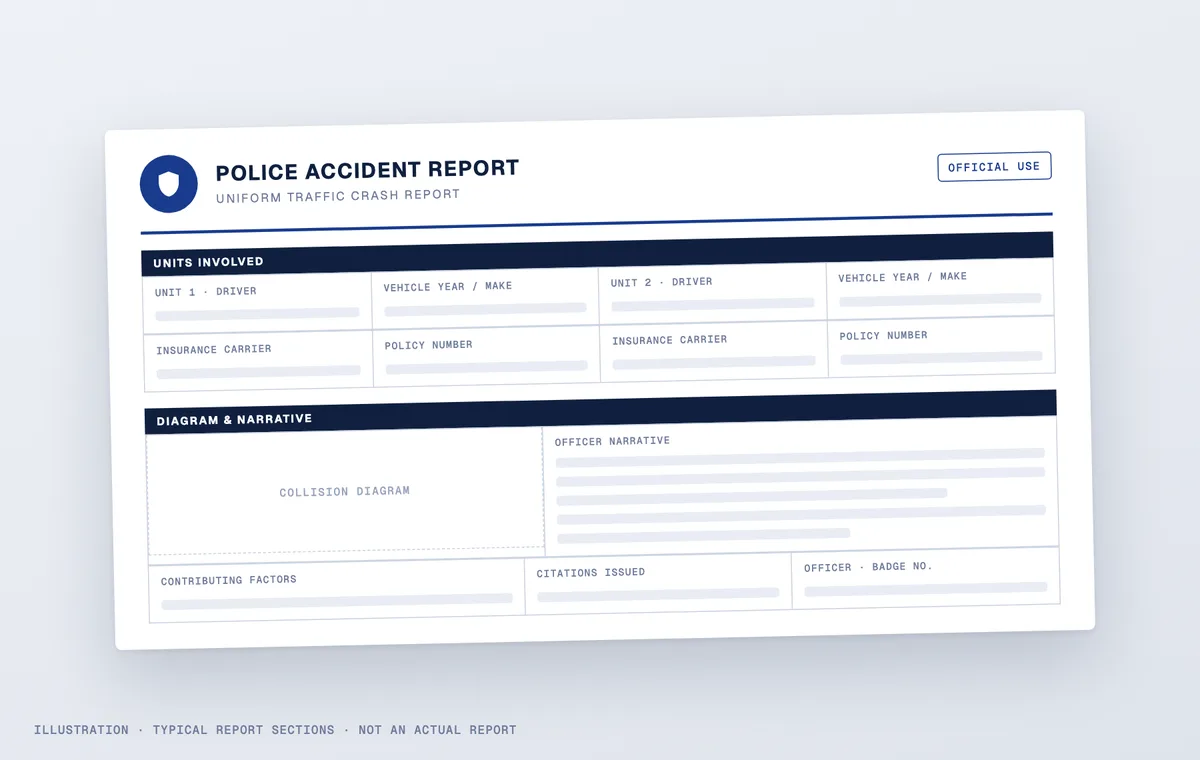
Reading an Alabama car accident report means working through several sections in order. The report names every driver, passenger, and pedestrian, records their insurance details, lays out the officer’s narrative and scene diagram, lists any citations, and marks the contributing factors the officer believes caused the collision. The contributing factors section carries the most weight, because it points to who was at fault.
An Alabama car accident report is needed because state law makes it the foundational record after a serious crash. Alabama Code § 32-10-5 requires a driver to notify law enforcement immediately when a crash causes injury or death. Alabama Code § 32-7-5 requires the operator to file a written report with the Alabama Department of Public Safety within 30 days when the crash caused injury, death, or property damage over $250. Alabama Code § 32-10-7 requires the investigating officer to produce a written report and defines who may obtain a copy.
The report serves both sides of a claim. When you pursue a claim, it establishes what happened and supports your demand for fair compensation from the at-fault driver or their insurer. When you defend against a claim, it documents the facts that can reduce or disprove the allegations against you. Accuracy in every field matters, because Alabama’s contributory negligence doctrine bars recovery from anyone found even one percent at fault.
Get Alabama Online Car Accident Investigation Report from Police
AccidentReports.com can request the document from law enforcement on your behalf when you would rather not handle the state portal yourself. You provide the crash date, the location, and the party names, and the service retrieves the report without requiring a report number.
This website is a pooled attorney advertisement. AccidentReports.com is not a law firm or a lawyer referral service, and nothing on this site is legal advice. Disclaimer
- ALDOT Crash Facts 2024
- NHTSA FARS
- ALEA
- Code of Alabama
Last updated
967Source: 2024 Alabama Crash Facts (ALDOT), p. 5
Traffic fatalities in Alabama, 2024
182Source: 2024 Alabama Crash Facts (ALDOT), county map, p. 29
Deaths with apparent alcohol or drug involvement, 2024
895Source: NHTSA FARS 2024 Annual Report File
Fatal crashes in NHTSA FARS, Alabama, 2024
10,183Source: 2024 Alabama Crash Facts (ALDOT), p. 28
Crashes involving a truck in Alabama, 2024
Crash Facts uses ALEA crash data and FARS uses NHTSA’s national file, so their totals differ slightly (FARS counts 962 deaths in Alabama for 2024).
Alabama recorded 967 traffic fatalities in 2024, and 182 of those deaths involved apparent alcohol or drug use, according to the 2024 Alabama Crash Facts report produced by ALDOT and published through Drive Safe Alabama. Every crash a law enforcement officer investigates is reported to the state on the uniform crash report within 24 hours after the investigation is completed (Ala. Code § 32-10-7(a)), and that report is the document requesters obtain through ALEA. The tables below summarize the crash categories that most often drive report requests.
Railroad crossing crashes, ten-year data
Driver behavior at crossings drives most of these crashes, including ignoring flashing lights or other active warning devices, passing through barrier gates, driving around already-lowered gates, and failing to observe passive warning signs.
| Year | Crashes | Injuries | Fatalities |
|---|---|---|---|
| 2015 | 90 | 34 | 5 |
| 2016 | 78 | 42 | 9 |
| 2017 | 66 | 23 | 9 |
| 2018 | 55 | 33 | 7 |
| 2019 | 85 | 36 | 6 |
| 2020 | 84 | 28 | 3 |
| 2021 | 85 | 30 | 9 |
| 2022 | 88 | 20 | 8 |
| 2023 | 83 | 33 | 9 |
| 2024 | 87 | 30 | 9 |
Source: 2024 Alabama Crash Facts (ALDOT), p. 26
According to NHTSA, as cited in the 2024 Alabama Crash Facts, a motorist is almost 20 times more likely to die in a crash involving a train than in a collision involving another motor vehicle.
Work zone crashes, ten-year data
ALDOT promotes Work Zone Awareness each April, and the 2024 theme was that work zones are temporary. Most work zone crashes are rear-end collisions that result from speeding or inattentive driving, and speeding fines double in a work zone when workers are present.
| Year | Injury crashes | Injuries | Fatal crashes | Fatalities |
|---|---|---|---|---|
| 2015 | 492 | 705 | 31 | 31 |
| 2016 | 652 | 954 | 18 | 19 |
| 2017 | 640 | 963 | 25 | 31 |
| 2018 | 769 | 1,155 | 28 | 34 |
| 2019 | 589 | 812 | 19 | 16 |
| 2020 | 398 | 616 | 17 | 19 |
| 2021 | 420 | 596 | 17 | 17 |
| 2022 | 382 | 511 | 16 | 18 |
| 2023 | 358 | 510 | 19 | 23 |
| 2024 | 385 | 527 | 13 | 15 |
Source: 2024 Alabama Crash Facts (ALDOT), p. 27
Alabama logged 2,093 work zone crashes in 2024. Property damage accounted for 1,625 of them at 78 percent, injury crashes for 385 at 18 percent, serious injury crashes for 50 at 2 percent, fatal crashes for 13 at 1 percent, and unknown severity for 20 at 1 percent.
Truck crashes, ten-year data
A truck here means a vehicle heavier than a light truck or SUV, such as a delivery truck, an 18-wheeler, a tow truck, a dually, or a work truck, and it does not include a bus of any type.
| Year | Trucks involved | Injuries | Fatalities |
|---|---|---|---|
| 2015 | 8,484 | 2,367 | 118 |
| 2016 | 8,937 | 2,345 | 157 |
| 2017 | 9,351 | 2,563 | 101 |
| 2018 | 10,079 | 2,629 | 121 |
| 2019 | 10,486 | 2,612 | 137 |
| 2020 | 8,579 | 2,330 | 130 |
| 2021 | 10,588 | 2,577 | 148 |
| 2022 | 10,452 | 2,417 | 162 |
| 2023 | 10,210 | 2,590 | 134 |
| 2024 | 10,183 | 2,368 | 131 |
The primary cause of the 10,183 crashes that involved a truck in 2024 breaks down as follows. The source notes that these causes do not infer whether the truck or another vehicle caused the crash.
Primary cause of crashes with truck involvement, 2024
| Primary cause | Crashes | Share | Share of all truck crashes |
|---|---|---|---|
| Improper Lane Change or Use | 1,746 | 17.2% | |
| Failed to Yield Right of Way | 1,063 | 10.4% | |
| Unseen Object, Person, or Vehicle | 748 | 7.4% | |
| Tailgating | 724 | 7.1% | |
| Misjudged Stopping Distance | 452 | 4.4% | |
| Defective Equipment | 436 | 4.3% | |
| Improper Backing | 375 | 3.7% | |
| Improper Turn | 354 | 3.5% | |
| Avoiding Animal, Object, or Person | 350 | 3.4% | |
| Crossed Median or Centerline | 299 | 2.9% | |
| Failure to Heed Sign or Signal | 275 | 2.7% | |
| Improper Passing | 235 | 2.3% | |
| Driving too Fast for Conditions | 230 | 2.3% | |
| Fatigued or Asleep | 222 | 2.2% | |
| Driving Under the Influence | 126 | 1.2% | |
| Ran Off Road | 123 | 1.2% | |
| Over the Speed Limit | 70 | 0.7% | |
| Unknown | 441 | 4.3% | |
| All Other | 1,914 | 18.8% | |
| Total | 10,183 | 100% |
Truck-involved crashes and fatalities by road type, 2024
Truck-involved crashes and fatalities also vary by road type.
| Road type | Crashes | Crash share | Fatalities | Fatality share |
|---|---|---|---|---|
| Interstate | 3,114 | 30.6% | 36 | 27.5% |
| City | 2,236 | 22.0% | 8 | 6.1% |
| State Route | 2,055 | 20.2% | 41 | 31.3% |
| U.S. Route | 1,442 | 14.1% | 31 | 23.7% |
| County | 1,074 | 10.5% | 15 | 11.4% |
| Other | 262 | 2.6% | 0 | 0.0% |
| Total | 10,183 | 100% | 131 | 100% |
Traffic fatalities by county, 2024
The first figure is total traffic fatalities in the county, and the second is fatalities with apparent alcohol or drug involvement. Statewide the totals were 967 and 182.
| County | Fatal | Alc/Dr |
|---|---|---|
| Autauga | 8 | 3 |
| Baldwin | 26 | 5 |
| Barbour | 7 | 3 |
| Bibb | 7 | 0 |
| Blount | 16 | 4 |
| Bullock | 4 | 1 |
| Butler | 8 | 2 |
| Calhoun | 24 | 4 |
| Chambers | 6 | 0 |
| Cherokee | 12 | 1 |
| Chilton | 15 | 3 |
| Choctaw | 6 | 0 |
| Clarke | 6 | 1 |
| Clay | 4 | 0 |
| Cleburne | 9 | 1 |
| Coffee | 5 | 1 |
| Colbert | 11 | 1 |
| Conecuh | 10 | 4 |
| Coosa | 6 | 0 |
| Covington | 11 | 0 |
| Crenshaw | 3 | 1 |
| Cullman | 22 | 2 |
| Dale | 7 | 1 |
| County | Fatal | Alc/Dr |
|---|---|---|
| Dallas | 16 | 2 |
| DeKalb | 21 | 3 |
| Elmore | 9 | 2 |
| Escambia | 9 | 3 |
| Etowah | 23 | 2 |
| Fayette | 11 | 6 |
| Franklin | 7 | 3 |
| Geneva | 7 | 4 |
| Greene | 2 | 0 |
| Hale | 4 | 1 |
| Henry | 2 | 0 |
| Houston | 13 | 3 |
| Jackson | 11 | 0 |
| Jefferson | 103 | 8 |
| Lamar | 4 | 1 |
| Lauderdale | 20 | 3 |
| Lawrence | 11 | 0 |
| Lee | 25 | 11 |
| Limestone | 22 | 1 |
| Lowndes | 5 | 0 |
| Macon | 8 | 3 |
| Madison | 45 | 3 |
| Marengo | 5 | 1 |
| County | Fatal | Alc/Dr |
|---|---|---|
| Marion | 14 | 3 |
| Marshall | 15 | 5 |
| Mobile | 73 | 22 |
| Monroe | 4 | 2 |
| Montgomery | 44 | 9 |
| Morgan | 25 | 5 |
| Perry | 5 | 1 |
| Pickens | 7 | 2 |
| Pike | 9 | 2 |
| Randolph | 5 | 0 |
| Russell | 10 | 4 |
| St. Clair | 18 | 3 |
| Shelby | 12 | 2 |
| Sumter | 6 | 0 |
| Talladega | 26 | 1 |
| Tallapoosa | 7 | 4 |
| Tuscaloosa | 34 | 10 |
| Walker | 22 | 5 |
| Washington | 4 | 2 |
| Wilcox | 3 | 0 |
| Winston | 8 | 2 |
How to Get Alabama Car Accident Report Online?
Getting an Alabama car accident report online through the ALEA portal is the fastest method available to authorized individuals. The process requires basic crash details and a state-mandated fee. Once the report is processed and posted, eligible requesters can download or print a certified copy from the system.
1. Confirm You Are Eligible Under Alabama Law to Request an Alabama Car Accident Report
Confirming eligibility is the first step, governed by Alabama Code § 32-10-7. Only individuals with a direct and lawful interest may obtain the report, including a person involved in the crash, a parent or guardian of an involved minor, an insurer or its designee, an attorney holding signed written consent, a personal representative or heir of a deceased party, an owner or lienholder of an involved vehicle, or a qualifying governmental entity. This step decides whether the request moves forward at all, since ALEA releases reports only to the persons listed in § 32-10-7. If the portal records your eligibility incorrectly, an attorney can verify your standing and submit the request on your behalf.

2. Wait Until Law Enforcement Finalizes the Alabama Police Report
Waiting for law enforcement to finalize the report is necessary before any online retrieval works. The investigating officer must complete the documentation, record all findings, and forward the report to the state, which Alabama Code § 32-10-7(a) requires within 24 hours after the investigation is completed. A search run before the report posts returns no results, so this step saves you a wasted request. If the report does not appear, contact ALEA to confirm the officer has submitted it.
3. Visit the Alabama Law Enforcement Agency (ALEA) System to Access the Alabama Car Accident Report Database
Visiting the ALEA system is where the online retrieval begins. Go to the official ALEA website and select the crash reports purchase option, and the portal prompts you to confirm eligibility under Alabama Code § 32-10-7 before it proceeds. This state-maintained database is the only authorized online source for official Alabama crash reports, which makes it the most reliable route for eligible requesters. If the portal is unavailable or rejects a valid request, an in-person visit to an ALEA Driver License Office is the backup.
4. Enter Required Details to Locate the Alabama Police Report
Entering the right details lets the ALEA system find the correct record. Provide at least one strong identifier, which can be the crash report number, the involved driver’s last name, or the driver’s license number, and add the crash date and location to narrow the results. Accurate entry here prevents delays and keeps the system from returning the wrong report. If a search detail such as a misspelled name blocks the match, contact ALEA to confirm the correct identifier before trying again.
5. Pay the Required State Fee to Obtain the Alabama Car Accident Report
Paying the state fee is the step that unlocks the document. The online fee totals $17.00, which covers the $15.00 base report cost and a $2.00 processing fee, payable by debit or credit card through the portal. An in-person request at an ALEA Driver License Office costs $15.00, and personal checks are not accepted. If you are charged the wrong amount or the payment fails, keep the transaction record and contact ALEA before resubmitting so you are not billed twice.
6. Download or Request a Certified Copy of the Alabama Police Report or Alabama Fatal Car Crash Report, If Applicable
Downloading the certified copy completes the retrieval. Once payment clears, the report becomes available for immediate download through the portal and stays accessible for 7 days from the purchase, and a fatal crash produces an Alabama fatal car crash report within the same retrieval. Save a digital copy and print a backup so the record is ready for an insurer or an attorney. If the downloaded file is incomplete or unreadable, contact ALEA to reissue the copy before the payment window closes.
7. Review the Alabama Car Accident Report for Accuracy and Completeness
Reviewing the report for accuracy directly affects insurance and legal outcomes. Examine it for correct identification of all parties, an accurate description of the crash, proper citations, and the officer’s determination of contributing factors. Catching an error now is far easier than reversing its effect on a claim later. If you find a wrong address, a misattributed fault, or a missing detail, contact the investigating agency to request a correction, or submit a formal challenge through ALEA when the error is material.
8. Use the Alabama Police Report or Alabama Fatal Car Crash Report Only for Insurance or Legal Purposes
Using the report only for insurance or legal purposes keeps you within its lawful scope. The report is an authorized record built to support insurance claims and inform legal proceedings, not a general-purpose public document. Under Alabama Code § 32-10-11, reports filed by involved parties are confidential and cannot be admitted as direct evidence in civil or criminal trials, though the report can still substantiate that the crash occurred. Retain the copies securely and share them only with your insurer or your attorney.
How to Read Alabama Car Accident Report?
Reading an Alabama car accident report takes a structured pass through each section, from identifying the parties to locating the officer’s fault determination. Each section serves a distinct purpose, and reading carefully lets you catch inaccuracies before you submit the report for a claim.
1. Start by Confirming the Report Type, Whether It Is an Alabama Car Accident Report or Alabama Fatal Car Crash Report
Confirming the report type is the first step. The document differs depending on whether the crash caused a fatality or injuries alone, because a fatal crash report adds sections on cause of death, medical intervention, and injury severity that a standard report omits. Confirming the type ensures you review the correct version before analyzing anything else. If you received the wrong type or the classification looks incorrect, contact the issuing agency or ALEA to request the correct document.
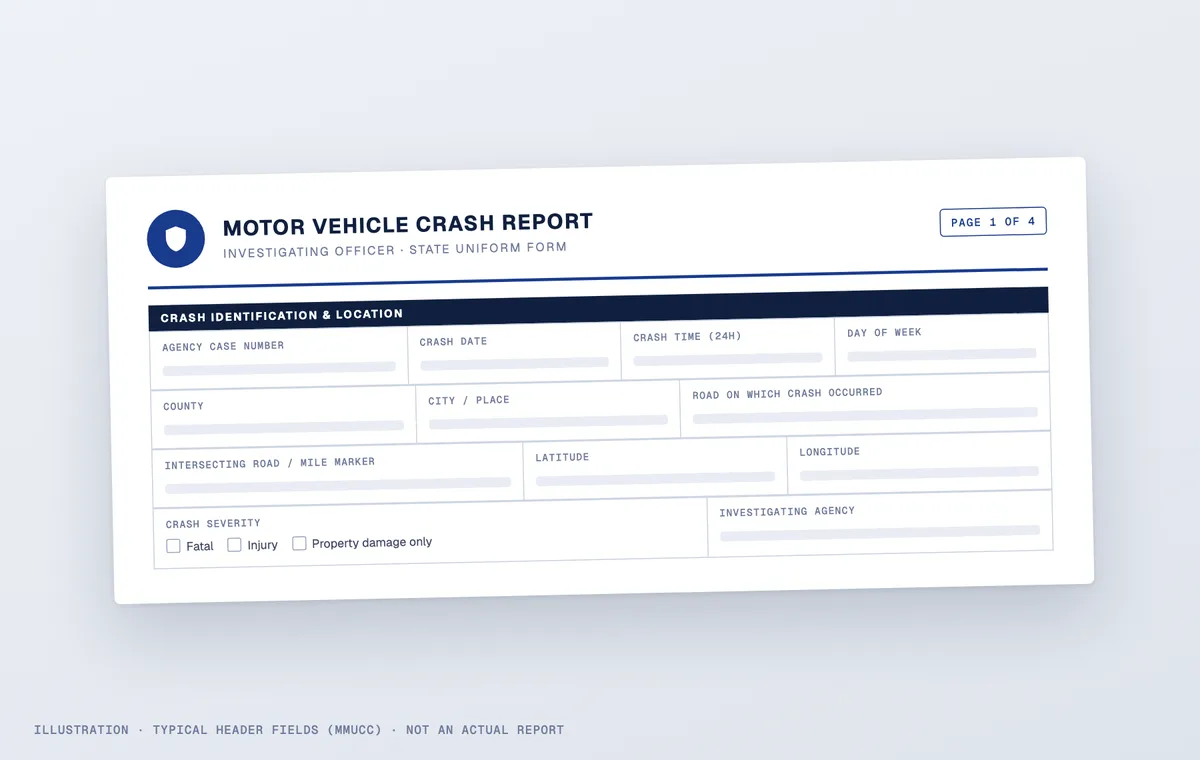
2. Review the Header Section of the Alabama Police Report for Date, Time, Location, and Report Number
Reviewing the header establishes the foundational facts of the incident. This area holds the crash date, time, location, county, and the unique report number the agency assigned. Confirming these anchors every later detail to a specific, verifiable event and gives you the reference number for any future correction. If a date, time, or location is wrong, contact the investigating agency with supporting proof such as witness statements or time-stamped photos to request a correction.
3. Identify All Involved Parties and Vehicles Listed in the Alabama Car Accident Report
Identifying every party and vehicle ensures no one connected to the crash is overlooked. This section names each driver, passenger, and pedestrian and records their personal details, license numbers, and vehicle information. Accuracy matters because omissions or errors here change how insurers route and process claims. If a party is missing or misidentified, file a correction request with the issuing agency and include valid identification to substantiate the change.
4. Check the Diagram and Narrative to Understand How the Crash Occurred in the Alabama Police Report
Checking the diagram and narrative gives you both a visual and a written reconstruction of the crash. The diagram shows vehicle positions, directions of travel, and the point of impact, and the narrative gives the officer’s account of events at the scene. These two elements are among the most heavily weighed when fault is determined. If either contains an error such as incorrect vehicle placement or a misrecorded sequence, submit a written objection to the investigating agency with any contradicting evidence.
5. Examine Contributing Factors and Citations Noted in the Alabama Car Accident Report
Examining contributing factors and citations reveals the officer’s view of what caused the crash. This section lists violations such as speeding, failure to yield, impaired driving, or distraction, and records any citations issued during the investigation. Contributing factors carry heavy weight when insurers and courts assign fault. If a factor is inaccurate or a citation was issued in error, contact the issuing agency with evidence such as traffic camera footage or independent witness statements to dispute the finding.
6. Review Injury and Damage Sections, Especially in an Alabama Fatal Car Crash Report
Reviewing the injury and damage sections documents the physical consequences of the crash for each party. This area records reported injuries, describes the extent of vehicle damage, and notes emergency treatment given at or near the scene. Severity recorded here directly influences claim valuations and any later legal action. If injuries or damage are understated or omitted, provide medical records or professional repair estimates to the investigating agency to support a correction.
7. Verify Insurance Information and Vehicle Details in the Alabama Police Report
Verifying insurance and vehicle details ties every party to their coverage. This section lists policy numbers, insurer names, and vehicle registration details for each car involved. Insurers depend on this information to identify the responsible policy and start processing without delay. If any insurance or vehicle detail is wrong, notify the reporting agency and your own insurer in writing with the accurate information to prevent claim delays or denials.
8. Use the Alabama Car Accident Report to Support Insurance or Legal Review Only
Using the report only for insurance or legal review keeps it within its lawful scope. The report is an authorized record produced for claims and legal proceedings, not a general-purpose document open to unrestricted use. Under Alabama Code § 32-10-11, reports filed by involved parties are confidential and cannot serve as direct evidence in civil or criminal trials. If you believe an error in the report will hurt your claim, raise the objection with your insurer or an attorney before the report is submitted for review.
What are the Laws for Car Accidents in Alabama?
The laws governing car accidents in Alabama define reporting duties, set access rules for official records, and fix the standards that determine fault and compensation. Understanding these statutes is essential for anyone pursuing or defending a claim tied to a law enforcement crash report.
Originally enacted in 1943, not amended since
This statute requires the driver of any motor vehicle involved in a crash that results in injury or death to immediately notify, by the quickest means of communication, the local police department if the crash is inside a municipality, or otherwise the county sheriff or the state highway patrol.
This law triggers the official crash report by requiring law enforcement to respond and begin documenting the incident. Without the notification, no report is generated, and injured parties lack the foundational record a claim needs.
Originally enacted in 1951, last amended in 1995
This statute requires the operator of every motor vehicle involved in a crash that caused injury, death, or property damage over $250 to file a written report with the Director of Public Safety, now part of ALEA, within 30 days. If the operator cannot report, the owner must report within 10 days of learning of the crash.
This requirement creates a layer of documentation beyond the officer's report. Failing to file within the 30-day window can lead to a fine and driver license suspension under § 32-7-37, and can weaken the party's position when pursuing or defending a claim.
Originally enacted in 1943, last amended in 2018
This statute requires every officer who investigates a crash to forward a written report on the uniform form within 24 hours after completing the investigation, and defines the categories of people and entities authorized to receive a copy.
This law controls who can access the official report and under what conditions. It directly decides whether an involved party, insurer, or attorney can obtain the documentation needed to evaluate and pursue a claim.
Originally enacted in 1943
This statute establishes that accident reports filed by persons involved in crashes or by garages are confidential and cannot be used as evidence in a civil or criminal trial arising from the crash.
This provision limits how reports filed by involved persons or garages can be presented in court. Such a report still supports insurance processing and can show that a report was made, even though it cannot be admitted as trial evidence.
Enacted in 2000, amended in 2011 and 2025
This statute prohibits operating, registering, or maintaining registration of a highway vehicle without a liability insurance policy, bond, or deposit that meets the state minimum coverage amounts.
Insurance compliance or non-compliance is documented in the report by the investigating officer. An uninsured driver significantly complicates the claims process and can affect the injured party's ability to recover through standard liability channels.
Enacted in 1991, amended in 2019
This statute requires occupants of passenger cars to wear a properly fastened safety belt while the vehicle is in motion, and a violation carries a fine of up to $25 under § 32-5B-5.
Seatbelt compliance is recorded in the report by the officer. The notation can influence fault assessments and the value of compensation, particularly under Alabama's contributory negligence doctrine.
Enacted in 1980, most recently amended in 2018
This statute defines DUI offenses and sets criminal penalties for operating a motor vehicle while impaired by alcohol, a controlled substance, or any combination.
Documented impairment in the report strengthens a claim against the at-fault driver, supports recovery of fair compensation, and can raise the at-fault party's legal exposure.
Common law; the Supreme Court of Alabama declined to replace it with comparative negligence in Williams v. Delta International Machinery Corp. (1993)
Under this doctrine, an injured party found even one percent at fault may be barred from recovering any compensation, regardless of how much fault the other party bears.
The factual accuracy of the report becomes decisive under this doctrine. Any detail suggesting shared fault by the injured party can be used to deny compensation entirely, which makes the report's contents decisive to the outcome.
As currently codified
This subsection provides that an action for injury to the person not arising from contract must be brought within two years, and filing after that deadline generally bars the lawsuit.
The crash date recorded in the report generally sets the start of the two-year filing deadline. Timely retrieval of the report is essential to preserve the right to sue before the limitation period expires.
What Details does an Alabama Car Accident Report Include?
An Alabama car accident report includes the full set of facts the investigating officer records at or shortly after the crash, organized into the components below. Each component feeds a different part of an insurance claim or legal case, from identifying the parties to establishing the officer’s fault determination.
1. Accident Date, Time, and Location Within the State
The accident date, time, and location fix when and where the collision happened. This detail matters for a claim because it anchors the event to a specific, verifiable point in time and place, and it shows insurers and courts the jurisdiction and circumstances of the crash. You should also know that the date generally starts Alabama’s two-year statute of limitations under Ala. Code § 6-2-38(l). If any of these entries is wrong, contact the investigating agency with supporting documentation to request a correction before you file.
2. Driver and Passenger Information Recorded by Law Enforcement
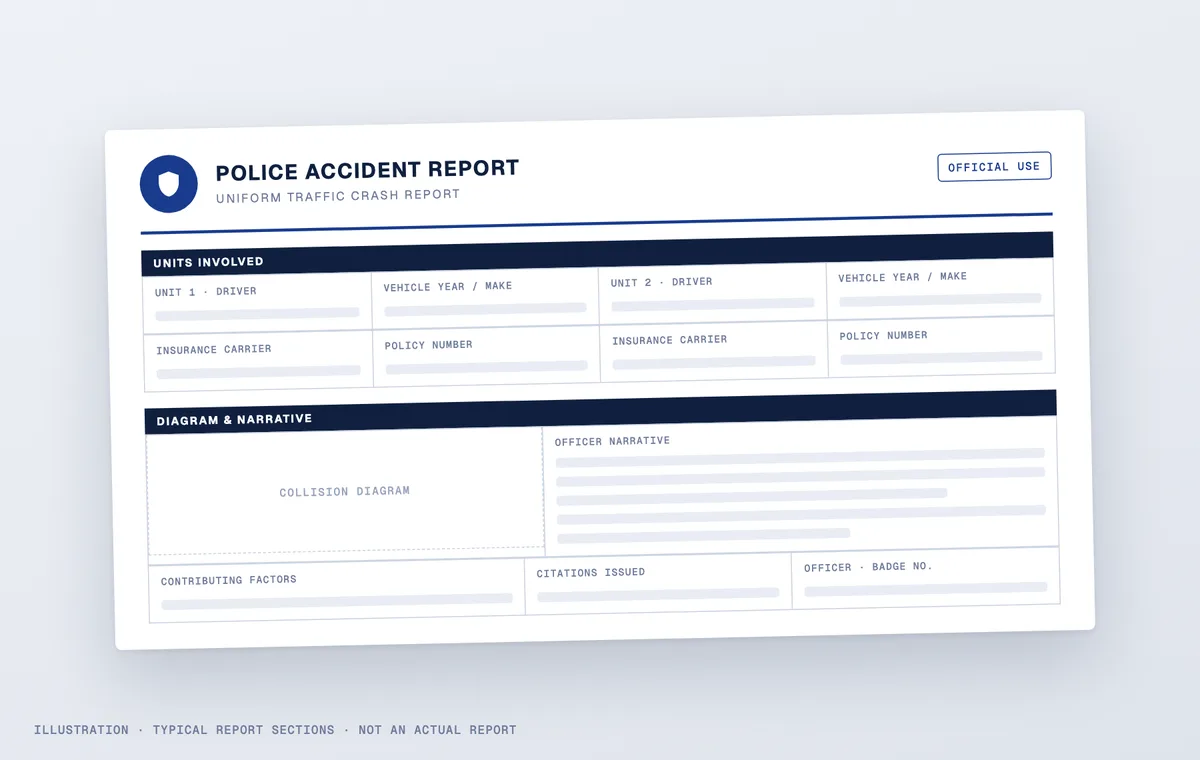
Driver and passenger information identifies everyone involved by name, address, date of birth, and license number. This detail matters because insurers must confirm the identity of every party before processing a payout, and it establishes each person’s connection to the crash. You should know that a misspelled name or wrong address can stall claim processing and complicate later proceedings. If any party’s information is inaccurate, submit a written correction request to the issuing agency with valid identification.
3. Vehicle Details and Damage Descriptions in Traffic Accidents
Vehicle details and damage descriptions record the make, model, year, color, and plate of every car, along with the damage each sustained. This detail matters because it lets insurers assess repair costs, determine total-loss status, and calculate the financial impact, and it shows the physical consequence of the collision on each vehicle. You should know that the officer’s damage notes may miss harm found later in a professional inspection. If the damage is understated, provide repair estimates or inspection reports to support a correction.
4. Insurance and Policy Information Required Under Alabama Law
Insurance and policy information records each driver’s insurer, policy number, and coverage limits as noted at the scene. This detail matters because it establishes which policy pays for damages or repairs, and it shows whether the drivers met Alabama’s mandatory liability requirement under Ala. Code § 32-7A-4. You should know that gaps or errors here delay claim routing. If insurance details are missing or wrong, notify both the reporting agency and your own insurer in writing with the accurate policy information.
5. Officer Observations and Citations Issued at the Scene
Officer observations and citations reflect the officer’s firsthand assessment and any violations identified during the response. This detail matters because it provides a contemporaneous account that insurers weigh heavily, and it shows which driver, if any, broke a traffic law that contributed to the crash. You should know that a citation can strongly influence the outcome, especially under Alabama’s contributory negligence doctrine. If an observation or citation is factually wrong, contact the issuing agency with supporting evidence and request a formal amendment.
6. Crash Diagrams and Scene Descriptions Used in Official Reports
Crash diagrams and scene descriptions give a visual and written reconstruction of the collision. This detail matters because the diagram clarifies vehicle positions, directions of travel, and the point of impact in a way words alone cannot, and it shows how the crash physically unfolded from evidence at the scene. You should know that these diagrams are among the most referenced elements when fault is assigned. If a diagram shows the wrong placement or direction, file a written objection with the agency and include photographic or witness evidence that contradicts it.
7. Witness Names and Statements Collected at the Accident Scene
Witness names and statements give independent, third-party accounts from people not involved in the crash. This detail matters because witness testimony can corroborate or contradict the officer’s narrative, which strengthens or challenges the fault determination, and it shows what neutral observers actually saw. You should know that recorded witness statements carry weight in both insurance reviews and legal proceedings. If a statement is inaccurate or a known witness was left out, ask the investigating agency to add or correct the information.
8. Injury Details and Medical Response Documented After the Crash
Injury details and medical response record the physical harm to each party and the emergency treatment given at or near the scene. This detail matters because it sets the initial scope of harm that insurers use to value a claim, and it shows what injuries were reported and what care followed immediately. You should know that injuries found or worsened after the report is filed may not appear here. If injury details are incomplete, provide updated medical records to the reporting agency and your insurer so the claim reflects all documented injuries.
What are the Differences in an Alabama Car Accident Report?
Differences in an Alabama car accident report emerge from who produces the document, which authority issues it, and what legal purpose it serves. Each report type carries distinct filing requirements, access restrictions, and weight in insurance or court proceedings. The points below list the differences that decide which document to obtain and use.
-
1. Filing obligation.
Whether a report must be filed varies by the type of Alabama car accident report. Officer-prepared reports are mandatory when law enforcement responds to a crash, whereas privately drafted reports remain optional supplementary documentation.
-
2. Person who files.
The individual responsible for filing differs across report types. Officers produce the official crash report at the scene, drivers submit the SR-13 form within 30 days, and private parties draft their own records independently.
-
3. Issuing authority.
The issuing authority changes with the report. ALEA and local law enforcement issue the official crash report, while the Alabama Department of Public Safety, now part of ALEA, receives the driver-filed SR-13 form.
-
4. Timing.
Timing requirements distinguish each report type. Officers document the crash at the scene, drivers must file within 30 days under Alabama Code § 32-7-5, and private reports carry no statutory deadline.
-
5. Access restrictions.
Access rules apply differently across official and unofficial reports. Alabama Code § 32-10-7 limits official crash reports to the persons it lists, such as involved parties, insurers, attorneys, and certain governmental entities, while privately prepared reports face no such restriction.
-
6. Legal admissibility.
Admissibility differs by report type. Reports filed by involved persons or garages are confidential under Alabama Code § 32-10-11 and cannot serve as trial evidence, whereas privately drafted reports carry no such statutory limit or protection.
-
7. Primary purpose.
The purpose shifts by report. Officer-prepared reports document the crash for law enforcement, driver-filed reports satisfy a statutory duty, and private reports reinforce personal documentation for insurance or legal use.
-
8. Depth of detail.
The detail recorded varies by report. Officer-prepared reports contain scene diagrams, citations, and contributing factor assessments, while driver-filed and private reports usually include only basic collision and party information.
What Types of Car Accident Reports are Used in Alabama?
Several distinct report types are used in Alabama after a motor vehicle collision. Each is produced by a different party, serves a different function, and carries its own legal standing. The table summarizes them, and the descriptions that follow explain how each is obtained, applied, and read.
1Alabama Police Accident Report (PAR)
Investigating law enforcement officer
Alabama Law Enforcement Agency (ALEA) or local law enforcement
Released only to the persons listed in Ala. Code § 32-10-7(b).
Alabama Police Accident Report (PAR)
The Alabama Police Accident Report is the official on-scene record the investigating officer produces after a collision. Formally known as the Alabama Uniform Traffic Crash Report, it is generated by every officer who responds to and investigates a crash in the regular course of duty. It is the single most referenced document in both claim processing and legal proceedings. Every other piece of crash documentation is measured against the police accident report, which functions as the authoritative baseline.
- When it is required
- Immediately upon response to any crash involving injury, death, or property damage
- Primary use
- Official on-scene record used to support insurance claims and legal proceedings
- Availability method
- Available online through the ALEA crash report portal or in person at an ALEA Driver License Office, on payment of the state fee
How to obtain it
Visit the ALEA online Crash Report portal, confirm eligibility under Alabama Code § 32-10-7, enter the crash details such as the report number, driver’s last name, or license number, and pay the $17.00 fee by debit or credit card. An in-person request works at any ALEA Driver License Office for $15.00, and personal checks are not accepted.
How does it help for a claim or defense strategy
The report gives an officer-documented account that insurers and courts treat as the primary factual reference. When you pursue a claim, it identifies the at-fault party’s violations and contributing factors. When you defend, any inaccuracy or omission can be challenged to reduce assigned liability. The scene diagram and narrative help establish the sequence of events, which is decisive under Alabama’s contributory negligence doctrine where even minor shared fault can bar recovery.
How to read it
Confirm the report type and verify the header details, then identify all parties and their vehicles. Examine the officer’s narrative and scene diagram to see how the crash unfolded. Review the contributing factors and any citations, since these shape fault. Check the injury and insurance sections for accuracy before submitting the report to your insurer or attorney.
2Crash Report Used for Claims
Investigating law enforcement officer
ALEA
Carries the same standing as the original PAR. Released only to the persons listed in Ala. Code § 32-10-7(b).
Alabama Crash Report Used for Insurance Claims
The Alabama Crash Report used for insurance claims is a copy of the official Police Accident Report obtained to support an insurance claim. The underlying document is identical to the PAR, but its role shifts when submitted to an insurer, where it becomes the primary evidence used to evaluate liability, assess damages, and decide whether compensation is owed. This version is the most commonly requested document after a collision in Alabama.
- When it is required
- When an involved party or insurer requests a copy to process an insurance claim
- Primary use
- Submitted to insurers to support liability evaluation and compensation recovery
- Availability method
- Obtained through the ALEA online portal or in person at an ALEA Driver License Office
How to obtain it
Use the same channels as the standard PAR. Access the ALEA online Crash Report portal, confirm eligibility, provide the crash details, and pay the $17.00 online fee. An in-person request works at any ALEA Driver License Office for $15.00. Retain a copy designated for insurance submission.
How does it help for a claim or defense strategy
When you pursue a claim, this report goes directly to the at-fault party’s insurer as evidence of the crash and the other driver’s responsibility. It documents violations, officer observations, and scene conditions that support liability. For defense, it can reveal inconsistencies in the claimant’s account or details that shift fault. Under the contributory negligence doctrine, any hint of shared responsibility can be used to challenge a claim entirely.
How to read it
Read it with the insurance submission in mind. Start with the contributing factors and citations, which insurers weigh most heavily. Confirm all party and vehicle information, then examine the narrative and diagram for details that support or contradict the claim. Raise any outcome-changing error with the investigating agency before you submit the report.
3Driver's Accident Report
The vehicle operator involved in the crash
Alabama Department of Public Safety, now part of ALEA
Confidential under Ala. Code § 32-10-11 and not admissible as evidence in civil or criminal trials. Ala. Code § 32-7-12 also bars its use at a trial for damages.
Alabama Driver's Accident Report (Required Under State Law)
The Alabama Driver’s Accident Report is a separate document the operator must file directly with the Alabama Department of Public Safety. Submitted on Form SR-13, it is due within 30 days of any crash that caused injury, death, or property damage over $250, under Alabama Code § 32-7-5. This report exists independently of the officer’s crash report and satisfies a distinct duty placed on the driver.
- When it is required
- Within 30 days of any crash causing injury, death, or property damage over $250, under Ala. Code § 32-7-5
- Primary use
- Satisfies the driver's statutory duty and creates a separate state record
- Availability method
- Filed directly with the Alabama Department of Public Safety. Not publicly available for individual download
How to obtain it
The driver completes Form SR-13 with the crash date, location, parties involved, and a description of the collision, then mails it to the department within 30 days. The driver files this form rather than purchasing it, and because it goes directly to the state, it is not available for public download through the ALEA portal.
How does it help for a claim or defense strategy
The Driver’s Accident Report reinforces the state’s record and shows the party met the statutory duty. Failing to file within 30 days can lead to license suspension and can signal non-cooperation to an insurer or court. For defense, the details in this form can be compared against the officer’s report to surface contradictions relevant to the case.
How to read it
Read it as a companion to the official report. Confirm the date, location, and party details match the PAR. Check the driver’s own description for consistency with the officer’s narrative. Note any differences between what the driver reported and what the officer documented, since discrepancies affect how the claim or defense is evaluated.
4Traffic Collision Report for Enforcement
Investigating law enforcement officers statewide
Alabama Department of Transportation (ALDOT), from ALEA crash data
Functions as an aggregate statistical compilation. Individual records keep the confidentiality of the underlying reports.
Alabama Traffic Collision Report Filed by Law Enforcement
The Alabama Traffic Collision Report filed by law enforcement is an aggregate compilation of crash data submitted by investigating officers statewide. Published annually by the Alabama Department of Transportation, with analysis by the Center for Advanced Public Safety at the University of Alabama using ALEA crash data, it consolidates individual records into a statistical analysis. It appears in the Alabama Crash Facts report and is built mainly to inform infrastructure planning and public safety work.
- When it is required
- Compiled annually from officer-submitted crash data for statewide safety analysis
- Primary use
- Used to identify crash trends, dangerous road segments, and safety improvements
- Availability method
- Published annually through the Alabama Crash Facts report at DriveSafeAlabama.org
How to obtain it
This report is public through the Drive Safe Alabama website as part of the annual Alabama Crash Facts publication, with no fee or eligibility requirement. The Center for Advanced Public Safety at the University of Alabama produces it using ALEA data. Individual crash records inside it keep their confidentiality and must still be obtained separately through the ALEA portal.
How does it help for a claim or defense strategy
This report does not hold the details of any single crash, but it supplies valuable context. Attorneys and insurers reference statewide statistics such as fatality rates, common contributing factors, and dangerous road segments to establish patterns. Showing that a crash occurred in a location or under conditions flagged as high-risk can strengthen a claim and support an argument for greater caution.
How to read it
Read it as a statistical document rather than an incident record. Review crash totals, fatality data, contributing factors, and geographic breakdowns. Cross-reference relevant statistics with your specific incident to find patterns that support your claim or defense. Use it as supporting context, not a standalone exhibit.
5Private Motor Vehicle Accident Report
The involved party or their personal representative
No governmental authority. Prepared privately
Carries no statutory protection or independent legal weight. It may be referenced but holds no official authority.
Private Motor Vehicle Accident Report for Alabama Incidents
A private motor vehicle accident report is an unofficial document the involved party or their representative prepares to supplement the official record. No Alabama statute requires it, and it carries no independent legal authority. This report organizes and preserves personal documentation of a collision for insurance submissions or legal proceedings when extra detail beyond the official record helps.
- When it is required
- Voluntary. No Alabama statute requires it
- Primary use
- Supplements official records for insurance submissions or legal proceedings
- Availability method
- Created and retained by the individual. Not submitted to or available through any state agency
How to obtain it
The involved party creates this report, sometimes with an attorney’s help, and no state agency issues it. To prepare one, record the date, time, and location, identify all parties and vehicles, describe the events as you experienced them, and note any injuries or damage. Photographs, witness contact information, and any communications with other parties strengthen the record.
How does it help for a claim or defense strategy
A private report captures details the officer may not have documented, such as your immediate observations, conversations with other drivers, or conditions not visible in photographs. When you file a claim, it adds depth and shows diligence in preserving evidence. When you defend, it can serve as a contemporaneous account that contradicts or clarifies the claimant’s version.
How to read it
Read it alongside the official report to confirm consistency. Check that dates, locations, and party details align between the two. Weigh the personal account against any photographs, witness statements, or other evidence. Because this document carries no official authority, its value depends on how well corroborating evidence supports it.
Alabama Fatal Car Crashes on Record
These are Alabama fatal crashes recorded in NHTSA’s Fatality Analysis Reporting System (FARS) for 2024, the latest year NHTSA has published. FARS counts 895 fatal crashes and 962 deaths in Alabama that year; the table lists the 25 most recent, newest first. The 2024 file is NHTSA’s Annual Report File and can still be revised. A dash in the City column means the crash happened outside city limits.
| Case number | County | City | Crash date | Time | Road / Highway | Collision type | Fatalities |
|---|---|---|---|---|---|---|---|
| 10904 | Calhoun | — | Dec 31, 2024 | 23:30 | US-278 SR-74 | Single/non-collision: Tree (Standing Only) | 1 |
| 10905 | Bibb | — | Dec 31, 2024 | 14:52 | SR-139 | Single/non-collision: Ditch | 2 |
| 10671 | Conecuh | — | Dec 30, 2024 | 21:30 | I-65 | Front-to-Rear | 1 |
| 10672 | Montgomery | Montgomery | Dec 30, 2024 | 12:16 | CR-ATLANTA HWY at TECHNACENTER DR | Angle | 1 |
| 10903 | Limestone | — | Dec 30, 2024 | 10:08 | CR-ELKTON RD | Single/non-collision: Building | 1 |
| 10902 | Tallapoosa | — | Dec 29, 2024 | 20:44 | CR-CAMPGROUND RD | Single/non-collision: Fence | 1 |
| 10900 | Mobile | — | Dec 29, 2024 | 17:39 | CR-THREE NOTCH KRONER RD | Single/non-collision: Pedestrian | 1 |
| 10901 | Chilton | — | Dec 29, 2024 | 16:30 | CR-LAWLEY JUNCTION | Single/non-collision: Rollover/Overturn | 1 |
| 10667 | Jefferson | — | Dec 29, 2024 | 14:15 | SR-5 at CAIRO AVE | Angle | 1 |
| 10897 | Perry | — | Dec 28, 2024 | 10:40 | CR-23 | Single/non-collision: Rollover/Overturn | 1 |
| 10898 | Dale | — | Dec 28, 2024 | 09:00 | CR-72 | Single/non-collision: Tree (Standing Only) | 1 |
| 10899 | Jefferson | Bessemer | Dec 28, 2024 | 05:47 | MU-8TH AVE N | Single/non-collision: Pedestrian | 1 |
| 10890 | Dale | — | Dec 26, 2024 | 20:25 | SR-27 | Single/non-collision: Pedestrian | 1 |
| 10891 | Lee | — | Dec 26, 2024 | 16:27 | CR-LEE RD 240 | Single/non-collision: Tree (Standing Only) | 1 |
| 10894 | Mobile | Mobile | Dec 25, 2024 | 20:00 | SR-163 | Front-to-Front | 1 |
| 10895 | Choctaw | — | Dec 25, 2024 | 13:25 | SR-10 | Single/non-collision: Ditch | 2 |
| 10896 | Lawrence | — | Dec 25, 2024 | 00:45 | SR-20 | Front-to-Front | 1 |
| 10892 | Monroe | — | Dec 24, 2024 | 17:39 | SR-21 | Single/non-collision: Ditch | 1 |
| 10887 | Calhoun | — | Dec 22, 2024 | 20:25 | SR-77 at BOILING SPRING RD | Angle | 1 |
| 10888 | Baldwin | Summerdale | Dec 22, 2024 | 20:04 | SR-59 | Front-to-Rear | 1 |
| 10889 | Fayette | — | Dec 22, 2024 | 17:15 | SR-96 | Front-to-Rear | 1 |
| 10893 | Baldwin | Daphne | Dec 22, 2024 | 17:14 | US-90 SR-16 at BAYVIEW DR | Angle | 1 |
| 10886 | Walker | — | Dec 21, 2024 | 21:50 | CR-WHITEHOUSE RD | Single/non-collision: Bridge Rail (Includes parapet) | 1 |
| 10885 | Pickens | — | Dec 21, 2024 | 19:25 | SR-17 | Single/non-collision: Tree (Standing Only) | 1 |
| 10884 | Monroe | — | Dec 20, 2024 | 21:13 | SR-21 at PINEVILLE RD | Single/non-collision: Embankment | 1 |
Questions
Frequently asked questions
An Alabama car accident report includes every detail the investigating officer documented at or shortly after the collision. The report begins with foundational information. That opening covers the crash date, time, exact location, and a unique report number assigned by the issuing agency. It identifies all parties involved, including drivers, passengers, and pedestrians, along with their personal information, license numbers, and contact details.
Vehicle information follows, recording the make, model, year, and license plate of each car involved, accompanied by a description of the damage sustained. Insurance and policy details for every involved party are recorded.
The officer’s narrative provides a written account of the collision as observed and reported at the scene. A crash diagram illustrates vehicle positions, directions of travel, and the point of impact. Contributing factors and any citations issued are documented, identifying specific violations that caused or worsened the crash.
The report records injuries sustained by each party, any emergency medical treatment administered, and witness names and statements collected at the scene. Together, these elements create the official record upon which insurance claims and legal proceedings are built.
A car accident report and an incident report in Alabama serve fundamentally different purposes. The car accident report is an official record produced by a law enforcement officer following a motor vehicle collision, governed by Alabama Code § 32-10-7 and issued through ALEA or local law enforcement. An incident report is a broader document that may be prepared by private parties or institutional personnel to record any event, including but not limited to vehicle collisions.
The evidentiary weight of each document differs substantially. The car accident report carries the authority of a state agency and serves as the definitive factual record for insurance and legal purposes. An incident report carries no such official standing and lacks the release restrictions established under Alabama Code § 32-10-7.
The car accident report includes officer observations, scene diagrams, citations, and contributing factor assessments drawn from a formal investigation. An incident report typically reflects only the observations of whoever prepared it, without investigative authority or official documentation standards. When both documents exist following the same event, the car accident report takes precedence in any insurance or legal evaluation.
The Alabama Police Accident Report plays a central role in any car accident case as the state’s official record of the collision. It documents the officer’s firsthand observations, the sequence of events, and scene conditions, information neither party can replicate.
In an insurance claim, the report guides the adjuster’s fault determination. The officer’s narrative, contributing factors, and any citations are treated as the primary basis for evaluating liability. When the report identifies the other driver as responsible, it substantially strengthens the position of anyone seeking to recover fair compensation.
In a legal case, the report remains influential. Attorneys review it to identify details that support or undermine the claims being made. Under Alabama’s contributory negligence doctrine, any indication that the injured party shared fault, even minimally, can result in a complete denial of compensation. The accuracy of the report and how its contents are presented or challenged can be decisive to the case outcome.
Injuries documented in an Alabama motor vehicle accident report are recorded by the investigating officer based on direct observations at the scene and statements from involved parties and emergency responders.
- Whiplash. Whiplash injuries occur when the neck is forcibly jerked during impact and are among the most commonly documented injuries in Alabama car accident reports. Officers note reported pain and restricted motion at the scene.
- Fractures. Fractures to bones including arms, legs, ribs, and the pelvis are documented when the officer observes visible deformity or when the involved parties report significant pain localized to a specific area of the body.
- Head injuries and concussions. Head injuries and concussions are recorded when a driver or passenger strikes the steering wheel, dashboard, or another hard surface during impact. The officer documents reported dizziness, disorientation, or visible bleeding to the head.
- Spinal injuries. Spinal injuries are documented when involved parties report severe back or neck pain, numbness, or inability to move following the collision. These injuries are noted as urgent by responding officers due to their severity.
- Soft tissue injuries. Soft tissue injuries affecting muscles, ligaments, and tendons are among the most frequently reported in Alabama crash reports. Officers record complaints of pain, swelling, and tenderness in affected areas based on the parties’ statements.
- Internal injuries. Internal injuries are documented when emergency responders identify signs such as abdominal pain, difficulty breathing, or visible torso trauma. These injuries frequently require immediate medical intervention and are recorded in detail by the officer.
- Lacerations and cuts. Lacerations and cuts sustained during a collision are documented when visible bleeding or wound marks appear on any involved party at the scene. The officer records the severity and location of each injury observed.
- Burns. Burns resulting from fire, fluid leaks, or contact with hot engine components are recorded when the officer observes burn marks or when involved parties report pain consistent with thermal injuries sustained during the crash.
Damages reflected in an Alabama car accident report are recorded by the investigating officer to capture the full physical impact of the collision on vehicles, surrounding property, and the roadway.
- Vehicle body damage. Vehicle body damage including dents, crumpling, shattered windows, and broken mechanical components is documented for each car involved in the crash. The officer describes each vehicle’s overall condition and identifies areas of greatest impact.
- Roadside damage. Roadside damage to structures such as signs, poles, and guardrails is documented when the collision strikes property near the road. This detail captures the full physical extent of the crash beyond the vehicles involved.
- Parked vehicle damage. Damage to any parked or stationary vehicle struck during the crash is recorded alongside the involved cars. Each affected vehicle receives its own notation describing the extent of physical harm documented at the scene.
- Road surface damage. Road surface damage caused by skid marks, debris, or gouges is noted by the officer. These details help reconstruct the crash sequence and indicate how the vehicles were moving at the moment of impact.
- Personal property damage. Damage to personal property inside the vehicles, such as child car seats or electronics, is noted when visibly destroyed during the crash. This detail supports the officer’s overall assessment of the collision’s impact severity.
- Fuel or fluid leakage. Fuel or fluid leakage onto the roadway is recorded when spills result from ruptured tanks or damaged components. This notation documents environmental impact and contributes to the overall damage assessment in the crash report.
Documents that supplement the Alabama accident report strengthen or clarify the official crash record. Each supplemental document provides context or detail that the officer’s report alone may not fully capture.
- Photographs. Photographs taken at the crash scene capture vehicle positions, damage, road conditions, and visible injuries immediately after the collision. These images provide strong visual evidence that corroborates or contradicts the official crash report details.
- Medical records. Medical records from hospitals, clinics, and physicians establish the injuries sustained and the treatment received following the crash. These documents are essential for quantifying damages and supporting the overall value of any insurance claim.
- Witness statements. Independent witness statements obtained from individuals present at the crash provide third-party accounts separate from the officer’s report. These statements can confirm or challenge the narrative and contributing factors documented in the official record.
- Repair estimates. Vehicle repair estimates from certified collision shops document the cost of restoring each damaged car after the crash. These estimates substantiate the property damage amounts when submitted alongside the crash report to an insurer.
- Camera footage. Body camera footage from responding officers or dashcam recordings from involved vehicles capture real-time visual evidence of the crash. This footage can verify or dispute the sequence of events described in the official report.
- Insurance correspondence. Insurance correspondence including claim acknowledgments, adjuster communications, and denial or approval letters document the insurer’s response following the crash. These records establish a timeline of the claims process and positions taken by the insurer.
- Private accident report. A privately prepared motor vehicle accident report captures the involved party’s personal observations and details not included in the official crash report. This document reinforces the overall evidentiary record for insurance or legal proceedings.
Several Alabama state laws directly shape how car accident reports are generated, maintained, and applied after a collision. Alabama Code § 32-10-5 requires the involved driver to immediately notify law enforcement when a crash results in injury or death, triggering creation of the official report. Alabama Code § 32-10-7 mandates that every investigating officer produce a written crash record and defines who is authorized to obtain copies.
Alabama Code § 32-7-5 requires drivers to file a written report with the Department of Public Safety within 30 days when the collision caused injury, death, or property damage over $250. Alabama Code § 32-10-11 classifies reports filed by involved parties as confidential and bars their use as evidence in civil or criminal trials. Alabama Code § 32-7A-4 requires all motor vehicles on public highways to carry liability insurance, and compliance is documented in the crash report.
Alabama’s contributory negligence doctrine, though not codified as a single statute, functions as a governing legal standard that makes the crash report’s factual accuracy decisive. Any detail suggesting the injured party shared even minimal fault can bar compensation entirely, making these reports decisive in determining claim outcomes.
The Alabama motor vehicle accident report is not a fully public record. Alabama Code § 32-10-7 limits access to the officer’s report to specific persons, namely those directly involved, a parent or guardian of an involved minor, their insurers, attorneys with signed consent, personal representatives or heirs of deceased parties, owners or lienholders of involved vehicles, and certain governmental entities, or anyone holding a subpoena or court order. News organizations may obtain reports for news use, limited to names and ages for the first 30 days. Alabama Code § 32-10-11 separately makes reports filed by involved persons or garages confidential and bars their use as evidence in any civil or criminal trial.
The Alabama car accident report includes insurance details recorded by the investigating officer at the scene. The officer documents each party’s insurer name, policy number, and coverage information as provided. This information is essential for routing claims and determining which policy is responsible for paying damages. If any insurance details are missing or inaccurate, contact the issuing agency to request a correction before filing a claim.
Yes, multiple reports can exist for a single Alabama car accident. The investigating officer produces the official Police Accident Report. The involved driver may be required to file a separate Driver’s Accident Report using Form SR-13 within 30 days under Alabama Code § 32-7-5. A private accident report may also be created by the involved party to supplement the official record. Each of these reports serves a distinct purpose and carries different legal standing under Alabama law.
Obtaining and timing an Alabama accident report means knowing where to request it, how long it takes, and what it costs. This group explains the retrieval steps, the processing windows, the fees, and what to do when the report is delayed.
Obtaining an Alabama car accident report requires confirming eligibility, locating the report through the correct state system, and paying the required fee.
- Confirm eligibility. Confirm your eligibility under Alabama Code § 32-10-7 before proceeding. Only the persons the statute lists, such as individuals involved in the crash, insurers, attorneys with signed consent, or certain governmental entities, are authorized to request a copy.
- Gather crash details. Gather the crash date, location, and involved driver’s name before accessing the ALEA portal.
- Visit the ALEA site. Visit the official ALEA website and select the Crash Reports purchase option. Confirm your eligibility as an authorized requester under Alabama Code § 32-10-7 before the system allows you to proceed.
- Enter search details. Enter the required search details to locate your specific Alabama car accident report in the database. Search by crash report number, driver’s last name, or license number, and include the crash date for accuracy.
- Pay the fee. Pay the $17.00 online fee by debit or credit card to complete your request. The total includes the $15.00 base report cost and a $2.00 processing fee.
- Download the report. Download your Alabama car accident report once payment is confirmed and the document becomes available. Purchased reports stay accessible for 7 days, so save a digital copy and print a backup for submission to your insurer or attorney.
The time it takes to receive an Alabama car accident report depends on the method used to request it. Online requests through the ALEA portal allow immediate download once payment is confirmed, but the report must first be entered into the system by the investigating officer.
Alabama Code § 32-10-7(a) requires the investigating officer to forward the completed report within 24 hours after finishing the investigation.
Several timelines govern the process of obtaining an Alabama car accident report, and understanding each one prevents unnecessary delays. The investigating officer must first complete and submit the crash report, which Alabama Code § 32-10-7(a) requires within 24 hours after the investigation is completed; complex crashes can take longer to investigate.
Once the report is posted, online requests through the ALEA portal allow immediate access upon payment. Alabama Code § 32-7-5 also imposes a 30-day deadline on drivers involved in qualifying crashes to file their own written report with the Department of Public Safety, and missing it can result in driver license suspension.
Fees that apply to requesting an Alabama car accident report vary depending on the specific method used to submit your request.
- Online fee. The online request fee through the ALEA portal totals $17.00. This covers the $15.00 base report cost and a $2.00 processing fee.
- In-person fee. In-person requests at an ALEA Driver License Office cost $15.00 per report copy.
- Accepted payment. Personal checks are not accepted as payment for any report request. ALEA accepts a money order, cashier’s check, cash, or credit card.
When the Alabama accident report is delayed, the affected party should contact ALEA directly to inquire about the status. Delays may result from complex crash investigations, high-volume periods at the agency, or incomplete documentation by the investigating officer.
If the delay is preventing you from filing a time-sensitive insurance claim, notify your insurer of the situation in writing. An attorney can also assist by contacting the agency on your behalf to expedite the process.
An Alabama police accident report is not technically required to file an insurance claim, but it is the strongest single piece of evidence available to support one. Insurers rely on the official crash report to evaluate liability and determine compensation. Without it, the claim becomes significantly harder to advance and more vulnerable to denial or delay. Submitting the report alongside other documentation such as photographs and medical records substantially strengthens the overall claim.
Yes, a claim can be filed without an Alabama accident report, but doing so weakens your evidentiary position. Insurers use the official crash report as the primary basis for evaluating fault and damages. Without it, you must rely on alternative evidence such as photographs, witness statements, and medical records to support your claim. The insurer may take longer to process the submission or request additional documentation before making a determination.
Yes, your case can proceed using the Alabama car accident report as a foundational piece of evidence. The report documents the officer’s findings, including contributing factors, citations, and scene conditions. It can be used to substantiate that the accident occurred, inform settlement negotiations, and guide the overall direction of your claim or legal case.
Liability, fault, and evidence in Alabama accident reports turn on what the officer recorded and how strongly it points to a cause. This group explains which report details prove fault, how weather and multiple vehicles factor in, and how to supplement or challenge the record.
Several categories of information within an Alabama traffic accident report carry significant weight when proving fault after a collision. The contributing factors section is among the most consequential, since it identifies the specific violations or driver behaviors the investigating officer determined caused or worsened the crash. Citations recorded in this section represent official findings that insurers and courts treat as strong indicators of responsibility.
The officer’s narrative provides a written account of the collision based on scene observations and party statements. When the narrative clearly identifies one driver’s actions as the cause of the crash, it becomes the primary basis for the insurer’s fault evaluation.
The crash diagram illustrates vehicle positions, directions of travel, and the point of impact. This visual record helps establish how the collision unfolded and which party failed to exercise reasonable care.
Witness names and statements recorded in the report offer independent confirmation of the officer’s findings. When witness accounts align with the contributing factors and narrative, they reinforce the overall determination of fault and strengthen the position of the party seeking to recover fair compensation.
Using an Alabama police accident report to prove fault requires identifying the specific sections that directly support your position and presenting them effectively.
- Contributing factors. Reference the contributing factors section to identify the specific violations the other driver committed. Speeding, failure to yield, or impaired driving documented here directly supports your fault determination.
- Officer narrative. Present the officer’s narrative to establish the sequence of events documented at the scene. This account describes how the collision unfolded and identifies the actions that caused it.
- Crash diagram. Use the crash diagram to show vehicle positions and directions of travel at the moment of impact. Visual placement of vehicles clarifies responsibility and strengthens your fault determination.
- Citations. Highlight any citations issued to the other party as documented in the crash report. These represent official violations the officer identified and serve as strong evidence of fault.
- Witness statements. Submit witness statements alongside the report to corroborate the officer’s findings on fault. Independent accounts that align with the crash report reinforce the determination and strengthen your position.
The Alabama car accident report does not make a final legal determination of fault, but it carries substantial influence over how fault is evaluated. The officer’s assessment of contributing factors and any citations issued are treated as the primary reference point by insurers when processing claims. Courts and attorneys also rely on the report’s contents when building or defending a case. While the report is not legally binding on its own, the information it contains often shapes the outcome of both insurance claims and legal proceedings.
Yes, partial fault can appear in the Alabama police report when the investigating officer determines that more than one party contributed to the crash. The officer may note violations or actions by multiple drivers in the contributing factors section. Under Alabama’s contributory negligence doctrine, any indication of shared fault in this report becomes decisive, since even a minor notation can be used by an insurer to deny compensation entirely.
Weather details recorded in an Alabama police report play a meaningful role in how liability is evaluated after a collision. The investigating officer documents conditions such as rain, fog, ice, wind, or reduced visibility at the time of the crash. These notations establish the environmental context in which the accident occurred and inform both insurers and courts when assessing fault.
When weather conditions were adverse, they may be used to argue that all drivers had an obligation to exercise heightened caution. A driver who failed to adjust speed or maintain a safe following distance during poor conditions may bear greater responsibility for the crash, regardless of other contributing factors.
Conversely, if the report documents that weather was clear and conditions were normal, the insurer may focus more heavily on driver behavior than on environmental factors when determining fault. Weather details are not treated as an independent cause of the crash but function as a relevant factor within the broader liability analysis.
Witness statements impact the Alabama incident report by providing independent accounts that can confirm or contradict the officer’s documented findings. When witnesses observed the crash and their accounts align with the report’s narrative and contributing factors, the overall evidentiary strength of the document increases substantially.
When witness statements conflict with the report, the discrepancy becomes a tool for challenging specific findings. Insurers and courts may reassess the officer’s fault determination if credible witnesses present a consistent alternative account. The impact is particularly significant under Alabama’s contributory negligence doctrine, where even a single detail suggesting shared fault can bar compensation entirely. Collecting signed witness statements promptly after the crash ensures they carry the most weight alongside the official record.
When multiple vehicles are involved in an Alabama collision, the crash report becomes more complex in both its structure and its evidentiary value. The investigating officer must document each vehicle separately, recording damage, party details, and insurance information for every car involved.
Fault determinations become significantly more difficult when three or more parties are involved. The officer may identify contributing factors for multiple drivers, and each party’s actions are evaluated independently. Under Alabama’s contributory negligence doctrine, any driver found even partially at fault is barred from recovering compensation, regardless of how many other parties share responsibility. Errors or omissions affecting any single vehicle can create delays across the entire claims process, so accuracy throughout every section matters when multiple vehicles are involved.
Challenging errors in an Alabama incident report requires a structured approach to preserve credibility and maximize the chance of correction. Begin by identifying the specific inaccuracy, whether it involves party information, the crash narrative, contributing factors, or the scene diagram, and documenting exactly how the recorded detail differs from what actually occurred.
Next, gather supporting evidence that contradicts the error. Photographs, witness statements, traffic camera footage, or professional accident reconstruction findings can all substantiate a correction request. The stronger and more independent the evidence, the more likely the agency is to act on the challenge. Submit a written correction request to the investigating agency that identifies the error, explains why it is inaccurate, and attaches all supporting documentation. If the agency declines, the error can still be countered by presenting contradicting evidence to the insurer or through legal proceedings.
Supplementing an Alabama collision report with evidence strengthens the overall record when the official document alone does not fully capture the circumstances of the crash. The goal is to fill gaps or correct inaccuracies by presenting independently obtained materials alongside the report.
Photographs taken at the scene immediately after the collision provide visual evidence of vehicle positions, damage, road conditions, and any visible injuries. These images complement the officer’s diagram and narrative by capturing details that written descriptions may not convey. Medical records from every provider establish the physical harm sustained and connect the injuries directly to the collision. Witness statements obtained in writing shortly after the crash provide third-party accounts that carry more weight than verbal recollections given later. Vehicle repair estimates from certified shops document restoration costs, and dashcam or body camera footage captures real-time evidence that can verify or dispute the officer’s account.
When the Alabama accident report favors the other driver, it means the officer’s findings, including contributing factors, citations, and narrative, point toward the other party as the cause of the crash. This outcome strengthens the other driver’s position in any proceeding and places additional pressure on the party seeking compensation.
However, a favorable report for the other driver does not guarantee an automatic denial of your claim. The report reflects the officer’s on-scene assessment, not a final legal determination, and insurers evaluate it alongside all other available evidence. To counter it, gather independent evidence that supports your account, such as photographs, witness statements, or accident reconstruction findings. An attorney can present this evidence to challenge the officer’s conclusions and protect your ability to recover fair compensation.
Legal strategy and case resolution with Alabama crash reports cover how the report guides a case from negotiation through trial. This group explains the report’s use at trial, how to explain it to a client, and how to handle conflicts, delays, and case closure.
Using an Alabama car accident report at trial requires understanding both its evidentiary limitations and the indirect ways it can still influence the outcome of the case.
- Discovery. Reference the crash report during discovery to identify the contributing factors and citations documented by the investigating officer. These findings guide deposition questions and document requests.
- Pretrial motions. Present the report to opposing counsel during pretrial motions to establish the factual baseline of the collision. This shapes settlement discussions before the case reaches the courtroom.
- Witness preparation. Use the officer’s narrative to prepare witness examination questions that align with or challenge the documented sequence of events. Consistency with the report strengthens your presentation.
- Crash diagram. Introduce the crash diagram through professional testimony to explain vehicle positions and the point of impact to the jury. Visual reconstruction based on the report aids the jury’s understanding of how the crash occurred.
- Pretrial evidence package. Submit the report as part of the pretrial evidence package so all parties and the court have reviewed the official record before proceedings begin. This prevents delays during the case.
- Closing arguments. Reference the officer’s contributing factor findings during closing arguments to reinforce the connection between the other party’s actions and the resulting injuries. This ties the report directly to your liability argument.
Yes, an Alabama car accident case can proceed to trial if settlement negotiations fail to produce an agreement between the parties. The case must be filed within Alabama’s two-year statute of limitations under Ala. Code § 6-2-38(l), generally measured from the date of the crash.
At trial, the information the crash report contains informs every stage of the litigation. Professional testimony, witness examinations, and closing arguments are all shaped by the officer’s findings. Alabama’s contributory negligence doctrine remains a central factor, since any evidence suggesting the injured party shared fault can bar recovery entirely.
Explaining the Alabama police report to clients requires clarity on what the document contains, how it functions within the legal process, and what its limitations are.
- Report type and header. Begin by identifying the report type and confirming the header information, including the date, time, location, and report number, so the client understands which event the document covers. Ask the client whether these details match their recollection.
- Parties and vehicles. Walk through the party and vehicle sections to confirm every individual and car is correctly identified. Point out any missing or incorrect names, addresses, or license numbers and explain why accuracy here matters for the insurer.
- Narrative and diagram. Review the officer’s narrative and crash diagram together so the client can compare the documented sequence of events against their own experience. Identify any discrepancies immediately and document them in writing.
- Contributing factors and citations. Explain the contributing factors and citations section clearly, noting which violations the officer attributed to which party. Describe how these findings will be used by the insurer when evaluating the claim.
- Confidentiality. Clarify that the report is released only to the persons listed in Alabama Code § 32-10-7(b). Explain that its value lies in guiding the claims process, informing negotiations, and shaping the overall legal strategy.
Reviewing the Alabama accident report before negotiations is an essential step to ensure the client understands every detail before any communication with the insurer takes place. The report contains the officer’s findings on fault, contributing factors, and scene conditions, all of which the insurer will reference during discussions.
A thorough pre-negotiation review lets the client identify errors or gaps that could weaken the claim if left unaddressed. It also sets expectations about the insurer’s likely position based on what the report documents. Understanding the report’s contents before negotiations begin keeps the client from being caught off guard by the insurer’s interpretation and strengthens the negotiation posture.
When conflicting information exists between Alabama car crash reports or between a report and other evidence, a structured approach is required to resolve the discrepancy and protect the client’s position.
- Identify the conflict. Identify the specific points of conflict between the reports or between the report and independent evidence before taking any action. Document each discrepancy clearly.
- Obtain witness statements. Obtain signed witness statements that address the conflicting details directly. Independent accounts help determine which version of events is better supported.
- Submit a correction. Submit a formal correction request to the investigating agency if the conflict stems from a verifiable error in the official crash report. Include all supporting evidence.
- Present to the insurer. Present the contradicting evidence alongside the report to the insurer in writing. Explain the discrepancy and why the alternative account is better supported.
- Engage a reconstruction professional. Engage an independent accident reconstruction professional if the conflict involves the sequence of events or vehicle positions. Professional findings can resolve disputes the report alone cannot.
Delays in the Alabama accident report can slow the progress of an insurance claim and create pressure on the injured party. Insurers cannot fully evaluate liability or begin processing compensation until the official record is available. Extended delays may also affect the client’s ability to file timely documentation or respond to insurer requests.
Contacting ALEA directly to inquire about the report’s status is the recommended first step. If the delay is prolonged, notifying the insurer of the situation in writing protects the client and creates a record of the delay. An attorney can also advocate on the client’s behalf to expedite the process.
After reviewing the Alabama accident report, the next steps determine how effectively the document is used to advance or defend a claim.
- Prepare corrections. Document any errors or inaccuracies identified during the review and prepare a correction request for submission to the investigating agency. Include supporting evidence with the request.
- Gather supplemental evidence. Gather supplemental evidence, including photographs, medical records, and witness statements, that fills gaps or reinforces the findings in the official report. Organize these for insurer submission.
- Notify your insurer. Notify your insurer of the crash in writing and include a copy of the accident report along with any supplemental documentation. Retain a copy of everything submitted.
- Consult an attorney. Consult with an attorney to evaluate the report’s impact on the claim under Alabama’s contributory negligence doctrine. Identify any details that could be used to challenge your right to compensation.
Closing a case after the Alabama accident report has been finalized requires confirming that all documentation has been submitted, all disputes resolved, and all parties satisfied with the outcome.
- Confirm the final report. Confirm that the final version of the Alabama accident report reflects all approved corrections and is consistent with the supporting evidence gathered throughout the case. Any remaining discrepancies must be addressed before proceeding.
- Verify documentation. Verify that all medical records, photographs, witness statements, and supplemental documentation have been submitted to the insurer or included in the settlement file. Incomplete submissions can reopen the case or delay final resolution.
- Review the agreement. Review the settlement agreement or court judgment to ensure it accurately reflects the compensation negotiated or awarded and covers all documented damages. Sign only after every term has been confirmed.
- Obtain written closure. Obtain written confirmation from the insurer that the claim has been fully processed and closed. This documentation protects the client from future disputes or reopened claims related to the same incident.
- Retain case files. Retain all case files, including the accident report, correspondence, medical records, and settlement documentation, in a secure location. These records may be needed if related issues arise after the case is formally closed.
Collision reports in Alabama are the official crash records read closely for accuracy and completeness. This group of answers covers the errors to check before you submit a report, what happens when details are missing or disputed, and how to correct or amend the record.
Errors in an Alabama collision report must be caught before the document is submitted to any insurer or used in legal proceedings.
- Crash date and time. Confirm the crash date and time are accurately recorded in the report. Incorrect entries in this section can invalidate the overall document’s reliability.
- Crash location. Confirm the crash location recorded in the report matches the actual collision site. An incorrect address or road name can delay claim processing.
- Party details. Review all party names, addresses, and license numbers for accuracy. Incorrect identification details can prevent insurers from correctly routing or processing your claim.
- Vehicle details. Confirm that the make, model, year, and license plate recorded for each vehicle are correct. Wrong vehicle details can misdirect the claim entirely.
- Crash diagram. Check the crash diagram for correct vehicle placement and directions of travel. An inaccurate diagram can misrepresent the collision and directly affect fault.
- Contributing factors. Check that contributing factors match the officer’s scene observations. Inaccurate entries can shift fault determination and significantly affect claim outcomes under Alabama law.
- Citations. Verify that citations were issued to the correct party. Misassigned citations can alter the fault determination and negatively affect any submitted insurance claim.
- Insurance details. Confirm insurance policy numbers and insurer names are correct for every party. Errors here can delay or misdirect claim processing by the insurer.
- Injury descriptions. Review injury descriptions for accuracy and completeness. Understated or omitted injuries in this section can reduce the documented value of your insurance claim.
- Witness list. Confirm all known witnesses are listed with accurate contact details. Missing witness information can weaken the report’s evidentiary value and affect claim outcomes.
When the Alabama auto accident report is missing details, any insurance claim or legal case built on that document is directly compromised. Insurers rely on the crash report as the primary record when evaluating liability and damages. Omitted information, such as missing party details, undocumented injuries, or absent contributing factors, creates gaps the insurer may use to delay or deny a claim.
The affected party should contact the investigating agency to request that missing information be added. If the agency declines, supplement the record with independent documentation such as photographs, medical records, or witness statements to fully support the claim.
When the Alabama incident report conflicts with witness statements, the discrepancy becomes a decisive factor in how insurers and courts evaluate the crash. The official report carries the weight of a law enforcement investigation, but independent witness accounts may contradict the officer’s findings.
Conflicting statements can weaken the insurer’s reliance on the report. The affected party should collect signed witness statements and present them alongside the crash report to document the inconsistency. If the conflict affects the fault determination, the investigating agency may be asked to amend the report, since any suggestion of shared fault in the official record can bar compensation entirely under Alabama’s contributory negligence doctrine.
When the Alabama police report assigns partial fault to the injured party, it creates a serious obstacle under Alabama’s contributory negligence doctrine. This doctrine bars any recovery of compensation if the injured party is found even one percent responsible, regardless of how heavily the other driver bears fault.
The fault assignment recorded by the officer is not a legally binding determination. It reflects the officer’s on-scene assessment, but insurers and courts evaluate fault independently. An attorney can challenge the documented findings by presenting contradicting evidence such as photographs, witness statements, or accident reconstruction analysis. If partial fault is incorrectly recorded, submit a correction request to the investigating agency before any insurer reviews the report.
When no Alabama car accident report was filed after a collision, the injured party loses the most authoritative evidence available to support a claim. Insurers rely on the official crash report to evaluate liability and process compensation requests. Without it, the claim becomes more difficult to advance.
The affected party can still pursue compensation by gathering alternative evidence such as photographs, witness statements, and medical records. However, the absence of an official report weakens the evidentiary position and may cause delays or denials. Filing a police report after the fact should be pursued immediately to strengthen any pending insurance claim.
Corrections to an Alabama incident report can be requested when the document contains factual errors that could affect an insurance claim or legal proceeding. The process begins by identifying the specific inaccuracy, whether it involves party details, the crash narrative, contributing factors, or the scene diagram.
The affected party should contact the investigating agency and submit a written correction request. The request must identify the error and include supporting evidence such as photographs or witness statements that contradict what was recorded. The agency reviews the submission and determines whether an amendment is warranted. If the agency declines, document the discrepancy and communicate it to your insurer or attorney so independent evidence can counter the inaccurate information.
Witness statements cannot formally override the Alabama incident report, but they can significantly weaken its authority when they directly contradict the officer’s findings. The official report carries the weight of a law enforcement investigation but is not immune to challenge when independent testimony presents a conflicting account.
When multiple witnesses provide consistent statements that contradict a specific section of the report, such as the fault determination or the sequence of events, insurers and courts may give those accounts substantial consideration. The witness statements do not replace the official record but create reasonable doubt about its accuracy on the disputed points. Obtain each statement in writing promptly after the crash so it carries the most weight when presented alongside the report.
Errors in the Alabama car crash report can directly harm both insurance claims and legal cases. The crash report is the primary document that insurers and courts reference when evaluating fault, assessing damages, and determining whether compensation is owed. When that document contains inaccuracies, the consequences extend through every subsequent step of the process.
An error that incorrectly assigns fault to the injured party is particularly damaging under Alabama’s contributory negligence doctrine. If the report suggests the injured party bore even partial responsibility, the insurer may use that finding to deny the claim entirely, regardless of the other party’s actual degree of fault. Errors affecting injury descriptions can reduce the documented value of a claim, while inaccuracies in vehicle or party details may cause processing delays. Catching and correcting errors before the report reaches an insurer is the most effective way to prevent them from damaging your case.
Yes, amendments to the Alabama police report can be requested when the document contains verifiable errors. The process requires contacting the investigating law enforcement agency directly and submitting a written request that identifies the specific inaccuracy.
The request must include supporting evidence, such as photographs, witness statements, or other documentation, that substantiates the correction. The agency reviews the evidence and determines whether the report warrants an amendment. If the agency declines, the error remains in the official record, so document the discrepancy and communicate it to your insurer or attorney so contradicting evidence can be presented alongside the report.
The insurance and settlement impact of an Alabama accident report runs through every claim decision an insurer makes. This group explains how insurers read the report, how it shapes settlement value, and how uninsured claims and medical details affect the outcome.
An Alabama collision report has a direct and significant impact on how insurance claims are evaluated, processed, and resolved. The report serves as the primary factual reference that insurers use when determining which party bears responsibility for the crash.
When the report clearly identifies one driver’s violations or actions as the cause of the collision, the insurer for that driver faces pressure to accept liability and process the claim. Contributing factors, citations, and the officer’s narrative all inform this determination and shape the insurer’s initial response.
The report also influences the speed at which claims move through processing. Complete and accurate documentation allows insurers to act quickly, while errors or omissions can trigger delays or requests for additional information. Under Alabama’s contributory negligence doctrine, any detail in the report suggesting shared fault can be used by the insurer to deny compensation entirely.
The overall value assigned to a claim is also affected. Injury descriptions, damage assessments, and documented conditions recorded in the report form the baseline that adjusters use when evaluating damages.
Insurers interpret the Alabama auto accident report as the most authoritative single source of information available when evaluating a claim. The adjuster assigned to the case reviews the report section by section, beginning with the contributing factors and citations, which provide the clearest indication of which party the officer determined was responsible.
The narrative section is examined next. Insurers look for details that establish a clear cause-and-effect relationship between one driver’s actions and the resulting collision. Vague or incomplete narratives may prompt the insurer to request supplemental documentation before proceeding.
The crash diagram is used to reconstruct the physical event and confirm whether the described sequence of events is consistent with the recorded vehicle positions. Inconsistencies between the diagram and the narrative may raise questions about the report’s overall reliability.
Injury and damage descriptions inform the insurer’s assessment of claim value. More severe documentation supports higher valuations, while understated or missing entries may reduce the amount the insurer is willing to pay. Adjusters also consider whether all parties met Alabama’s mandatory liability insurance requirement under Ala. Code § 32-7A-4, as reflected in the report.
The Alabama collision report directly affects settlement amounts by establishing the factual baseline that insurers use to calculate damages. Injury descriptions, documented property damage, and the severity of conditions recorded at the scene all inform the adjuster’s valuation of the claim.
When the report clearly documents serious injuries and significant vehicle damage, the insurer’s initial offer tends to reflect a higher value. Conversely, understated or missing entries may reduce the amount offered. The contributing factors section also plays a part, since a report that strongly supports the injured party’s position leaves the insurer less room to negotiate downward.
Yes, insurers rely heavily on the Alabama traffic accident report when processing claims. It is the single most referenced document in the evaluation process. Adjusters use the officer’s findings to assess liability, determine fault, and establish the scope of damages sustained in the collision.
However, the report is not the only document considered. Insurers also review medical records, photographs, witness statements, and any other evidence submitted alongside the claim. The report carries the most weight, but supporting documentation can reinforce or challenge its findings.
The Alabama traffic accident report affects settlement value by providing the factual foundation upon which insurers calculate the worth of a claim. The officer’s documentation of injuries, vehicle damage, and contributing factors establishes the baseline that adjusters reference throughout the negotiation process.
Reports that clearly document severe injuries and significant damage support higher settlement valuations. When the contributing factors section strongly identifies the other party as responsible, the insurer’s ability to reduce the offer during negotiations is limited. Conversely, vague documentation or missing details may give the insurer grounds to argue that the damages are less significant than claimed, resulting in a lower initial offer and a harder negotiation.
When the Alabama accident report contains unclear or incomplete information, negotiation requires supplemental evidence to establish the position the report alone cannot.
- Fill the gaps. Gather photographs, medical records, and witness statements to fill the gaps left by the unclear sections of the crash report. Present these alongside the report.
- Request clarification. Request a written explanation from the insurer identifying which specific sections they consider unclear before responding to any offer they submit.
- Submit a correction. Submit a correction request to the investigating agency if the unclear language results from an error that can be documented and supported with evidence.
- Present reconstruction. Present an independent accident reconstruction analysis if the diagram or narrative fails to establish the sequence of events with sufficient clarity for the insurer.
- Counter low offers. Respond to any lowball offer in writing, citing the specific evidence that supports a higher valuation than the insurer’s unclear report interpretation allows.
When the at-fault driver is uninsured, the Alabama incident report becomes even more critical to the claim process. The official crash record establishes that the collision occurred and documents the circumstances surrounding it, information that is essential when no liability insurer is available to receive and process the claim through standard channels.
The injured party may need to file an uninsured motorist claim with their own insurance company. In that scenario, the report serves as the primary evidence submitted to their own insurer to substantiate the crash and support the determination of fault. Without the official report, proving that the accident occurred and identifying the responsible party becomes significantly more difficult, and the insurer may deny or delay the claim.
The Alabama incident report is not automatically shared with insurers by the state. The involved party or their attorney can obtain a copy through the ALEA portal or in person at an ALEA Driver License Office and then submit it directly to the insurer as part of the claim. Timely submission of the report strengthens the claim and prevents unnecessary delays.
Medical details in the Alabama incident report are limited to what the investigating officer observed or was told at the scene. Emergency treatment administered on-site, reported symptoms, and visible injuries may be noted. However, the report does not include subsequent medical evaluations, diagnoses, or treatment records. For a complete picture of the injuries sustained, medical records from all providers must be obtained separately and submitted alongside the crash report.
Medical records align with the Alabama car accident report by providing detailed documentation of the injuries that the officer noted at the scene. The crash report captures initial observations, including visible injuries, reported symptoms, and emergency treatment, while medical records expand on those findings with diagnoses, treatment plans, and ongoing recovery documentation.
When both documents are consistent, they create a strong evidentiary foundation for an insurance claim. Discrepancies between the two, such as injuries appearing in medical records that were not noted in the crash report, should be explained and reconciled before submission to an insurer to avoid weakening the overall claim.