
Huntsville, Alabama Car Accident Reports
A Huntsville, Alabama car accident report is the official written record a law enforcement officer creates after investigating a motor vehicle collision within Huntsville and the surrounding Madison County roads.
The record is formally titled the Alabama Uniform Traffic Crash Report, and it captures the officer’s findings on the parties, the vehicles, the location, and the cause of the crash on routes such as Interstate 565 and Memorial Parkway. This page defines the report, shows how to read it, explains why it matters, and walks through obtaining one after a Huntsville crash.
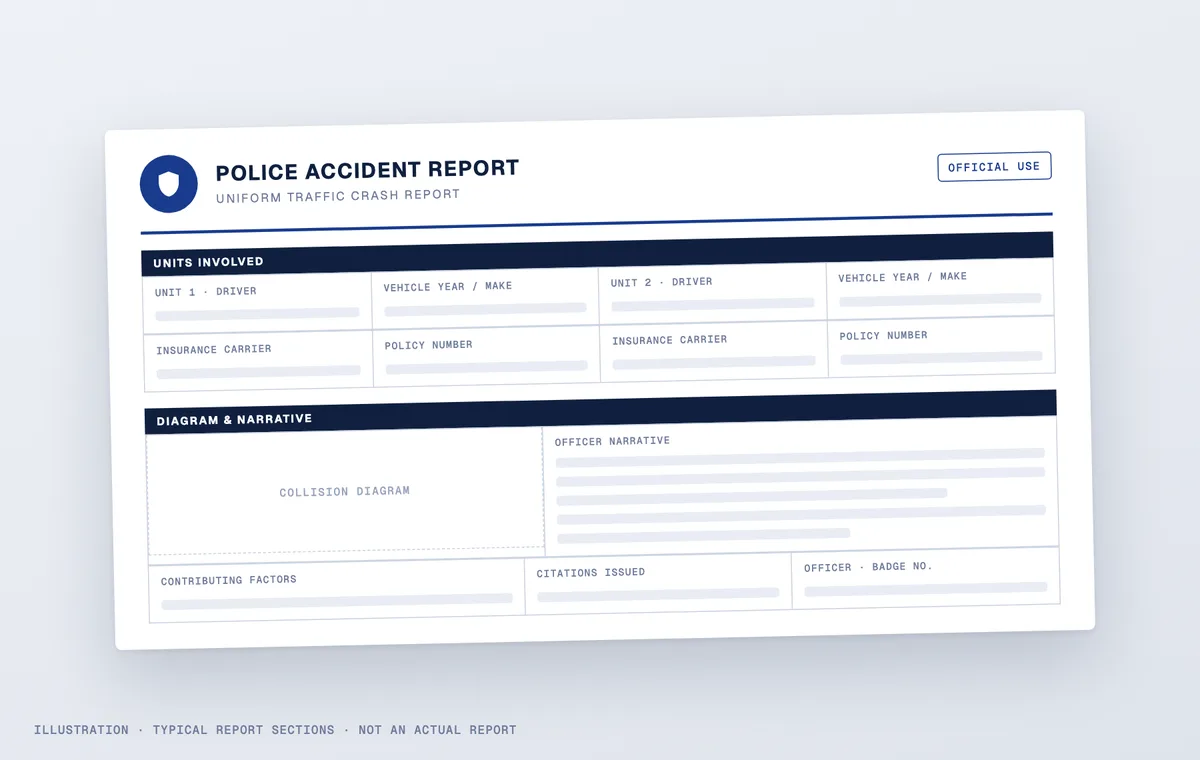
Reading a Huntsville car accident report means moving through its sections in order. The report names every driver, passenger, and pedestrian, records their insurance details, lays out the officer’s narrative and scene diagram, and marks the contributing factors behind the collision. These structured accident reports let a reader see who was at fault before an insurer or court weighs the claim.
A Huntsville car accident report is needed because Alabama law makes it the foundational record after a serious crash. Alabama Code § 32-10-5 requires a driver to notify law enforcement immediately when a crash causes injury or death. Alabama Code § 32-7-5 requires the operator to file a written report with the Alabama Department of Public Safety within 30 days when the crash caused injury, death, or property damage over $250. Alabama Code § 32-10-7 requires the investigating officer to produce a written report and defines who may obtain a copy.
The report serves both sides of a claim. When you pursue a claim, it establishes what happened and supports your demand for fair compensation from the at-fault driver or their insurer. When you defend against a claim, it documents the facts that can reduce or disprove the allegations against you. Accuracy in every field matters, because Alabama’s contributory negligence doctrine bars recovery from anyone found even one percent at fault.
Get Huntsville Online Car Accident Investigation Report from Police
Requesting a Huntsville online car accident investigation report from law enforcement takes four things, and the officer's finished report must already be in the state system before you start. Confirm you are an authorized requester, gather the crash details, prepare a valid payment method, and allow enough processing time.
This website is a pooled attorney advertisement. AccidentReports.com is not a law firm or a lawyer referral service, and nothing on this site is legal advice. Disclaimer
- 2024 Alabama Crash Facts (ALDOT)
- NHTSA FARS
- ALEA
- Code of Alabama
Last updated
45Source: 2024 Alabama Crash Facts (ALDOT), fatalities by county, p. 29
Traffic fatalities in Madison County, 2024
67Source: 2024 Alabama Crash Facts (ALDOT), p. 29; metro area per U.S. Census Bureau CBSA 26620
Traffic fatalities in the Huntsville metro (Madison and Limestone counties), 2024
3Source: 2024 Alabama Crash Facts (ALDOT), fatalities by county, p. 29
Madison County deaths with apparent alcohol or drug involvement, 2024
967Source: 2024 Alabama Crash Facts (ALDOT), p. 5
Traffic fatalities statewide in Alabama, 2024
Madison County, home to Huntsville, recorded 45 traffic fatalities in 2024, and 3 of those deaths involved apparent alcohol or drug use, according to the county figures in the 2024 Alabama Crash Facts report published by ALDOT through Drive Safe Alabama. Neighboring Limestone County, the other county in the Huntsville metro area, added 22 fatalities, which brings the two-county metro total to 67. Statewide, Alabama recorded 967 traffic fatalities that year, with 182 involving apparent alcohol or drug use. An officer who investigates a crash must forward the report to the state within 24 hours of completing the investigation under Alabama Code § 32-10-7, and that report is the document requesters obtain through ALEA.
Huntsville metro compared with the state, 2024
| Measure | Madison County | Limestone County | Alabama statewide |
|---|---|---|---|
| Traffic fatalities | 45 | 22 | 967 |
| Fatalities involving apparent alcohol or drug use | 3 | 1 | 182 |
Source: 2024 Alabama Crash Facts, Alabama Department of Transportation (p. 29)
North Alabama county fatalities, 2024
North Alabama carried a large share of the region’s fatal crashes, and the counties nearest Huntsville show where the risk concentrated. The table below lists the 2024 fatality figures for Madison County and its neighbors.
| County | Traffic fatalities | Alcohol or drug involved | Alcohol or drug involved, scale |
|---|---|---|---|
| Madison | 45 | 3 | |
| Morgan | 25 | 5 | |
| Etowah | 23 | 2 | |
| Cullman | 22 | 2 | |
| Limestone | 22 | 1 | |
| DeKalb | 21 | 3 | |
| Lauderdale | 20 | 3 | |
| Marshall | 15 | 5 | |
| Cherokee | 12 | 1 | |
| Colbert | 11 | 1 | |
| Jackson | 11 | 0 | |
| Lawrence | 11 | 0 | |
| Franklin | 7 | 3 |
Source: 2024 Alabama Crash Facts, Alabama Department of Transportation (p. 29, North Region counties)
Statewide crash categories, 2024
Statewide crash categories add context for the roads that run through Huntsville. Alabama logged 2,093 work zone crashes in 2024, and most work zone crashes are rear-end collisions caused by speeding or inattention. Trucks were involved in 10,183 crashes statewide, and interstates carried the largest share of those crashes at 30.6 percent. Railroad crossing crashes reached 87 statewide, and NHTSA reports that a motorist is almost 20 times more likely to die in a crash involving a train than in one involving another motor vehicle.
| Category | 2024 figure |
|---|---|
| Total traffic fatalities | 967 |
| Fatalities involving apparent alcohol or drug use | 182 |
| Work zone crashes | 2,093 |
| Crashes involving a truck | 10,183 |
| Railroad crossing crashes | 87 |
Source: 2024 Alabama Crash Facts, Alabama Department of Transportation (pp. 5, 26, 27, 28, 29)
How to Get Huntsville, Alabama Car Accident Report Online?
Getting a Huntsville car accident report online through the ALEA portal is the fastest route for an authorized requester. The steps below run in order, and each one moves you closer to a certified copy you can hand to an insurer or attorney.
-
Ensure you are eligible to request the report as an involved party, an insurer, or an attorney with signed consent under Alabama Code § 32-10-7. This step decides whether the request proceeds at all, since ALEA releases reports only to the persons listed in § 32-10-7. If the portal records your eligibility incorrectly, an attorney can verify your standing and submit on your behalf.
-
Wait for the Huntsville police to finalize the report and submit it into the state system. A search run before the report posts returns nothing, so this step saves a wasted request. If the report never appears, contact the Huntsville Police Department or ALEA to confirm it was submitted.
-
Access the report through the Alabama Law Enforcement Agency website and select the crash reports purchase option. This state-maintained database is the only authorized online source for official Huntsville crash reports. If the portal is down or rejects a valid request, an in-person visit to an ALEA Driver License Office is the backup.
-
Enter the crash date, the Huntsville location, the involved names, and the report number so the system locates the correct record. Accurate entry prevents delays and keeps the system from returning the wrong report. If a detail such as a misspelled name blocks the match, contact ALEA to confirm the correct identifier.
-
Pay the state fee and download or request a certified copy of the report. The online total is $17.00, and an in-person request at an ALEA Driver License Office is $15.00; personal checks are not accepted. If you are charged the wrong amount, keep the transaction record and contact ALEA before resubmitting so you are not billed twice.
-
Review the report for accuracy and use it only for insurance or legal purposes. Alabama Code § 32-10-7 limits release of the officer’s report to the persons it lists. If you spot a wrong address, a misattributed fault, or a missing detail, contact the investigating agency to request a correction before you submit it.

How to Read Huntsville, Alabama Car Accident Report?
Reading a Huntsville car accident report takes a structured pass through each section, from the report type to the insurance details. Reading carefully lets you catch inaccuracies before you submit the report for a claim.
-
1. Confirm the report type.
Confirm whether the document is a standard crash report or a fatal crash report, since a fatal report adds sections on cause of death and injury severity. Confirming the type ensures you review the correct version before analyzing anything else. If you received the wrong type, contact the issuing agency or ALEA to request the correct document.
-
2. Check the header.
Check the header for the date, time, location, and report number. The purpose of this step is to anchor every later detail to a specific, verifiable event and to give you the reference number for any correction. If a date, time, or location is wrong, contact the investigating agency with supporting proof such as time-stamped photos.
-
3. Identify parties and vehicles.
Identify every involved party and vehicle, including names, license numbers, and vehicle details. This step matters because omissions here change how insurers route and process claims. If a party is missing or misidentified, file a correction request with valid identification.
-
4. Review the diagram and narrative.
Review the crash diagram and the officer’s narrative for the details of how the crash occurred. These two elements are among the most heavily weighed when fault is determined. If either shows an error such as wrong vehicle placement, submit a written objection with contradicting evidence.
-
5. Note factors, citations, injuries, and damages.
Note the contributing factors, any citations, the injuries, and the damages recorded at the scene. This step matters because contributing factors and citations carry heavy weight when insurers and courts assign fault. If a factor or citation is inaccurate, dispute it with the issuing agency using traffic camera footage or witness statements.
-
6. Verify insurance and vehicle information.
Verify the insurance and vehicle information for every party. Insurers depend on this data to identify the responsible policy and start processing without delay. If any insurance or vehicle detail is wrong, notify the reporting agency and your own insurer in writing with the correct information.
-
7. Use it for claims or legal purposes only.
Use the report only for an insurance claim or a legal purpose. The report is an authorized record released only to the persons listed in Alabama Code § 32-10-7, not a general-purpose public document. If you believe an error will hurt your claim, raise it with your insurer or attorney before the report is submitted.
What Details Does a Huntsville, Alabama Car Accident Report Include?
A Huntsville car accident report includes a fixed set of components the investigating officer completes at or shortly after the crash. Anyone trying to understand what a car accident report holds should start with the eight parts below, since each one feeds a different part of an insurance claim or legal case.
Report Header
The header records the crash date, time, exact location, county, and the unique report number the agency assigned.
Involved Parties
This section names every driver, passenger, and pedestrian and lists their addresses, dates of birth, and license numbers.
Vehicle Information
This part records the make, model, year, color, plate, and identification number of each vehicle in the crash.
Accident Details
The officer’s narrative and scene diagram describe how the crash unfolded, the directions of travel, and the point of impact.
Injuries and Medical Information
This section records the injuries each party reported and any emergency treatment given at or near the scene.
Citations or Violations
This part lists the contributing factors the officer identified and any citations issued during the investigation.
Insurance and Legal Notes
This section records each party’s insurer, policy number, and coverage as provided at the scene.
Attachments
Supplemental material such as photographs, witness lists, and additional forms is attached to complete the record.
How to File a Car Accident Claim with Car Crash Report in Huntsville, Alabama?
Filing a car accident claim with a crash report in Huntsville takes gathering the official documentation, notifying the correct insurers, and submitting evidence in the right order. The crash report anchors the whole process.
-
1. Obtain the report.
Obtain a certified copy of the Huntsville car accident report from the ALEA portal or in person at an ALEA Driver License Office before starting any claim, since it is the primary document that supports your submission.
-
2. Document injuries.
Document all injuries by seeking prompt care at a provider such as Huntsville Hospital and keeping every evaluation, diagnosis, and treatment record. These records establish the harm the crash caused.
-
3. Notify your insurer.
Notify your own automobile insurer within the timeframe your policy specifies, providing the date, location, and basic details, and keep a written record of the notification.
-
4. File with the at-fault insurer.
File a formal claim with the at-fault party’s liability insurer using the crash report, including the policy number, insurer name, and driver details so the claim routes correctly.
-
5. Submit supporting evidence.
Submit the crash report with all supporting evidence, including photographs, medical records, and witness statements, to the at-fault party’s insurer as one package.
-
6. Follow up.
Follow up with the insurer regularly, and if the claim is denied or delayed without a valid reason, request the reason in writing and consult an attorney.
-
7. Guard your statements.
Avoid any statement to an adjuster that could read as accepting responsibility before you consult an attorney, because Alabama’s contributory negligence doctrine bars recovery if you are found even partially at fault.
How to Defend Against a Car Accident Claim Using a Crash Report in Huntsville, Alabama?
Defending against a car accident claim with a Huntsville crash report takes a careful review of the official record and a plan to surface the details that support your position.
- Review for errors. Review the crash report for factual errors, inaccuracies, or omissions in the narrative, diagram, or contributing factor assessment, since these can be challenged before the report is used against you.
- Gather contradicting evidence. Gather photographs, traffic camera footage, or independent witness statements that conflict with the recorded events, and present them alongside the report to shift the fault picture.
- Identify claimant fault. Identify details in the report that show the claimant contributed to the crash, since under Alabama’s contributory negligence doctrine even one percent of assigned fault bars the claimant from any recovery.
- Request reconstruction. Request an independent accident reconstruction analysis when the diagram or narrative does not match the physical evidence, so a qualified professional can produce findings that contradict the officer’s account.
- Document pre-existing conditions. Document any pre-existing conditions or prior injuries the claimant had before the crash, which keeps the report from establishing that the current claim is fully attributable to this crash.
Huntsville Area Fatal Car Crashes on Record
This table lists the 25 most recent fatal crashes in Madison County, home to Huntsville, recorded in the National Highway Traffic Safety Administration’s Fatality Analysis Reporting System (FARS) for 2024, the latest year available. FARS counts 43 fatal crashes and 44 deaths in Madison County that year. The 2024 file is NHTSA’s Annual Report File and can still be revised. FARS counts deaths within 30 days of a crash, so its county total can differ slightly from the state Crash Facts figure above. Case numbers are FARS case numbers, not police report numbers.
| Case number | County | City | Crash date | Time | Road / Highway | Collision type | Fatalities |
|---|---|---|---|---|---|---|---|
| 10852 | Madison | Outside city limits | Dec 9, 2024 | 05:20 | CR-CHARITY LANE | Single/non-collision: Tree (Standing Only) | 1 |
| 10867 | Madison | Outside city limits | Dec 2, 2024 | 18:29 | CR-OLD RAILROAD BED RD | Front-to-Front | 1 |
| 10830 | Madison | Outside city limits | Nov 29, 2024 | 08:25 | SR-53 at KELLY SPRING RD | Angle | 1 |
| 10806 | Madison | Madison | Nov 23, 2024 | 16:04 | I-565 | Angle | 1 |
| 10779 | Madison | Outside city limits | Nov 8, 2024 | 10:45 | CR-WALKER LN | Single/non-collision: Fire Hydrant | 1 |
| 10777 | Madison | Outside city limits | Nov 7, 2024 | 19:32 | SR-53 at HARVEST RD | Front-to-Front | 1 |
| 10736 | Madison | Outside city limits | Oct 23, 2024 | 18:30 | CR-MOORES MILL RD | Single/non-collision: Pedalcyclist | 1 |
| 10703 | Madison | Triana | Oct 12, 2024 | 21:13 | MU-WALL TRIANA HWY at ADVENT CIRCLE | Angle | 1 |
| 10702 | Madison | Huntsville | Oct 11, 2024 | 01:36 | I-565 EXIT RAMP | Single/non-collision: Utility Pole/Light Support | 1 |
| 10630 | Madison | Huntsville | Sep 25, 2024 | 06:29 | MU-WINCHESTER RD at MEMORIAL PKWY | Angle | 1 |
| 10631 | Madison | Outside city limits | Sep 25, 2024 | 05:30 | CR-MCKEE RD | Front-to-Front | 1 |
| 10615 | Madison | Huntsville | Sep 20, 2024 | 10:57 | CR-OLD HWY 431 | Angle | 1 |
| 10609 | Madison | Outside city limits | Sep 17, 2024 | 18:12 | CR-BLAKE BOTTOM RD | Angle | 1 |
| 10561 | Madison | Huntsville | Aug 30, 2024 | 19:03 | MU-I-565 ENTRANCE RAMP | Single/non-collision: Rollover/Overturn | 1 |
| 10543 | Madison | Huntsville | Aug 22, 2024 | 23:50 | MU-UNIVERSITY DR SR-2 | Single/non-collision: Pedestrian | 1 |
| 10370 | Madison | Outside city limits | Aug 14, 2024 | 17:08 | US-231 SR-1 at JACOB LANDING DR | Angle | 1 |
| 10518 | Madison | Huntsville | Aug 9, 2024 | 19:58 | SR-1 | Front-to-Front | 1 |
| 10558 | Madison | Huntsville | Aug 7, 2024 | 11:30 | SR-2 at SHIELDS RD | Front-to-Rear | 1 |
| 10489 | Madison | Huntsville | Jul 31, 2024 | 10:17 | SR-3 UNIVERSITY DR | Single/non-collision: Pedestrian | 1 |
| 10454 | Madison | Outside city limits | Jul 15, 2024 | 08:40 | CR-WINCHESTER RD | Angle | 2 |
| 10453 | Madison | Huntsville | Jul 14, 2024 | 11:16 | MU-WALL TRIANA HWY at TRADEMARK DR | Single/non-collision: Rollover/Overturn | 1 |
| 10449 | Madison | Outside city limits | Jul 13, 2024 | 01:35 | CR-INDIAN CREEK RD | Single/non-collision: Tree (Standing Only) | 1 |
| 10428 | Madison | Huntsville | Jul 6, 2024 | 14:40 | MU-BANKHEAD PKWY | Single/non-collision: Tree (Standing Only) | 1 |
| 10405 | Madison | Huntsville | Jun 24, 2024 | 14:49 | I-565 | Single/non-collision: Ditch | 1 |
| 10394 | Madison | Huntsville | Jun 20, 2024 | 18:45 | SR-2 at MEADOW DR | Front-to-Front | 1 |
Source: NHTSA Fatality Analysis Reporting System (FARS), 2024 Annual Report File
Questions
Frequently asked questions
The foundations of Huntsville accident reports cover what the record contains and the part it plays in a claim. This group explains what a report includes, the role the police report plays in a case, the injuries and damages it documents, and its standing as a record.
A Huntsville car accident report includes the crash date, time, and location, the involved parties and their vehicles, the officer’s narrative and scene diagram, the contributing factors and any citations, the injuries and damages, and the insurance details for each party. Together these parts form the official account of the collision.
The report exists to give insurers, attorneys, and courts a single, consistent record they can rely on. The contributing factors and citations carry the most weight, because they point to who was at fault, while the injury and damage entries set the baseline an insurer uses to value the claim.
The Huntsville police report in accident plays a central role in any car accident case as the official record of the collision. Insurers and courts treat the findings in a police accident report as the primary factual reference when they evaluate liability, so its contents shape the direction of a claim from the start.
In an insurance claim, the report guides the adjuster’s fault determination through the officer’s narrative, contributing factors, and citations. In a legal case, attorneys use it to prepare the case and guide discovery. Under Alabama’s contributory negligence doctrine, any indication that the injured party shared fault can be decisive to the outcome.
Injuries and damages documented in a Huntsville car accident report are recorded by the investigating officer from scene observations and statements. The list below covers the categories that appear most often.
- Whiplash and soft tissue. Whiplash and soft tissue injuries to the neck, muscles, and ligaments are among the most commonly reported, noted from complaints of pain and restricted motion.
- Fractures. Fractures to the arms, legs, ribs, or pelvis are documented when the officer observes deformity or a party reports localized pain.
- Head injuries. Head injuries and concussions are recorded when an occupant strikes a hard surface and reports dizziness, disorientation, or visible bleeding.
- Internal injuries. Internal injuries are noted when responders identify signs such as abdominal pain or difficulty breathing that require immediate care.
- Vehicle damage. Vehicle body damage such as dents, crumpling, and broken components is described for each car, with the areas of greatest impact.
- Property and roadway damage. Damage to guardrails, signs, poles, or the road surface is recorded to capture the full physical impact beyond the vehicles.
The Huntsville car accident report is not a fully public record. Alabama Code § 32-10-11 makes the accident reports filed by involved drivers and by garages confidential. Alabama Code § 32-10-7 limits access to the officer’s report to the persons it lists, including those directly involved, their insurers, attorneys with signed consent, and personal representatives of a deceased party, so releasing the report outside those channels is prohibited.
Yes, multiple reports can exist for a single Huntsville car accident. The investigating officer produces the official police accident report, the involved driver may be required to file a separate Driver’s Accident Report on Form SR-13 within 30 days under Alabama Code § 32-7-5, and a private accident report may be created to supplement the record. Each serves a distinct purpose and carries different legal standing.
Obtaining and timing a Huntsville report means knowing where to request it, how long it takes, and what it costs. This group explains the retrieval route, the processing window, the fees, and whether a claim can proceed without the report.
Obtaining a Huntsville car accident report requires confirming eligibility, locating the record in the state system, and paying the fee.
- Confirm eligibility. Confirm your eligibility under Alabama Code § 32-10-7 as an involved party, insurer, attorney with consent, or qualifying governmental entity.
- Gather crash details. Gather the crash date, the Huntsville location, and the driver’s name, and contact ALEA for the report number when it is unknown.
- Visit the ALEA portal. Visit the ALEA website, select the crash reports purchase option, and confirm your eligibility before the system proceeds.
- Enter search details. Enter the report number, the driver’s last name, or the license number, along with the crash date, to locate the record.
- Pay the fee. Pay the $17.00 online fee by debit or credit card, or pay $15.00 in person at an ALEA Driver License Office.
- Download the report. Download the report once payment clears, then save a digital copy and print a backup for your insurer or attorney.
The time to receive a Huntsville car accident report depends on the request method. Online requests through the ALEA portal allow immediate download once payment clears, but only after the investigating officer submits the report into the system.
Alabama Code § 32-10-7 requires the investigating officer to forward the report within 24 hours of completing the investigation.
Fees for requesting a Huntsville car accident report depend on the method used.
- Online fee. The online request through the ALEA portal totals $17.00, which covers the $15.00 report and a $2.00 processing fee.
- In-person fee. An in-person request at an ALEA Driver License Office requires the standard $15.00 report fee.
- Accepted payment. Personal checks are not accepted. ALEA accepts a money order, cashier’s check, cash, or credit card.
Yes, you can file a claim without a Huntsville police accident report, but doing so weakens your position. Insurers use the official report as the primary basis for evaluating fault and damages, so without it you must rely on photographs, witness statements, and medical records. The insurer may take longer to process the claim or request more documentation before deciding on liability and compensation.
Liability in a Huntsville crash turns on what the report records and how strongly it points to a cause. This group explains how to use the report to prove fault, how partial fault and outside factors weigh in, and how to supplement the record with evidence.
Using a Huntsville car accident report to prove fault requires pulling the sections that support your position and presenting them clearly.
- Contributing factors. Reference the contributing factors section to identify the specific violations the other driver committed, such as speeding or failure to yield.
- Officer narrative. Present the officer’s narrative to establish the documented sequence of events and the actions that caused the crash.
- Crash diagram. Use the crash diagram to show vehicle positions and directions of travel at the point of impact.
- Citations. Point to any citations issued to the other party as official violations the officer identified.
- Witness statements. Submit witness statements that align with the report to corroborate the officer’s findings on fault.
Yes, partial fault can appear in the Huntsville police report when the officer determines that more than one party contributed to the crash. The officer may note violations by multiple drivers in the contributing factors section. Under Alabama’s contributory negligence doctrine, any indication of shared fault is decisive, since even a minor notation can let an insurer deny compensation entirely.
Witness statements and weather details both shape how liability is evaluated in a Huntsville crash. Witness accounts that align with the report strengthen its fault determination, while accounts that conflict give the injured party grounds to challenge specific findings.
Weather details such as rain, fog, or reduced visibility establish the conditions at the time of the crash. Adverse weather can support an argument that every driver owed heightened caution, so a driver who failed to slow down may bear greater responsibility. Clear conditions shift the focus back to driver behavior when fault is assigned.
Supplementing a Huntsville accident report with evidence strengthens the record when the official document does not capture the full picture.
- Photographs. Gather scene photographs of vehicle positions, damage, and road conditions to complement the officer’s diagram and narrative.
- Medical records. Collect medical records from every provider to establish the injuries and connect them directly to the crash.
- Witness statements. Obtain signed witness statements shortly after the crash, since they carry more weight than later verbal recollections.
- Repair estimates. Add repair estimates from certified shops to document the cost of restoring each damaged vehicle.
- Camera footage. Include dashcam or traffic camera footage that can verify or dispute the officer’s recorded account.
Legal strategy with a Huntsville crash report covers how the record guides a case from negotiation through resolution. This group explains its use in court or negotiations, how to handle conflicts or delays, and the next steps after a review.
Using a Huntsville car accident report in court or negotiations requires understanding its limits and the indirect ways it still shapes the outcome.
- Negotiation baseline. Present the report to the insurer to establish the factual baseline of the collision before any offer is discussed.
- Discovery. Reference the report during discovery to identify the contributing factors and citations that guide deposition questions.
- Witness preparation. Use the officer’s narrative to prepare examination questions that align with or challenge the documented sequence of events.
- Diagram through testimony. Introduce the crash diagram through professional testimony to explain vehicle positions and the point of impact.
- Closing argument. Reference the contributing factor findings in closing to tie the other party’s actions to the resulting injuries.
Handling conflicting or delayed Huntsville car accident reports takes a structured approach that protects the claim.
- Identify the conflict. Identify the specific points of conflict between reports or between a report and other evidence, and document each clearly.
- Gather witness statements. Obtain signed witness statements that address the conflicting details directly.
- Request a correction. Submit a correction request to the investigating agency when the conflict stems from a verifiable error, with all supporting evidence.
- Address delays. Contact ALEA about a delayed report, and notify your insurer in writing so the delay is on record and does not stall a time-sensitive claim.
- Escalate when needed. Engage an attorney or an accident reconstruction professional when the conflict involves the sequence of events or vehicle positions.
After reviewing a Huntsville car accident report, the next steps decide how effectively the document advances or defends a claim.
- Prepare corrections. Document any errors found during the review and prepare a correction request with supporting evidence for the investigating agency.
- Gather supplemental evidence. Gather photographs, medical records, and witness statements that fill gaps or reinforce the report, organized for insurer submission.
- Notify your insurer. Notify your insurer in writing and include a copy of the report with any supplemental documentation, keeping a copy of everything submitted.
- Consult an attorney. Consult an attorney to evaluate the report’s impact under Alabama’s contributory negligence doctrine and to identify any detail that could challenge your right to compensation.
Accuracy in a Huntsville crash report decides how well it holds up in a claim. This group covers the errors to check, what happens when details are missing or conflict, and how to correct the record.
Errors in a Huntsville car accident report should be caught before the document reaches an insurer or a court. Work through the checklist below.
- Crash date and time. Confirm the crash date and time are accurate, since wrong entries undercut the document’s reliability.
- Crash location. Confirm the Huntsville location and road name match the actual site, because an error here delays claim processing.
- Party details. Review every party’s name, address, and license number, since incorrect identification stops insurers from routing the claim.
- Vehicle details. Confirm the make, model, year, and plate for each vehicle, because wrong details can misdirect the claim.
- Crash diagram. Check the diagram for correct vehicle placement and directions of travel, since an inaccurate diagram misrepresents the collision and affects fault.
- Contributing factors and citations. Confirm the contributing factors and citations match the scene and were assigned to the correct party, because they carry heavy weight under Alabama law.
- Insurance details. Confirm the insurer names and policy numbers for every party, since errors delay or misdirect processing.
- Injuries and witnesses. Review the injury descriptions for completeness and confirm all known witnesses are listed, because gaps here reduce the report’s value.
When details are missing or conflicting in a Huntsville police report, any claim built on it is directly weakened. Insurers rely on the report as the primary record, so omitted party details, undocumented injuries, or a narrative that conflicts with witness accounts create gaps the insurer may use to delay or deny the claim.
The affected party should contact the investigating agency to add missing information and should collect independent documentation such as photographs, medical records, and signed witness statements. Presenting that evidence alongside the report documents the conflict, which matters under Alabama’s contributory negligence doctrine where any suggestion of shared fault can bar recovery.
Corrections to a Huntsville car accident report can be requested when the document contains a verifiable factual error. The process begins by identifying the specific inaccuracy, whether it sits in the party details, the narrative, the contributing factors, or the diagram.
The affected party submits a written correction request to the investigating agency with supporting evidence such as photographs or witness statements. The agency reviews the submission and decides whether an amendment is warranted. If the agency declines, document the discrepancy and give it to your insurer or attorney so contradicting evidence can be presented alongside the report.
The insurance and settlement impact of a Huntsville report runs through every claim decision an insurer makes. This group explains how the report affects claims and settlements, how insurers read it, and how it aligns with medical records.
A Huntsville car accident report has a direct impact on how insurance claims are evaluated and settled. The report is the primary factual reference an insurer uses to decide which party bears responsibility, so a report that clearly identifies the other driver’s violations pressures that insurer to accept liability.
The report also shapes settlement value. Injury descriptions, damage assessments, and documented conditions set the baseline an adjuster uses to calculate the claim, and a report that supports the injured party leaves the insurer less room to negotiate downward. Under Alabama’s contributory negligence doctrine, any detail suggesting shared fault can be used to deny compensation entirely.
Insurers interpret the Huntsville accident report as the most authoritative single source when evaluating a claim. The adjuster reviews it section by section, starting with the contributing factors and citations that show which party the officer found responsible.
The narrative and diagram are read next for a clear cause-and-effect account, and inconsistencies between them can raise questions about reliability. Injury and damage entries inform the claim’s value, and the adjuster also checks whether every party met Alabama’s mandatory liability insurance requirement under Alabama Code § 32-7A-4.
Medical records align with the Huntsville car accident report by expanding on the injuries the officer noted at the scene. The report captures initial observations such as visible injuries and emergency treatment, while medical records add the diagnoses, treatment plans, and recovery documentation.
When the two are consistent, they form a strong evidentiary foundation for a claim. Discrepancies, such as an injury in the medical records that the report never noted, should be explained and reconciled before submission to an insurer so the claim is not weakened.