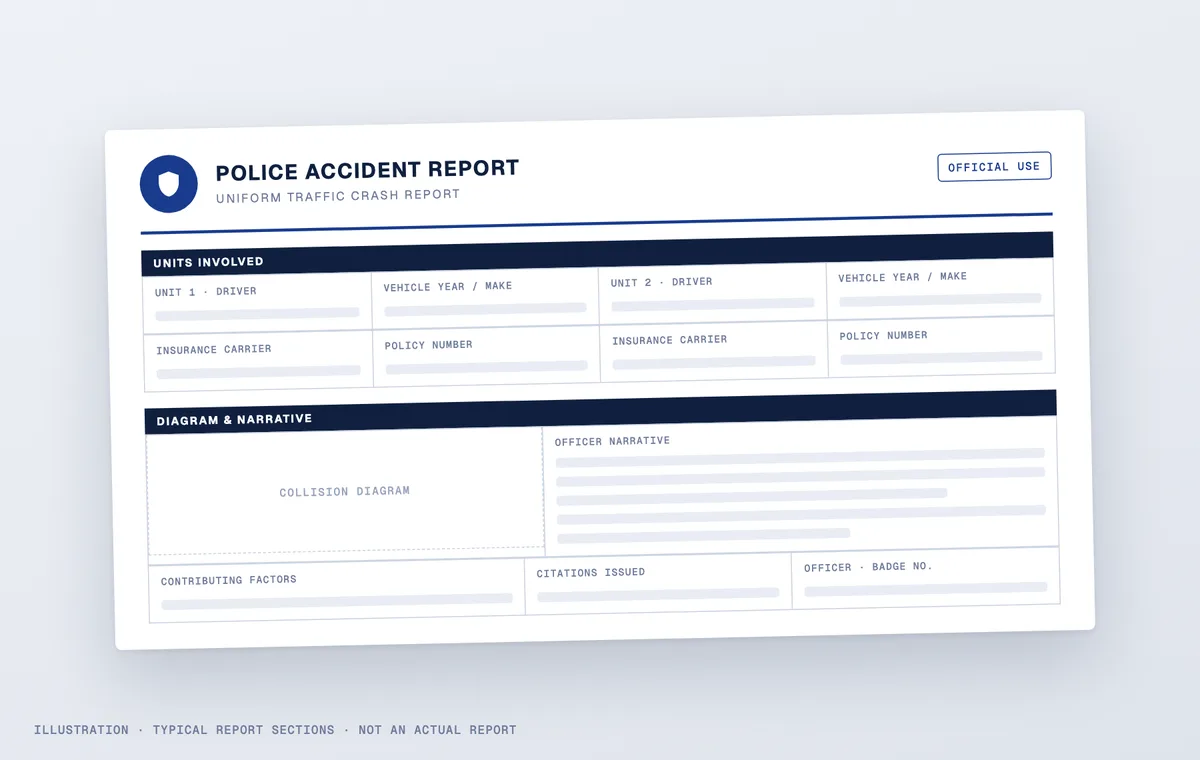
Every collision that meets a state's reporting threshold generates the same starting document: a car accident report written by the officer who responds to the scene, rather than by either driver involved.
Every collision that meets a state’s reporting threshold generates the same starting document, a car accident report written by the officer who responds to the scene rather than by either driver involved. That distinction matters more than it might seem, since a report an officer writes carries a different legal weight than anything either party writes on their own. The document covers who was involved, what damage occurred, what injuries were reported, and the circumstances that led to the crash, all recorded through witness statements, vehicle positions, road conditions, and the officer’s preliminary read on fault.
The investigation happens through this document, not around it. An officer measures skid marks, photographs the scene, interviews everyone present, and notes environmental factors like weather and visibility, and all of that becomes part of the same record insurers, attorneys, and courts pull from months or years later when memory alone is no longer reliable. Fair settlements depend on the accident report existing in the first place, since an adjuster with no objective evidence has nothing to separate a legitimate claim from an inflated one. Transportation departments lean on the same records too, aggregating them across thousands of crashes to spot a dangerous intersection or a hazardous stretch of road before it causes another collision.
A car accident report exists to protect a driver's legal rights and financial interests once the collision is over. Proving fault gets significantly harder without one, particularly when the other party disputes what happened or an insurer starts poking holes in the claim.
What the report captures, close to the moment of impact, is exactly what starts to fade once memories set in and evidence disappears. Details a driver would likely miss on their own, a skid mark measurement, a sight distance limitation, a malfunctioning traffic signal, get written down by someone trained to notice them.
Adjusters lean on the report heavily when setting liability percentages and settlement figures. A report with a clear fault indicator moves a claim through processing fast and tends to produce a stronger offer. A claim without one drags, and the driver on the losing end of that delay is usually the one with less documentation to point to. Attorneys build cases around the same document, tracing liability, locating witnesses, and establishing a pattern of negligence. A medical provider uses it too, tying an injury to the mechanism and severity of the crash in a way that strengthens the case for treatment.
Contents
What Information Is Included in a Car Accident Report?
Consistency across jurisdictions comes from a shared structure, even when the exact form differs by state. Eight categories of information typically show up inside a car accident report, and each one earns its place for a different reason.
Personal identification data
The full name, address, license number, date of birth, and contact information for every driver, passenger, and witness. Without this section, an insurer or attorney has no way to confirm who was actually there.
Vehicle information
The make, model, year, color, license plate, vehicle identification number, registration, and insurance policy. This is where an adjuster starts an early damage estimate.
Crash details
The exact location, date, time, weather, road surface, lighting, posted speed limit, and traffic control devices present. A hazardous condition noted here can shift fault or support a claim outright.
Officer narrative
A description of the sequence of events before, during, and after impact. Courts and insurers tend to treat this as the single most persuasive section, since a trained officer wrote it with no stake in the outcome.
Diagrams
A drawing of the intersection layout, vehicle paths, point of impact, and final rest positions. A picture answers spatial questions a paragraph of text cannot.
Injury descriptions
A record of visible trauma, symptom complaints, and emergency response. This is the first link between the crash date and an injury.
Contributing factor codes
Flags for a violation, a hazardous action, a driver condition, a vehicle defect, or an environmental cause. These codes often explain the reasoning behind a fault call.
Citation information
Any charge filed and the court date assigned, which can support a negligence argument later in a claim.
Corrections
Is It Possible to Correct Errors on a Car Accident Report?
Yes. A car accident report can be corrected, though the process runs through the issuing agency rather than through an insurer or a court.
Chaos at the scene, incomplete information in the moment, and an ordinary clerical mistake all show up in a first draft more often than people expect. Most agencies accept an amendment once a driver backs up the correction with a photograph, a witness affidavit, a medical record, or a registration document showing the accurate detail. A misspelled name or a transposed license plate digit tends to get fixed quickly once flagged.
Requesting a correction means submitting a written request to the agency’s records division, naming the specific error, providing the correct information, and attaching supporting proof. Include the report number, the crash date, the location, and contact information with the request. The agency reviews it, verifies the correction, and issues either an amended report or a supplemental document. A disputed fault call or a contested narrative takes longer to fix, and it often means a supervisor gets involved or a follow up interview happens with the people who were there.
How to Correct Errors on a Car Accident Report?
A driver who spots a mistake starts by writing the agency’s records division directly, not the insurer and not the other driver’s carrier. Name the exact error, state the correct information, and attach proof, a registration document, a dated photograph, or a signed witness account. Reference the report number, the crash date, and the location so the request reaches the right file.
Thresholds
When Are Car Crash Reports Required?
Each state sets its own trigger for when a car crash report becomes mandatory, built around a dollar threshold, a filing deadline, and a designated reporting party.
Each state sets its own trigger for when a car crash report becomes mandatory, built around a dollar threshold, a filing deadline, and a designated reporting party. Most states require a written report once a crash causes an injury, a fatality, or property damage above the state’s dollar threshold. An injury crash requires immediate notification and a report no matter how minor the injury looks in the moment, since a symptom can surface days later. A fatal crash triggers a deeper investigation, often involving a dedicated reconstruction team and closer supervisory oversight.
Some states separate the immediate notification requirement from the full written report deadline. A driver who leaves before an officer arrives generally has to file directly with the state Department of Motor Vehicles instead. Skipping a required report is a criminal violation in most states, and it can mean a suspended license, a fine, or a voided policy. A commercial vehicle operator carries an added federal reporting duty on top of whatever the state requires. According to the National Highway Traffic Safety Administration, 39,254 people died in traffic crashes during 2024, a number that shows exactly why this documentation matters at every threshold a state sets.
Types
What are the types of car accident reports?
A single crash can generate more than one kind of report, since different entities prepare documentation for different reasons, and each version carries its own level of detail and legal weight. Knowing which type actually applies, and where to find it, saves real time once a claim is on the line.
Report types06
Type 01
1. Police accident report
A police accident report is the document a responding officer prepares while investigating a crash, typically covering party identification, vehicle details, injury descriptions, property damage, witness statements, environmental conditions, a diagram, officer observations, a preliminary fault call, and any citation issued. Training shapes how this document gets built, since the officer examines physical evidence, interviews everyone present, measures the scene, photographs the damage, and applies traffic law to work out what caused the crash. What comes out of that process carries substantial weight in an insurance claim, a civil case, and a criminal proceeding alike.
Everything downstream of a crash tends to run through this one document first, since insurers, attorneys, and courts all treat it as the primary reference point for a liability or compensation decision. The agency that created the police accident report keeps it on file and releases it to involved parties, insurers, and attorneys through a formal request process. Digital access has become common enough that many agencies now offer immediate download once identity and payment are verified. Most reports become available within days, though a complex investigation can push that timeline out.
Type 02
2. DMV accident report
A DMV accident report exists for one specific situation, a crash that law enforcement never investigated even though it still meets the state’s reporting threshold. The driver files this self reported form directly with the state’s Department of Motor Vehicles, providing personal identification, vehicle information, insurance details, a description of the crash, a damage estimate, and any injury, all without independent verification from an officer. Most states set a deadline for this filing once the property damage or injury threshold is met.
Because this version reflects one driver’s own account rather than a neutral officer’s investigation, it can lean toward minimizing that driver’s fault. Insurers know this and treat a DMV report with more skepticism than a police report, often running their own independent investigation when it’s the only documentation available. Filing it keeps a license in good standing and satisfies the legal requirement, but it carries far less weight than a police report if fault ever gets disputed.
Type 03
3. Insurance accident report
An insurance accident report is the claim form a policyholder fills out to notify their insurer and get the claims process started. Each carrier has its own version, asking for the date, time, location, the parties involved, the vehicle damage, any injury, witness information, the police report number if one exists, and a narrative of what happened. That information is what opens the claim file, kicks off the liability investigation, and starts the adjustment process moving.
What separates this from a police report is perspective, since it reflects the policyholder’s own account rather than an independent investigation. An adjuster reads it looking for a coverage issue, a policy violation, an inconsistency worth clarifying, or a sign of fraud. Timing matters here too, since many policies require prompt notification regardless of who was at fault, and a late report can put coverage itself at risk.
Type 04
4. Private or company accident report
A private or company accident report gets generated whenever a corporate fleet vehicle, an employee driving on business, or company property is involved in a crash. Employers keep their own internal reporting systems running to track how often crashes happen, how bad they get, and what they cost, while also flagging a high risk driver or an overdue maintenance issue. This version usually goes further than an insurance form, pulling in photographs, witness statements, a supervisor’s own investigation, and whatever corrective action followed.
Human resources decisions often trace back to this same report, whether that means a disciplinary action or a new training requirement. A risk management department studies the pattern across many reports to shape a safety program or adjust coverage levels. When liability exposure looks serious enough, a company sometimes runs a parallel investigation entirely separate from the police, bringing in a private investigator or a reconstruction professional of its own.
Type 05
5. Self-reported accident statement
A self reported accident statement is what a person involved writes down on their own, usually within hours of the crash and before any formal investigation gets underway. Insurers frequently request one of these from a driver, a passenger, or a witness specifically to capture the account while memory is still sharp, before anyone else has a chance to shape the story. These early statements sometimes include an admission or a detail the person tries to walk back later, once an attorney or an insurer has gotten involved.
Most attorneys advise against giving a detailed statement without legal review first, since an insurer can mine it for an inconsistency, an admission of fault, or a coverage defense. Writing down the basic facts right away still holds value for a driver’s own records, even without handing that account directly to an insurer.
Type 06
6. Accident reconstruction report
An accident reconstruction report brings in an engineering professional to examine the physical evidence, the vehicle damage, and the collision dynamics, determining what actually caused the crash, how fast the vehicles were moving, and how the impact forces affected everyone inside. This level of analysis gets reserved for a severe crash, a disputed liability case, or a complex multi vehicle collision, exactly the situations where a standard police investigation doesn’t settle the question of fault or injury causation on its own.
What comes out of this process includes a calculation, a computer simulation, a photographic analysis, and a scientific conclusion built to support professional testimony at trial. Reconstruction becomes necessary when an eyewitness account contradicts the physical evidence, or when an injury looks far more serious than the apparent force of the crash would explain. Both insurers and attorneys retain reconstructionists for exactly this reason, and it isn’t unusual for two opposing analysts to reach different conclusions from the same set of facts.
Is a crash report the same as a police report?
Yes.
The two terms describe the same document, and which one a given agency uses comes down to preference rather than any real difference in content. Some departments favor “crash report” specifically to avoid the implication that a collision was unavoidable, while others stick with “police report” to emphasize that law enforcement authored it. Either way, the content, the purpose, and the legal weight stay identical.
At the scene
How to File a Car Accident Report with the Police?
A few steps protect a driver’s rights and keep the documentation accurate from the very start.
Call 911 from the scene, requesting both police and medical response whenever an injury or substantial damage exists. A precise location, an injury description, a vehicle count, and any hazard warning all help dispatch send the right resources.
Stay until law enforcement arrives, unless a medical emergency requires transport first. Photograph the damage before moving a vehicle out of traffic, and use hazard lights, flares, or cones to secure the area if available.
Collect names, addresses, phone numbers, license numbers, plate numbers, vehicle identification numbers, and insurance details from everyone involved. Photographing each license, registration, and insurance card locks in accuracy.
Photograph vehicle damage from multiple angles along with road conditions, traffic control devices, sight obstructions, weather, and debris. Video captures detail a photograph alone might miss.
Record contact information for anyone who saw the crash, since an independent account becomes valuable the moment liability gets disputed. A brief statement while memory is fresh matters more than a detailed one collected later.
Stick to what you saw, heard, and felt rather than offering an opinion on who caused the crash. Fault determination is the officer’s job.
Record the report number, the officer’s name, and the badge number, along with instructions for retrieving the finished report once it’s ready.
Step 01 of 07
Contact Emergency Services.
Online filing
How to file a car accident report online
Many states now let a driver file directly through an online portal when the crash meets specific eligibility requirements.
Step 01
Go to the official website
Use the local agency’s site or the state Department of Motor Vehicles portal, and confirm the address belongs to an actual government site before entering any personal information.
Step 02
Confirm eligibility
Check that the crash qualifies for online filing, since most systems restrict this option to property damage only crashes below a set threshold, with no injury, no suspected impairment, no fleeing driver, and no commercial vehicle involved.
Step 03
Create an account or log in
Verify reporting authority with a license number, a registration detail, or the crash date and location.
Step 04
Complete every required field
Enter accurate driver, vehicle, insurance, and crash details through whatever dropdown, checkbox, or text field the system provides.
Step 05
Upload supporting documentation
Add a photograph of the damage, the scene, and each license, registration, and insurance card. Multiple angles strengthen both the damage and liability record.
Step 06
Review before submitting
Check every entry, since most systems will not allow an edit once the report goes through.
Step 07
Save the confirmation
Record the confirmation number and download the completed report, since some systems limit how long the report stays accessible online.
Responsibility
Who can file a car accident report?
Responsibility for filing usually falls on the driver, particularly when law enforcement never responded or when state law requires direct reporting to the Department of Motor Vehicles. Most states place this obligation on every driver involved in a crash meeting the statutory threshold, regardless of fault.
A passenger generally cannot file, outside an unusual circumstance like an incapacitated driver or an abandoned vehicle.
A vehicle owner who wasn’t present can step in and file if the driver fails to, which comes up most often with a rental, a fleet vehicle, or a borrowed car. A policyholder still has to notify their own insurer regardless of whether an officer responded, since most policies run on their own separate timeline. A parent or guardian handles the filing for a minor driver, taking on that responsibility directly.
Fastest route
How to Get a Car Accident Report Today?
Getting a crash report does not have to mean tracking down the right office on your own. A driver who wants the accident today, as soon as it is available, has a few straightforward paths, and an online service like AccidentReports.com is the simplest of them.
Enter the incident number, driver information, and the crash date and location, and AccidentReports.com locates the report from the responding agency and delivers it as soon as it is available. This is the simple, effective way to get a crash report without chasing down a records window.
Use the officer’s business card, the incident number from the scene, or a dispatch record if neither was provided. Jurisdiction could belong to a county sheriff, a city police department, or the state highway patrol.
Bring valid photo identification and the crash details to request the report directly from the agency that investigated the collision.
Ask about status and availability, and a clerk can confirm whether the report is ready or point toward another way to obtain it.
Step 01 of 04
Request It Through AccidentReports.com
Statistics
What Are the Latest Car Accident Statistics?
Current car accident statistics explain why documentation carries the weight it does. The federal car accident statistics below, released for 2024, put the stakes in plain numbers.
39,254
Traffic fatalities, 2024
Traffic Fatalities in 2024.
The National Highway Traffic Safety Administration counted 39,254 traffic fatalities in 2024, down 4.3 percent from the 41,025 deaths in 2023, and the first year since 2020 the total dropped below 40,000.
The fatality rate fell to 1.19 deaths per 100 million vehicle miles traveled in 2024, the lowest since 2019, though still above the 2013-2019 average of 1.13.
FMVSS No. 127 is scheduled to require automatic emergency braking on new passenger cars and light trucks by September 1, 2029. NHTSA estimates the rule will save at least 360 lives a year; automakers are challenging it in court.
Where a copy comes from depends entirely on which agency investigated the crash. A law enforcement records division is the primary source for an official police report, keeping both a physical archive and a digital database on file.
Showing up in person with valid identification and the report number or crash details is one way to request it directly from that agency.
An online service like AccidentReports.com offers a simpler path, pulling the report from the responding agency so a driver can request it in one place and receive it as soon as it is available. Entering the incident number, the driver information, and the crash date and location is usually all the service needs to locate the right file.
A state Department of Motor Vehicles separately maintains any driver filed report submitted when law enforcement didn’t respond, available through the DMV office or an online portal requiring license verification and a fee.
Comparison
What Are the Differences Between Incident Reports and Police Reports?
Authorship is where the real difference starts. An incident report is typically an internal document a property owner, a business, or an individual writes up about something that happened on their own premises, with no law enforcement investigation behind it. A police report is the official document a trained officer produces after a formal investigation, applying legal authority to determine a violation and assign preliminary fault. That gap in authorship and investigative authority is exactly why courts and insurers treat the two so differently once either one gets pulled into a claim.
Feature
Incident Report
Police Report
Prepared By
A private party, such as a business employee, a property manager, or an involved individual, without law enforcement authority or investigation training
A sworn law enforcement officer with accident investigation training and legal authority to gather information
Purpose
Internal documentation for business records, insurance notification, and risk management, without an investigative mandate
Official government documentation supporting violation prosecution, statistical analysis, and legal proceedings
Legal Standing
Limited evidentiary weight, often subject to a hearsay objection, without the judicial notice given to a government record
Presumptively admissible as an official government record, carrying substantial evidentiary weight
Content
Basic information, including the date, time, location, a brief description, and an immediate action taken, without a detailed investigation
Full documentation, including party identification, vehicle detail, damage assessment, injury documentation, witness statements, a diagram, and a fault assignment
Scope
Narrow, focused on the organization's own interests rather than any broader traffic safety objective
Broad, covering every aspect relevant to law enforcement, from criminal violation to traffic safety pattern identification
Distribution
Restricted to internal circulation, shared with an insurer or legal counsel only as necessary
A public record, accessible to the involved parties, insurers, attorneys, and the general public, subject to specific privacy exceptions
Two documents describing the same crash can end up carrying almost nothing in common once they reach a courtroom or a claims adjuster’s desk. A driver holding only an incident report should go in expecting far less leverage than a police report would provide.