
Law Enforcement Motor Vehicle Crash Report Sections
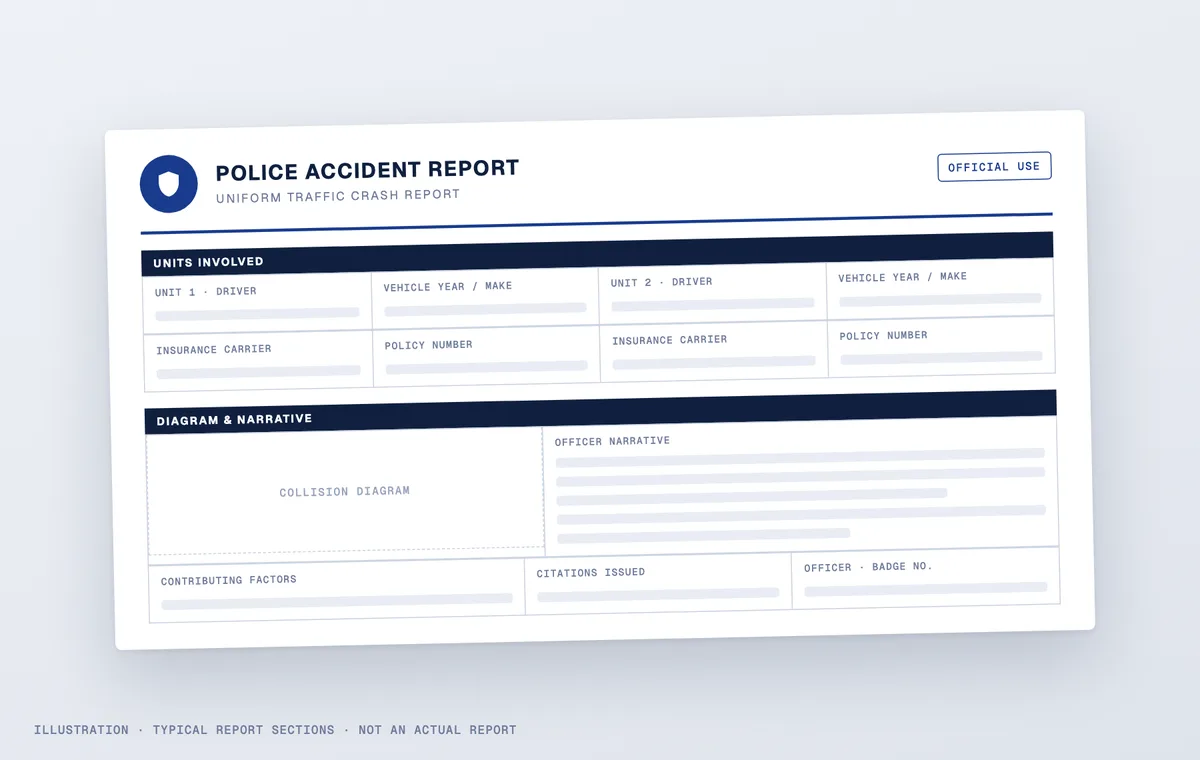
A law enforcement motor vehicle crash report in Texas is the Texas Peace Officer's Crash Report (Form CR-3), the official record that an officer files with the Texas Department of Transportation (TxDOT) after investigating a reportable crash. The CR-3 has four coded sections, identification and location, vehicle, driver, and persons, commercial motor vehicle, and factors and conditions, and the Texas Peace Officer's Crash Report code sheet lists every value an officer may enter in its 46 numbered fields.
The page reproduces the code values of the current code sheet, Form CR-3CS revision 4/1/2023, which applies to crashes that occurred on or after April 1, 2023, and adds the TxDOT CR-100 reporting rules for the main fields. The official PDF is available from TxDOT.
Texas crash statistics are built from the same codes. The car accident statistics in Texas page reports crashes by injury severity, contributing factor, light condition, and weather condition using the values listed here.
Get Texas Online Car Accident Investigation Report from Police
AccidentReports.com can request the document from law enforcement on your behalf when you would rather not use the TxDOT purchase system yourself. You provide the crash date, the location, and the party names.
This website is a pooled attorney advertisement. AccidentReports.com is not a law firm or a lawyer referral service, and nothing on this site is legal advice. Disclaimer
- TxDOT CR-3 Code Sheet
- TxDOT CR-100 Instructions
- TxDOT Crash Records
Last updated
Definition
What Is a Law Enforcement Motor Vehicle Crash Report in Texas?
A law enforcement motor vehicle crash report in Texas is the Texas Peace Officer's Crash Report (Form CR-3). Texas Transportation Code §550.062 requires an officer who investigates a crash that injures or kills a person, or damages one person's property to the apparent extent of $1,000 or more, to submit the written report to TxDOT not later than the tenth day after the crash (TxDOT).
The purpose of the CR-3 is data collection: TxDOT's instructions to police state that crash data support problem identification, goal setting, resource allocation, and the evaluation of highway and vehicle safety countermeasures (CR-100). The legal implications follow from the statute: the report is the record TxDOT keeps as custodian of Texas crash records, and Transportation Code §550.065 limits release of a copy to persons with a direct interest in the crash.
Each section of the form matters for accurate reporting because every numbered field accepts only the values on the code sheet. TxDOT returns a report with a blank mandatory field or an invalid value to the investigating officer for correction.
Sections of the Texas Peace Officer's Crash Report
The Texas Peace Officer's Crash Report divides its numbered fields into four coded sections, and the code sheet prints one numbered list for each field. Each section below lists its fields with the number of codes and the CR-100 reporting rules that govern them.
Roadway and Location Information (fields 1 to 4)
The roadway and location section, printed on the code sheet as Identification and Location, holds four numbered lists that describe the road where the crash occurred.
- 1. Roadway System: the road system of the road on which the crash occurred (19 codes).
- 2. Roadway Part: the part of the roadway where the unit traveled before the crash (6 codes).
- 3. Direction: the compass direction used for street prefixes, direction of traffic, and direction from an intersection or reference marker (8 codes).
- 4. Street Suffix: the road-type word that ends a street name (21 codes).
The four lists locate the crash on the Texas road network, and the section feeds the county, city, and highway breakdowns in TxDOT crash statistics.
The CR-100 sets these rules for the location fields:
- Highway number: required when the Roadway System is a highway designation such as IH, US, SH, or FM, and not allowed for LR or PV.
- Highest designation: when a road carries several designations, the officer uses IH first, US second, and SH third.
- Roadway part: the code records where the unit was traveling before the crash, which may differ from where the first harmful event happened.
- Mandatory fields: a field marked with an asterisk in the CR-100 cannot be blank, or TxDOT returns the report to the officer.
The rules keep the location data consistent from agency to agency.
TxDOT returns a CR-3 with a blank mandatory field to the officer for correction.
Vehicle, Driver, and Persons (fields 5 to 29)
The vehicle, driver, and persons section holds 25 numbered lists that identify each unit and each person and record injuries, restraint use, testing, and vehicle damage.
- 5. Unit Description: the kind of unit involved in the crash (8 codes).
- 6. Vehicle Color: the color of the vehicle (24 codes).
- 7. Body Style: the body style of the vehicle or unit (20 codes).
- 8. Autonomous Unit: whether the unit was an autonomous vehicle (3 codes).
- 9. Autonomous Level Engaged: the level of automation engaged at the crash (8 codes).
- 10. Driver License/ID Type: the type of license or identification card of the primary person (8 codes).
- 11. Driver License Class: the license class on the Texas driver license (11 codes).
- 12. Commercial Driver License Endorsements: the endorsements on a commercial driver license (11 codes).
- 13. Driver License Restrictions: the restrictions printed on the driver license (70 codes).
- 14. Person Type: the role of each person in the crash (9 codes).
- 15. Seat Position: where each person sat or was located (17 codes).
- 16. Injury Severity: the most serious injury of each person (7 codes).
- 17. Ethnicity: the ethnicity of each person (8 codes).
- 18. Sex: the sex of each person (4 codes).
- 19. Ejected: whether and how far a person was expelled from the vehicle (5 codes).
- 20. Restraint Used: the restraint used by each person (11 codes).
- 21. Airbag: whether and where an airbag deployed (7 codes).
- 22. Helmet Use: whether a helmet was worn and damaged (6 codes).
- 23. Solicitation: whether a person wants to receive solicitation offers from professional service providers (2 codes).
- 24. Alcohol Specimen Type: the type of alcohol specimen taken (6 codes).
- 25. Drug Specimen Type: the type of drug specimen taken (5 codes).
- 26. Drug Test Result: the result of the drug test (4 codes).
- 27. Drug Category: the category of drug found (11 codes).
- 28. Financial Responsibility Type: the type of proof of financial responsibility (7 codes).
- 29. Vehicle Damage Rating: the direction of force, the damaged area, and the severity of vehicle damage (a three-part format plus 6 special-case codes).
The section supplies the injury, restraint, and person-type counts in TxDOT statistics.
The CR-100 sets these rules for the vehicle, driver, and persons fields:
- Person type matches unit: a unit described as a motor vehicle takes person types 1, 2, 5, 6, 95, or 99, a pedalcyclist takes 3, and a pedestrian takes 4.
- Primary person fields: license, date of birth, address, alcohol, and drug fields apply only to the primary person of each unit.
- Injury code for everyone: every person in the crash receives an injury code, including a person who was not injured.
- Late deaths: a person who dies within 30 days is changed to injury code K by a supplement report.
The rules make the person-level data comparable across crashes.
Every person in a Texas crash receives an injury severity code, including A, B, C, K, and N.
Commercial Motor Vehicle (fields 30 to 37)
The commercial motor vehicle section holds eight numbered lists for crashes that involve a commercial motor vehicle, including the sequence of events.
- 30. Vehicle Operation: the type of commerce in which the commercial vehicle operated (5 codes).
- 31. Carrier ID Type: the kind of carrier identification number (5 codes).
- 32. Vehicle Type: the type of commercial motor vehicle (13 codes).
- 33. Bus Type: the use category of a bus (8 codes).
- 34. Hazardous Material Class Number: the class of hazardous material carried (9 codes).
- 35. Cargo Body Type: the cargo body of the commercial vehicle (16 codes).
- 36. Trailer Type: the type of trailer towed (3 codes).
- 37. Sequence of Events: up to four collision and non-collision events in order (22 codes).
The section describes the truck, bus, cargo, and trailer involved in a commercial vehicle crash.
The CR-100 sets these rules for the commercial motor vehicle fields:
- Vehicle operation: the type of commerce follows the bill of lading and destination, and a personal move of household items is coded 5, Personal.
- Carrier ID: a vehicle operated for personal use takes code 96, None.
- Hazardous material: the class number comes from the bill of lading, the shipping papers, or the placard, and the field is completed only when the hazardous material box is checked.
- Sequence of events: up to four events are listed, and the first listed event is the first event that occurred.
The rules tie the commercial vehicle data to the documents carried in the cab.
The sequence of events field takes up to four events, and the first one listed is the first event that occurred.
Factors and Conditions (fields 38 to 46)
The factors and conditions section holds nine numbered lists for the investigator's opinion of contributing factors, vehicle defects, and the conditions at the crash scene.
- 38. Factors and Conditions: the contributing factors in the investigator's opinion (70 codes).
- 39. Vehicle Defects: the vehicle defects in the investigator's opinion (11 codes).
- 40. Weather Condition: the atmospheric condition at the crash (10 codes).
- 41. Light Condition: the level of light at the crash (8 codes).
- 42. Entering Roads: the layout of the intersection (9 codes).
- 43. Roadway Type: the type of roadway where the crash occurred (5 codes).
- 44. Roadway Alignment: the geometry of the roadway (8 codes).
- 45. Surface Condition: the condition of the road surface (9 codes).
- 46. Traffic Control: the traffic control present at the crash location (18 codes).
The section supplies the contributing factor and condition counts in TxDOT statistics.
The CR-100 sets these rules for the factors and conditions fields:
- Priority order: the officer lists up to three contributing factors for each unit, with the primary factor first.
- Speed factors: factors 22, 60, and 61 cannot apply to the same unit, and factors 45 and 67 are not both used for one driver.
- Light condition: a crash time between 2200 and 0500 cannot be coded 1, Daylight.
- Traffic control: code 96, None, is used only when no traffic control was present.
The rules keep the opinion fields consistent with each other.
A unit takes up to three contributing factors, listed in priority order.
Roadway and Location Information
Roadway System
The Roadway System list (field 1) names the road system of the road on which the crash occurred, using the 19 abbreviations below. The table gives each abbreviation, its road type, and the CR-100 rule for the Highway Number field that accompanies it.
| Abbreviation | Road Type | Highway Number rule (CR-100) |
|---|---|---|
| IH | Interstate | Highway number required |
| US | US Highway | Highway number required |
| SH | State Highway | Highway number required |
| FM | Farm to Market | Highway number required |
| RR | Ranch Road | Highway number required |
| RM | Ranch to Market | Highway number required |
| BI | Business Interstate | Highway number required |
| BU | Business US | Highway number required |
| BS | Business State | Highway number required |
| BF | Business FM | Highway number required |
| SL | State Loop | Highway number required |
| TL | Toll Road | Highway number or street name required |
| AL | Alternate | Highway number required |
| SP | Spur | Highway number required |
| CR | County Road | Highway number or street name required |
| PR | Park Road | Highway number or street name required |
| PV | Private Road | Highway number may not be entered |
| RC | Recreational Road | Highway number or street name required |
| LR | Local Road/Street (Street, Road, Ave., Blvd., Pl., Trl., Beach, Alley, Boat Ramp, etc.) | Highway number may not be entered |
When a highway carries more than one designation, the officer uses the highest one, with IH first, US second, and SH third, and enters the official highway number, for example IH with number 45 for Gulf Freeway. A crash in a parking lot takes the Roadway System of the physical address where the lot sits (CR-100).
Roadway and Location Information
Roadway Part and Direction
Roadway Part (field 2) records the part of the roadway on which the unit traveled before the crash, and Direction (field 3) records the compass direction used for the street prefix, the direction of traffic, and the direction from an intersection or reference marker. The two tables list every code for the two fields.
Roadway Part (field 2)
| Code | Description |
|---|---|
| 1 | Main/Proper Lane |
| 2 | Service/Frontage Road |
| 3 | Entrance/On Ramp |
| 4 | Exit/Off Ramp |
| 5 | Connector/Flyover |
| 98 | Other (Explain in Narrative) |
Source: TxDOT, Texas Peace Officer's Crash Report - Code Sheet (Form CR-3CS 4/1/2023), field 2
Direction (field 3), street prefix and direction from intersection
| Abbreviation | Description |
|---|---|
| N | North |
| NE | Northeast |
| E | East |
| SE | Southeast |
| S | South |
| SW | Southwest |
| W | West |
| NW | Northwest |
Source: TxDOT, Texas Peace Officer's Crash Report - Code Sheet (Form CR-3CS 4/1/2023), field 3
Roadway Part is the part where the unit was traveling before the crash and may differ from the place of the first harmful event: a vehicle that starts on a frontage road and ends on the main lanes is coded 2, Service/Frontage Road (CR-100).
Roadway and Location Information
Street Suffix
The Street Suffix list (field 4) holds the 21 abbreviations for the road-type word that ends a street name, such as RD for Road or BLVD for Boulevard. The two tables split the list in code-sheet order.
Street Suffix, RD to TRL
| Abbreviation | Description |
|---|---|
| RD | Road |
| ST | Street |
| DR | Drive |
| AVE | Avenue |
| BLVD | Boulevard |
| PKWY | Parkway |
| LN | Lane |
| FWY | Freeway |
| HWY | Highway |
| WAY | Way |
| TRL | Trail |
Source: TxDOT, Texas Peace Officer's Crash Report - Code Sheet (Form CR-3CS 4/1/2023), field 4
Street Suffix, LOOP to PT
| Abbreviation | Description |
|---|---|
| LOOP | Loop |
| EXPY | Expressway |
| CT | Court |
| CIR | Circle |
| PL | Place |
| PARK | Park |
| CV | Cove |
| PATH | Path |
| TRC | Trace |
| PT | Point |
Source: TxDOT, Texas Peace Officer's Crash Report - Code Sheet (Form CR-3CS 4/1/2023), field 4
The suffix is entered separately from the street name, so a crash on Gulf Freeway carries the name Gulf and the suffix FWY. The official sheet includes the suffixes PATH, TRC, and PT in addition to the first 18 abbreviations.
Vehicle, Driver, and Persons
Unit Description
The Unit Description list (field 5) classifies every party in a crash as a motor vehicle, train, pedalcyclist, pedestrian, motorized conveyance, towed unit, non-contact unit, or other. The table gives each code with the CR-100 definition of the unit.
| Code | Unit Description | Definition (CR-100) |
|---|---|---|
| 1 | Motor Vehicle | A motorized road vehicle, including its cargo, not operated on rails. The CR-100 list includes the all-terrain vehicle, autocycle, bus, farm tractor, golf cart, moped, motorcycle, passenger car, school bus, truck, and truck tractor. |
| 2 | Train | A motorized railway vehicle or a land vehicle operated on rails. |
| 3 | Pedalcyclist | A non-motorized vehicle propelled by pedaling, including an electric bicycle. |
| 4 | Pedestrian | Any person who is not an occupant of a motor vehicle in transport, including users of motorized and non-motorized wheelchairs. |
| 5 | Motorized Conveyance | A smaller motorized vehicle such as a pocket bike, go-cart, riding lawn mower, or Segway. Mopeds, motorcycles, and motor-driven cycles are excluded. |
| 6 | Towed/Pushed/Trailer | A unit pulled or pushed under another motor vehicle's control. A trailer not attached to a power unit at the time of the crash is listed under Damage instead. |
| 7 | Non-Contact | A vehicle that contributes to a crash through unusual or illegal behavior but strikes nothing and suffers no damage or injury. |
| 98 | Other (Explain in Narrative) | A streetcar, an animal carrying a person, an animal-drawn carriage, herded animals, or special mobile equipment. |
Unit Description is a mandatory field, and TxDOT returns a report with this field blank to the officer. A body style of TL, Trailer, Semi-Trailer, or Pole Trailer requires unit description 6 (CR-100).
Vehicle, Driver, and Persons
Vehicle Color
The Vehicle Color list (field 6) records the color of the vehicle with a three-letter abbreviation, plus codes 98 and 99. The two tables list all 24 values in code-sheet order.
Vehicle Color, BGE to ONG
| Abbreviation | Description |
|---|---|
| BGE | Beige |
| BLK | Black |
| BLU | Blue |
| BRZ | Bronze |
| BRO | Brown |
| CAM | Camouflage |
| CPR | Copper |
| GLD | Gold |
| GRY | Gray |
| GRN | Green |
| MAR | Maroon |
| MUL | Multicolored |
Source: TxDOT, Texas Peace Officer's Crash Report - Code Sheet (Form CR-3CS 4/1/2023), field 6
Vehicle Color, PNK to 99
| Abbreviation | Description |
|---|---|
| ONG | Orange |
| PNK | Pink |
| PLE | Purple |
| RED | Red |
| SIL | Silver |
| TAN | Tan |
| TEA | Teal (green) |
| TRQ | Turquoise (blue) |
| WHI | White |
| YEL | Yellow |
| 98 | Other (Explain in Narrative) |
| 99 | Unknown |
Source: TxDOT, Texas Peace Officer's Crash Report - Code Sheet (Form CR-3CS 4/1/2023), field 6
Code 98, Other, requires an explanation in the narrative, and code 99 records an unknown color.
Vehicle, Driver, and Persons
Body Style
The Body Style list (field 7) describes the body of the vehicle or unit, from a two-door passenger car (P2) to a truck tractor (TT), using 18 abbreviations plus codes 98 and 99. The table lists the abbreviation and body style for every value.
| Abbreviation | Body Style |
|---|---|
| P2 | Passenger Car, 2-Door |
| P4 | Passenger Car, 4-Door |
| PK | Pickup |
| AM | Ambulance |
| BU | Bus |
| SB | Yellow School Bus |
| SBO | School Bus Other |
| FE | Farm Equipment |
| FT | Fire Truck |
| MC | Motorcycle |
| SV | Sport Utility Vehicle |
| PC | Police Car/Truck |
| PM | Police Motorcycle |
| TL | Trailer, Semi-Trailer, or Pole Trailer |
| TR | Truck |
| TT | Truck Tractor |
| VN | Van |
| EV | Neighborhood Vehicle |
| 98 | Other (Explain in Narrative) |
| 99 | Unknown |
Source: TxDOT, Texas Peace Officer's Crash Report - Code Sheet (Form CR-3CS 4/1/2023), field 7
The CR-100 sends all-terrain vehicles, side-by-side utility vehicles, mopeds, and autocycles to code 98, Other. A body style of BU, SB, or TT requires commercial motor vehicle data (CR-100).
Vehicle, Driver, and Persons
Autonomous Unit and Autonomous Level Engaged
Autonomous Unit (field 8) records whether a unit was an autonomous vehicle, and Autonomous Level Engaged (field 9) records the level of automation active at the time of the crash, from 0 to 5. The two tables list both fields.
Autonomous Unit (field 8)
| Code | Description |
|---|---|
| 1 | Yes |
| 2 | No |
| 99 | Unknown |
Source: TxDOT, Texas Peace Officer's Crash Report - Code Sheet (Form CR-3CS 4/1/2023), field 8
Autonomous Level Engaged (field 9)
| Code | Description |
|---|---|
| 0 | No Automation |
| 1 | Driver Assistance |
| 2 | Partial Automation |
| 3 | Conditional Automation |
| 4 | High Automation |
| 5 | Full Automation |
| 6 | Automation Level Unknown |
| 99 | Unknown |
Source: TxDOT, Texas Peace Officer's Crash Report - Code Sheet (Form CR-3CS 4/1/2023), field 9
The CR-100 requires person type 95, Autonomous, for the primary person of a unit when the level is 4, High Automation, or 5, Full Automation, and bars person type 95 at lower levels. Appendix G of the CR-100 refers to the SAE International levels of driving automation (CR-100).
Vehicle, Driver, and Persons
Driver License/ID Type, Class, and Commercial Endorsements
Driver License/ID Type (field 10), Driver License Class (field 11), and Commercial Driver License Endorsements (field 12) describe the credential held by the primary person of each unit. The three tables list every code for the three fields.
Driver License/ID Type (field 10)
| Code | Description |
|---|---|
| 1 | Driver License |
| 2 | Commercial Driver Lic. |
| 3 | Occupational |
| 4 | ID Card |
| 5 | Unlicensed |
| 95 | Autonomous |
| 98 | Other |
| 99 | Unknown |
Source: TxDOT, Texas Peace Officer's Crash Report - Code Sheet (Form CR-3CS 4/1/2023), field 10
Driver License Class (field 11)
| Code | Description |
|---|---|
| A | Class A |
| AM | Class A and M |
| B | Class B |
| BM | Class B and M |
| C | Class C |
| CM | Class C and M |
| M | Class M |
| 5 | Unlicensed |
| 95 | Autonomous |
| 98 | Other/Out of State |
| 99 | Unknown |
Source: TxDOT, Texas Peace Officer's Crash Report - Code Sheet (Form CR-3CS 4/1/2023), field 11
Commercial Driver License Endorsements (field 12)
| Code | Description |
|---|---|
| H | Hazardous Materials |
| N | Tank Vehicle |
| P | Passenger |
| S | School Bus |
| T | Double/Triple Trailer |
| X | Tank Vehicle with Hazardous Materials |
| 5 | Unlicensed |
| 96 | None |
| 95 | Autonomous |
| 98 | Other/Out of State |
| 99 | Unknown |
Source: TxDOT, Texas Peace Officer's Crash Report - Code Sheet (Form CR-3CS 4/1/2023), field 12
A holder of a license from outside North America is coded 98, Other, under the CR-100. A Texas Class A, B, or C license with a motorcycle endorsement is issued as Class AM, BM, or CM, which is why the class list carries the combined codes (CR-100).
Vehicle, Driver, and Persons
Driver License Restrictions
The Driver License Restrictions list (field 13) records the restrictions printed on the driver license of the primary person, using the letters A to Z (without P), the codes P1 to P40, and the shared values 5, 95, 96, 98, and 99. The three tables list all 70 values.
Letter codes A to Z
| Code | Description |
|---|---|
| A | With corrective lenses |
| B | LOFS 21 or over |
| C | Daytime driving only |
| D | Speed not to exceed 45 mph |
| E | No manual transmission equipped CMV |
| F | Must hold valid learner lic. to MM/DD/YY |
| G | TRC 545.424 applies until MM/DD/YY |
| H | Vehicle not to exceed 26,000 lbs GVWR |
| I | MC not to exceed 250cc |
| J | Licensed MC operator 21 or over in sight |
| K | Intrastate only |
| L | No air brake equipped CMV |
| M | No Class A passenger vehicle |
| N | No Class A and B passenger vehicle |
| O | No tractor-trailer CMV |
| Q | LOFS 21 or over vehicle above Class B |
| R | LOFS 21 or over vehicle above Class C |
| S | Outside rearview mirror or hearing aid |
| T | Automatic transmission |
| U | Applicable prosthetic devices |
| V | Medical Variance |
| W | Power steering |
| X | No cargo in CMV tank vehicle |
| Y | Valid TX vision or limb waiver required |
| Z | No full air brake equipped CMV |
Source: TxDOT, Texas Peace Officer's Crash Report - Code Sheet (Form CR-3CS 4/1/2023), field 13
Codes P1 to P20
| Code | Description |
|---|---|
| P1 | For Class M TRC 545.424 until MM/DD/YY |
| P2 | To/from work/school |
| P3 | To/from work |
| P4 | To/from school |
| P5 | To/from work/school or LOFS 21 or over |
| P6 | To/from work or LOFS 21 or over |
| P7 | To/from school or LOFS 21 or over |
| P8 | With telescopic lens |
| P9 | LOFS 21 or over bus only |
| P10 | LOFS 21 or over school bus only |
| P11 | Bus not to exceed 26,000 lbs GVWR |
| P12 | Passenger CMVs restrict to Class C only |
| P13 | LOFS 21 or over in veh equip w/airbrake |
| P14 | Operation Class B exempt veh authorized |
| P15 | Operation Class A exempt veh authorized |
| P16 | If CMV, school buses interstate |
| P17 | If CMV, government vehicles interstate |
| P18 | If CMV, only trans personal prop interstate |
| P19 | If CMV, trans corpse/sick/injured interstate |
| P20 | If CMV, privately trans passengers interstate |
Source: TxDOT, Texas Peace Officer's Crash Report - Code Sheet (Form CR-3CS 4/1/2023), field 13
Codes P21 to P40 and shared values
| Code | Description |
|---|---|
| P21 | If CMV, fire/rescue interstate |
| P22 | If CMV, intra-city zone drivers interstate |
| P23 | If CMV, custom-harvesting interstate |
| P24 | If CMV, transporting bees/hives interstate |
| P25 | If CMV, use in oil/water well service/drill |
| P26 | If CMV, for operation of mobile crane |
| P27 | HME Expiration Date MM/DD/YY |
| P28 | FRSI CDL valid MM/DD/YY to MM/DD/YY |
| P29 | FRSI CDL MM/DD/YY - MM/DD/YY or exempt B veh |
| P30 | FRSI CDL MM/DD/YY - MM/DD/YY or exempt A veh |
| P31 | Class C only - no taxi/bus/emergency veh |
| P32 | Other |
| P33 | No passengers in CMV bus |
| P34 | No express or highway driving |
| P35 | Restricted to operation of three-wheeled MC |
| P36 | Moped |
| P37 | Occ/Essent need DL-no CMV-see court order |
| P38 | Applicable vehicle devices |
| P39 | Ignition Interlock required |
| P40 | Vehicle not to exceed Class C |
| 5 | Unlicensed |
| 95 | Autonomous |
| 96 | None |
| 98 | Other/Out of State |
| 99 | Unknown |
Source: TxDOT, Texas Peace Officer's Crash Report - Code Sheet (Form CR-3CS 4/1/2023), field 13
Several official descriptions carry a date placeholder, written MM/DD/YY, as in F, G, P1, P27, P28, P29, and P30, and the descriptions are reproduced here as printed on the code sheet. The abbreviations CMV, GVWR, MC, and HME are printed on the sheet without expansion.
Vehicle, Driver, and Persons
Person Type and Seat Position
Person Type (field 14) records the role of each person in the crash, and Seat Position (field 15) records where the person sat or was located. The two tables list the 9 person types and the 17 seat positions printed on the code sheet.
Person Type (field 14)
| Code | Description |
|---|---|
| 1 | Driver |
| 2 | Passenger/Occupant |
| 3 | Pedalcyclist |
| 4 | Pedestrian |
| 5 | Driver of Motorcycle Type Vehicle |
| 6 | Passenger/Occupant on Motorcycle Type Vehicle |
| 95 | Autonomous |
| 98 | Other (Explain in Narrative) |
| 99 | Unknown |
Source: TxDOT, Texas Peace Officer's Crash Report - Code Sheet (Form CR-3CS 4/1/2023), field 14
Seat Position (field 15)
| Code | Description |
|---|---|
| 1 | Front Left or Motorcycle Driver |
| 2 | Front Center or Motorcycle Sidecar Passenger |
| 3 | Front Right |
| 4 | Second Seat Left or Motorcycle Back Passenger |
| 5 | Second Seat Center |
| 6 | Second Seat Right |
| 7 | Third Seat Left |
| 8 | Third Seat Center |
| 9 | Third Seat Right |
| 10 | Cargo Area |
| 11 | Outside Vehicle |
| 13 | Other in Vehicle |
| 14 | Passenger in Bus |
| 16 | Pedestrian, Pedalcyclist, or Motorized Conveyance |
| 95 | Autonomous |
| 98 | Other (Explain in Narrative) |
| 99 | Unknown |
Source: TxDOT, Texas Peace Officer's Crash Report - Code Sheet (Form CR-3CS 4/1/2023), field 15
The person type must match the unit description: a motor vehicle unit takes person types 1, 2, 5, 6, 95, or 99, a pedalcyclist unit takes 3, and a pedestrian unit takes 4. License, date of birth, address, alcohol, and drug fields apply only to the primary person of each unit (CR-100).
Vehicle, Driver, and Persons
Injury Severity
The Injury Severity list (field 16) records the most serious injury of each person in the crash, using the letters A, B, C, K, and N plus codes 95 and 99. TxDOT uses these codes to classify crashes as fatal, suspected serious injury, suspected minor injury, possible injury, or non-injury crashes. The table gives each code with the CR-100 definition.
| Code | Injury Severity | Definition (CR-100) |
|---|---|---|
| A | Suspected Serious Injury | A severe injury that prevents continuation of normal activities, such as a severe laceration, a broken or distorted arm or leg, a crush injury, a suspected skull, chest, or abdominal injury, significant burns, unconsciousness when taken from the scene, or paralysis. |
| B | Suspected Minor Injury | An evident injury, such as bruises, abrasions, or minor lacerations, that does not incapacitate. |
| C | Possible Injury | An injury claimed, reported, or indicated by behavior without visible wounds, including limping or a complaint of pain. |
| K | Fatal Injury | Death from crash injuries at the scene or within 30 days of the crash. |
| N | Not Injured | The person did not sustain an A, B, C, or K injury. |
| 95 | Autonomous | Used when Person Type is 95, Autonomous. |
| 99 | Unknown | Injury status cannot be determined, as in a hit and run, a person who fled the scene, or a failure to stop and render aid. |
Every person involved in a crash receives an injury code, including a person who was not injured. TxDOT renamed Incapacitating Injury to Suspected Serious Injury in its 2010 annual reports and Non-Incapacitating Injury to Suspected Minor Injury in its 2012 annual reports (TxDOT crash statistics). The Texas car accident statistics page counts the 2025 crashes in each category.
Vehicle, Driver, and Persons
Ethnicity, Sex, and Ejected
Ethnicity (field 17), Sex (field 18), and Ejected (field 19) record the characteristics of each person and whether the body was expelled from the vehicle. The three tables list every code for the three fields.
Ethnicity (field 17)
| Code | Description |
|---|---|
| W | White |
| B | Black |
| H | Hispanic |
| A | Asian |
| I | Amer. Indian/Alaskan Native |
| 95 | Autonomous |
| 98 | Other |
| 99 | Unknown |
Source: TxDOT, Texas Peace Officer's Crash Report - Code Sheet (Form CR-3CS 4/1/2023), field 17
Sex (field 18)
| Code | Description |
|---|---|
| 1 | Male |
| 2 | Female |
| 95 | Autonomous |
| 99 | Unknown |
Source: TxDOT, Texas Peace Officer's Crash Report - Code Sheet (Form CR-3CS 4/1/2023), field 18
Ejected (field 19)
| Code | Description |
|---|---|
| 1 | No |
| 2 | Yes |
| 3 | Yes, Partial |
| 97 | Not Applicable |
| 99 | Unknown |
Source: TxDOT, Texas Peace Officer's Crash Report - Code Sheet (Form CR-3CS 4/1/2023), field 19
Code 3, Yes, Partial, covers a person partly outside the vehicle, for example a body part outside the door that is crushed when the car overturns. Only persons in a motor vehicle or a towed unit are shown as ejected, and all other persons are coded 97, Not Applicable (CR-100).
Vehicle, Driver, and Persons
Restraint Used, Airbag, and Helmet Use
Restraint Used (field 20), Airbag (field 21), and Helmet Use (field 22) record the safety equipment in use and its condition after the crash. The three tables list every code for the three fields.
Restraint Used (field 20)
| Code | Description |
|---|---|
| 1 | Shoulder and Lap Belt |
| 2 | Shoulder Belt Only |
| 3 | Lap Belt Only |
| 4 | Child Seat, Facing Forward |
| 5 | Child Seat, Facing Rear |
| 6 | Child Seat, Unknown |
| 7 | Child Booster Seat |
| 96 | None |
| 97 | Not Applicable |
| 98 | Other (Explain in Narrative) |
| 99 | Unknown |
Source: TxDOT, Texas Peace Officer's Crash Report - Code Sheet (Form CR-3CS 4/1/2023), field 20
Airbag (field 21)
| Code | Description |
|---|---|
| 1 | Not Deployed |
| 2 | Deployed, Front |
| 3 | Deployed, Side |
| 4 | Deployed, Rear |
| 5 | Deployed, Multiple |
| 97 | Not Applicable |
| 99 | Unknown |
Source: TxDOT, Texas Peace Officer's Crash Report - Code Sheet (Form CR-3CS 4/1/2023), field 21
Helmet Use (field 22)
| Code | Description |
|---|---|
| 1 | Not Worn |
| 2 | Worn, Damaged |
| 3 | Worn, Not Damaged |
| 4 | Worn, Unk. Damage |
| 97 | Not Applicable |
| 99 | Unknown if Worn |
Source: TxDOT, Texas Peace Officer's Crash Report - Code Sheet (Form CR-3CS 4/1/2023), field 22
The CR-100 requires 97, Not Applicable, for restraint and airbag when the body style is a motorcycle, and treats the airbag entry as an observation, not a requirement to dismantle the vehicle. TxDOT reported that 45.94% of persons killed in 2025 in vehicles where restraint use applied were not restrained, as covered on the Texas car accident statistics page.
Vehicle, Driver, and Persons
Solicitation, Alcohol Specimen Type, and Drug Specimen Type
Solicitation (field 23) records whether a person wants to receive offers from professional service providers, and Alcohol Specimen Type (field 24) and Drug Specimen Type (field 25) record the type of test specimen taken from the primary person. The three tables list every code for the three fields.
Solicitation (field 23)
| Code | Description |
|---|---|
| Y | Solicit |
| N | No Solicit |
Source: TxDOT, Texas Peace Officer's Crash Report - Code Sheet (Form CR-3CS 4/1/2023), field 23
Alcohol Specimen Type (field 24)
| Code | Description |
|---|---|
| 1 | Breath |
| 2 | Blood |
| 3 | Urine |
| 4 | Refused |
| 96 | None |
| 98 | Other (Explain in Narrative) |
Source: TxDOT, Texas Peace Officer's Crash Report - Code Sheet (Form CR-3CS 4/1/2023), field 24
Drug Specimen Type (field 25)
| Code | Description |
|---|---|
| 2 | Blood |
| 3 | Urine |
| 4 | Refused |
| 96 | None |
| 98 | Other (Explain in Narrative) |
Source: TxDOT, Texas Peace Officer's Crash Report - Code Sheet (Form CR-3CS 4/1/2023), field 25
Transportation Code §550.064(b)(4) governs the solicitation field, which captures whether a person wants to receive solicitation offers from professional service providers such as attorneys, chiropractors, physicians, surgeons, and private investigators, and the field is completed for every person. Results from a portable breath test appear only in the narrative, and an oral swab is coded 98, Other (CR-100).
Vehicle, Driver, and Persons
Drug Test Result, Drug Category, and Financial Responsibility Type
Drug Test Result (field 26) and Drug Category (field 27) record the outcome of a drug test of the primary person, and Financial Responsibility Type (field 28) records the kind of proof of insurance shown. The three tables list every code for the three fields.
Drug Test Result (field 26)
| Code | Description |
|---|---|
| 1 | Positive |
| 2 | Negative |
| 97 | Not Applicable |
| 99 | Unknown |
Source: TxDOT, Texas Peace Officer's Crash Report - Code Sheet (Form CR-3CS 4/1/2023), field 26
Drug Category (field 27)
| Code | Description |
|---|---|
| 2 | CNS Depressants |
| 3 | CNS Stimulants |
| 4 | Hallucinogens |
| 6 | Narcotic Analgesics |
| 7 | Inhalants |
| 8 | Cannabis |
| 10 | Dissociative Anesthetics |
| 11 | Multiple Drugs (Explain in Narrative) |
| 97 | Not Applicable |
| 98 | Other Drugs (Explain in Narrative) |
| 99 | Unknown |
Source: TxDOT, Texas Peace Officer's Crash Report - Code Sheet (Form CR-3CS 4/1/2023), field 27
Financial Responsibility Type (field 28)
| Code | Description |
|---|---|
| 1 | Liability Insurance Policy |
| 2 | Proof of Liability Insurance |
| 3 | Insurance Binder |
| 4 | Surety Bond |
| 5 | Certificate of Deposit with Comptroller |
| 6 | Certificate of Deposit with County Judge |
| 7 | Certificate of Self-Insurance |
Source: TxDOT, Texas Peace Officer's Crash Report - Code Sheet (Form CR-3CS 4/1/2023), field 28
A negative or not applicable drug result requires drug category 97, and a positive result for several drugs is coded 11, Multiple Drugs, with the drugs listed in the narrative from the highest to the lowest concentration (CR-100).
Vehicle, Driver, and Persons
Vehicle Damage Rating
The Vehicle Damage Rating (field 29) is a range-based entry in the format XX-ABC-Y, where XX is the direction of force, ABC is the damage description, and Y is the damage severity. The first table explains the three parts and the second table lists the six special-case codes.
Format XX-ABC-Y
| Part | Meaning |
|---|---|
| XX | Direction of Force, a clock number from 1 to 12 |
| ABC | Damage Description, a 2-letter or 3-letter code for the damaged area, taken from the CR-80 Vehicle Damage Guide |
| Y | Damage Severity, a single digit from 0 to 7 |
Source: TxDOT, Texas Peace Officer's Crash Report - Code Sheet (Form CR-3CS 4/1/2023), field 29
Special cases
| Code | Meaning |
|---|---|
| VB-1 | Vehicle burned, NOT due to collision |
| VB-7 | Vehicle catches fire due to the collision |
| TP-0 | Top damage |
| VX-0 | Undercarriage damage |
| MC-1 | Motorcycle, moped, scooter, etc. |
| NA | Not Applicable (Farm Tractor, etc.) |
Source: TxDOT, Texas Peace Officer's Crash Report - Code Sheet (Form CR-3CS 4/1/2023), field 29
Agencies may omit the direction of force and enter the rating as ABC-Y, for example FR-0 for a front right area with no damage. When a vehicle is damaged in more than one area, the officer enters the most severe rating first, for example BD-4 before FC-2, and completes the field only for unit descriptions 1 and 6 (CR-100; the area codes are defined in the CR-80 Vehicle Damage Guide).
Commercial Motor Vehicle
Vehicle Operation and Carrier ID Type
Vehicle Operation (field 30) records the type of commerce in which a commercial motor vehicle operated, and Carrier ID Type (field 31) records the kind of identification number the carrier holds. The two tables list every code for the two fields.
Vehicle Operation (field 30)
| Code | Description |
|---|---|
| 1 | Interstate Commerce |
| 2 | Intrastate Commerce |
| 3 | Not in Commerce |
| 4 | Government |
| 5 | Personal |
Source: TxDOT, Texas Peace Officer's Crash Report - Code Sheet (Form CR-3CS 4/1/2023), field 30
Carrier ID Type (field 31)
| Code | Description |
|---|---|
| 1 | US DOT |
| 2 | TxDOT |
| 3 | ICC/MC |
| 96 | None |
| 98 | Other (Explain in Narrative) |
Source: TxDOT, Texas Peace Officer's Crash Report - Code Sheet (Form CR-3CS 4/1/2023), field 31
The type of commerce follows the bill of lading and destination, so a shipment from Atlanta to El Paso is still interstate commerce on the leg from Dallas to El Paso. A vehicle operated for personal use takes carrier ID type 96, None (CR-100).
Commercial Motor Vehicle
Vehicle Type
The Vehicle Type list (field 32) classifies the commercial motor vehicle from a passenger car to a tractor with triple trailers, using 11 numbered types plus codes 98 and 99. The table gives each code with the CR-100 definition of the type.
| Code | Vehicle Type | Definition (CR-100) |
|---|---|---|
| 1 | Passenger Car | Coded only when the vehicle must display hazardous material placards. A motor vehicle other than a motorcycle or utility vehicle, designed to carry ten or fewer persons. |
| 2 | Light Truck | Coded only when the vehicle must display hazardous material placards. A truck with a gross vehicle weight rating under 10,000 lbs. |
| 3 | Bus (9-15) | A motor vehicle designed to carry more than eight and fewer than sixteen persons, including the driver. |
| 4 | Bus (>15) | A motor vehicle designed to carry sixteen or more persons, including the driver. |
| 5 | Single Unit Truck 2 Axles 6 Tires | A truck consisting primarily of a single motorized transport device, which may be part of a truck combination when connected to a trailer. |
| 6 | Single Unit Truck 3 or More Axles | A single unit truck with three or more axles. |
| 7 | Truck Trailer | A single unit truck with one or more attached trailers. |
| 8 | Truck Tractor (Bobtail) | A motor vehicle designed primarily for towing trailers, operated without a trailer. |
| 9 | Tractor/Semi Trailer | A truck tractor pulling a semi-trailer. |
| 10 | Tractor/Double Trailer | A truck tractor pulling double trailers, semi or full. |
| 11 | Tractor/Triple Trailer | A truck tractor pulling triple trailers, semi or full. |
| 98 | Other (Explain in Narrative) | A commercial vehicle that fits no listed type; the narrative explains the type. |
| 99 | Unknown Heavy Truck | A heavy truck over 10,000 lbs that cannot be classified, including cranes. |
A bus in this field must match the cargo body type: Bus (9-15) pairs with cargo body 1 and Bus (>15) pairs with cargo body 2 (CR-100).
Commercial Motor Vehicle
Bus Type, Hazardous Material Class Number, and Trailer Type
Bus Type (field 33) records how a bus is used, Hazardous Material Class Number (field 34) records the class of hazardous material carried, and Trailer Type (field 36) records the kind of trailer towed. The three tables list every code for the three fields.
Bus Type (field 33)
| Code | Description |
|---|---|
| 0 | Not a Bus |
| 1 | School Bus (Public or Private) |
| 2 | Transit |
| 3 | Intercity |
| 4 | Charter |
| 5 | Other |
| 6 | Shuttle |
| 9 | Unknown |
Source: TxDOT, Texas Peace Officer's Crash Report - Code Sheet (Form CR-3CS 4/1/2023), field 33
Hazardous Material Class Number (field 34)
| Code | Description |
|---|---|
| 1 | Explosives |
| 2 | Gases |
| 3 | Flammable Liquids |
| 4 | Flammable Solids |
| 5 | Oxidizers and Organic Peroxides |
| 6 | Toxic Materials and Infectious Substances |
| 7 | Radioactive Materials |
| 8 | Corrosive Materials |
| 9 | Miscellaneous Dangerous Goods |
Source: TxDOT, Texas Peace Officer's Crash Report - Code Sheet (Form CR-3CS 4/1/2023), field 34
Trailer Type (field 36)
| Code | Description |
|---|---|
| 1 | Full Trailer |
| 2 | Semi-Trailer |
| 3 | Pole Trailer |
Source: TxDOT, Texas Peace Officer's Crash Report - Code Sheet (Form CR-3CS 4/1/2023), field 36
The class number is read from the bill of lading, the shipping papers, or the diamond-shaped placard, and the field is completed only when the hazardous material box is checked. A semi-trailer fitted with an auxiliary front axle (a converter dolly) is treated as a full trailer, and a body style of SB or SBO requires bus type 1 (CR-100).
Commercial Motor Vehicle
Cargo Body Type
The Cargo Body Type list (field 35) identifies the closest description of the cargo body of the commercial vehicle or combination, using 14 numbered body types plus codes 97 and 98. The table gives each code with the CR-100 definition.
| Code | Cargo Body Type | Definition (CR-100) |
|---|---|---|
| 1 | Bus (9-15) | A bus designed to carry more than eight and fewer than sixteen persons. |
| 2 | Bus (>15) | A bus designed to carry sixteen or more persons. |
| 3 | Van/Enclosed Box | A truck or trailer with an enclosed body, including refrigerated vans. |
| 4 | Cargo Tank | A vehicle designed to carry liquid or gaseous materials in a tank attached to the vehicle or chassis. |
| 5 | Flatbed | A truck with a flat load-bearing surface that normally has no fixed sides, though removable side-boards may be fitted. |
| 6 | Dump | A truck designed to haul rock, dirt, sand, gravel, and smaller materials, with mechanical unloading. |
| 7 | Concrete Mixer | A truck with a body designed to mix or agitate concrete. |
| 8 | Auto Transporter | A truck with a body designed to transport vehicles; tow trucks are excluded. |
| 9 | Garbage | A truck designed to collect and transport garbage or refuse, whether rear loading or over-the-top bucket loading. |
| 10 | Grain Chips Gravel | A belly dump truck designed to haul grain, chips, and gravel, with unloading through a center opening in the bed. |
| 11 | Pole | A pole trailer attached to the towing vehicle by a reach or pole, used for long or irregular loads such as poles, pipes, or structural members. |
| 13 | Intermodal | A trailer designed to carry containers to and from road and rail vehicles. |
| 14 | Logging | A vehicle used to transport logs on roadways, commonly called a log truck. |
| 15 | Vehicle Towing Another Vehicle | A wrecker-type vehicle that transports or recovers vehicles that are no longer drivable. |
| 97 | Not Applicable | The unit is not equipped for cargo. |
| 98 | Other (Explain in Narrative) | A unit description not listed, for example a livestock trailer. |
The code numbers skip 12, which the code sheet does not use. Code 97 applies to a unit not equipped for cargo (CR-100).
Commercial Motor Vehicle
Sequence of Events
The Sequence of Events list (field 37) holds the collision and non-collision events of a crash in the order they occurred, using 21 numbered events plus code 98. The table groups each code under non-collision events and collision events.
| Code | Event | Group |
|---|---|---|
| 1 | Non-Collision: Ran Off Road | Non-collision |
| 2 | Non-Collision: Jackknife | Non-collision |
| 3 | Non-Collision: Overturn Rollover | Non-collision |
| 4 | Non-Collision: Downhill Runaway | Non-collision |
| 5 | Non-Collision: Cargo Loss Or Shift | Non-collision |
| 6 | Non-Collision: Explosion Or Fire | Non-collision |
| 7 | Non-Collision: Separation of Units | Non-collision |
| 8 | Non-Collision: Cross Median/Centerline | Non-collision |
| 9 | Non-Collision: Equipment Failure | Non-collision |
| 10 | Non-Collision: Other | Non-collision |
| 11 | Non-Collision: Unknown | Non-collision |
| 12 | Collision Involving Pedestrian | Collision |
| 13 | Collision Involving Motor Vehicle in Transport | Collision |
| 14 | Collision Involving Parked Motor Vehicle | Collision |
| 15 | Collision Involving Train | Collision |
| 16 | Collision Involving Pedalcycle | Collision |
| 17 | Collision Involving Animal | Collision |
| 18 | Collision Involving Fixed Object | Collision |
| 19 | Collision With Work Zone Maintenance Equipment | Collision |
| 20 | Collision With Other Movable Object | Collision |
| 21 | Collision With Unknown Movable Object | Collision |
| 98 | Other (Explain in Narrative) | Other |
Source: TxDOT, Texas Peace Officer's Crash Report - Code Sheet (Form CR-3CS 4/1/2023), field 37
The CR-100 gives four event spaces and states that duplicate codes are allowed. The first listed event is the first event that occurred, which may not be the first event that produced injury or damage. A tractor that runs off the road, strikes a bridge abutment, overturns, and burns is coded 1, 18, 3, and 6 (CR-100).
Factors and Conditions
Factors and Conditions (Contributing Factors)
The Factors and Conditions list (field 38) holds 70 contributing factor codes that an investigator selects as opinion. The codes are grouped below by theme, with the code numbers exactly as printed on the code sheet; codes 5 to 13 and 72 are not used in this field, and code 14 appears in both field 38 and the vehicle defects field.
Right of way and signals (18 codes)
Factors for failures to yield, stop, or obey signals and signs. The list gives each field 38 code, the official wording, and the CR-100 rule, with the Transportation Code section printed in the CR-100.
- 15 = Disregard Stop and Go Signal: A vehicle fails to stop for or comply with a traffic light showing alternating red, yellow, or green. Transportation Code §544.007.
- 16 = Disregard Stop Sign or Light: A driver fails to stop for a stop sign or a flashing red light. A driver who stops and then fails to yield is coded 35. Transportation Code §544.008(a), 545.151, 545.153.
- 17 = Disregard Turn Marks at Intersection: A vehicle fails to follow the course directed by official traffic control devices at or near an intersection. Transportation Code §545.101.
- 18 = Disregard Warning Sign at Construction: A driver in a construction zone disregards the warning signs. Transportation Code §472.022.
- 25 = Failed to Heed Warning Sign or Traffic Control Device: A lack of proper caution in obeying an official traffic control device or warning sign contributes to the crash. Transportation Code §544.004.
- 28 = Failed to Signal or Gave Wrong Signal: A driver fails to give the appropriate signal or gives a wrong signal. Transportation Code §545.104, 545.105, 545.106.
- 29 = Failed to Stop at Proper Place: A vehicle fails to stop at the required place for a stop sign, yield sign, flashing red light, traffic signal, or railroad crossing. Transportation Code §544.007(d), 544.007(g), 544.008(a), 544.010(c), 545.251(a).
- 30 = Failed to Stop for School Bus: A vehicle fails to stop or remain stopped for a school bus that has its required visual signals operating. Transportation Code §545.066.
- 31 = Failed to Stop for Train: A vehicle disregards a railroad crossing gate, flagman, signal, or a plainly visible approaching train in hazardous proximity. Transportation Code §545.251.
- 32 = Failed to Yield ROW - Emergency Vehicle: A vehicle fails to yield the right of way to a legally authorized emergency vehicle responding to an actual emergency. Transportation Code §545.156.
- 33 = Failed to Yield ROW - Open Intersection: A vehicle fails to yield to a vehicle at an intersection not controlled by traffic signs or signals. Transportation Code §545.151(b, c, d, e).
- 34 = Failed to Yield ROW - Private Drive: A driver fails to yield before entering or crossing a roadway from an alley, building, private road, or driveway. Transportation Code §545.155, 545.256.
- 35 = Failed to Yield ROW - Stop Sign: A vehicle stops for a stop sign and then fails to yield to a vehicle at the intersection. Traffic Control must be 8, Stop Sign. Transportation Code §545.151(a), 545.153(b).
- 36 = Failed to Yield ROW - To Pedestrian: A vehicle fails to yield the right of way to a pedestrian legally on the highway. Transportation Code §544.007, 552.001, 552.002, 552.003(a, c), 552.006(c), 552.008, 552.010.
- 37 = Failed to Yield ROW - Turning Left: A driver turning left at an intersection, alley, private road, or driveway fails to yield to a vehicle approaching from the opposite direction. Transportation Code §545.152.
- 38 = Failed to Yield ROW - Turn on Red: A vehicle facing a steady red signal stops, then enters the intersection to turn without yielding to vehicles or pedestrians lawfully using it. Transportation Code §544.007(d).
- 39 = Failed to Yield ROW - Yield Sign: A vehicle fails to yield to another vehicle at an intersection controlled by a yield sign. Transportation Code §545.151(a), 545.153(c).
- 59 = Pedestrian FTYROW to Vehicle: A pedestrian fails to yield the right of way to vehicular traffic. Transportation Code §552.003, 552.004, 552.005.
Each factor is entered for the unit that carried it, and a trailer factor is attributed to the power unit.
18 of the 70 codes in field 38 sit in this group.
Speed and following distance (5 codes)
Factors for speed, following distance, and evasive action. The list gives each field 38 code, the official wording, and the CR-100 rule, with the Transportation Code section printed in the CR-100.
- 22 = Failed to Control Speed: An operator fails to control speed as needed to avoid colliding with a person or vehicle on or entering the highway. Factors 22, 60, and 61 cannot apply to the same unit. Transportation Code §545.351(b).
- 41 = Faulty Evasive Action: A driver takes no evasive action when it is reasonable to expect it, or takes improper or unreasonable evasive action to avoid a collision.
- 44 = Followed Too Closely: A vehicle does not keep an assured clear distance that allows the operator to stop safely without colliding. Transportation Code §545.062(a).
- 60 = Unsafe Speed: An operator does not drive at an appropriate reduced speed for traffic, pedestrians, weather, or roadway conditions; the CR-100 notes it refers to speed under the limit. Transportation Code §545.351(c).
- 61 = Speeding - (Over Limit): An operator travels over the posted speed limit and the speed contributes to the crash. Transportation Code §545.352, 545.353(h-1), 545.353(h).
Each factor is entered for the unit that carried it, and a trailer factor is attributed to the power unit.
5 of the 70 codes in field 38 sit in this group.
Lane use, passing, and turning (18 codes)
Factors for lane position, passing, turning, and direction of travel. The list gives each field 38 code, the official wording, and the CR-100 rule, with the Transportation Code section printed in the CR-100.
- 3 = Backed without Safety: A driver makes an unsafe backing movement that contributes to the crash. Transportation Code §545.415(a).
- 4 = Changed Lane when Unsafe: A vehicle on a multi-lane roadway intentionally leaves its lane when the movement cannot be made safely. Transportation Code §545.060(a).
- 23 = Failed to Drive in Single Lane: A driver on a multi-lane roadway does not keep the vehicle entirely within the lane of travel. Transportation Code §545.060(a).
- 24 = Failed to Give Half of Roadway: A driver meeting an oncoming vehicle on a roadway wide enough for one lane each way does not give the oncoming vehicle one-half of the roadway. Transportation Code §545.052.
- 26 = Failed to Pass to Left Safely: A vehicle passing on the left infringes on the space of the overtaken vehicle; the CR-100 says not to confuse it with 53. Transportation Code §545.053(a).
- 27 = Failed to Pass to Right Safely: A vehicle passing on the right infringes on the space of the overtaken vehicle. Transportation Code §545.057.
- 49 = Improper Start from a Stopped, Standing, or Parked Position: A driver makes an unsafe movement from a stopped, standing, or parked position. Transportation Code §545.402.
- 53 = Overtake and Pass Insufficient Clearance: An overtaking vehicle lacks the space to return safely to the right side of the roadway because of oncoming traffic. Transportation Code §545.054(a).
- 57 = Passed in No Passing Lane: A vehicle overtakes and passes another in a no passing zone. Transportation Code §545.055.
- 58 = Passed on Shoulder: A vehicle illegally overtakes or passes on the left or right shoulder. Transportation Code §545.057, 545.058.
- 63 = Turned Improperly - Cut Corner on Left: A vehicle turning left at an intersection starts or ends the turn too soon. Transportation Code §545.101(b).
- 64 = Turned Improperly - Wide Right: A vehicle turning right at an intersection does not keep as near as practical to the right curb or edge of the roadway. Transportation Code §545.101(a).
- 65 = Turned Improperly - Wrong Lane: A vehicle turns right or left at an intersection from the wrong lane. Transportation Code §545.101.
- 66 = Turned when Unsafe: A vehicle turns, or moves from a direct course, when the movement cannot be made safely. Transportation Code §545.103.
- 69 = Wrong Side - Approach or Intersection: A vehicle illegally overtakes and passes left of the center of the roadway while approaching or traversing an intersection. Transportation Code §545.056(a)(1, 2).
- 70 = Wrong Side - Not Passing: A vehicle is driven on the wrong side of the roadway while not overtaking another vehicle. Transportation Code §545.051.
- 71 = Wrong Way - One Way Road: A vehicle is driven the wrong way on a one-way roadway or on a divided highway. Transportation Code §545.059.
- 79 = Drove on improved shoulder: A vehicle is illegally driven on the improved shoulder when not passing; illegal passing on the shoulder is coded 58. Transportation Code §545.058.
Each factor is entered for the unit that carried it, and a trailer factor is attributed to the power unit.
18 of the 70 codes in field 38 sit in this group.
Impairment, health, and distraction (16 codes)
Factors for the condition and attention of the driver, pedestrian, or pedalcyclist. The list gives each field 38 code, the official wording, and the CR-100 rule, with the Transportation Code section printed in the CR-100.
- 19 = Distraction in Vehicle: Actions of the driver or other occupants cause a lack of observance or vehicle control; the CR-100 example is a driver swatting at a bee.
- 20 = Driver Inattention: A driver's lack of attention to the roadway or traffic; the CR-100 examples are eating, putting on makeup, and adjusting the radio.
- 40 = Fatigued or Asleep: A driver goes to sleep or into a period of mental inactivity from exhaustion or weariness that impairs reaction time or perception.
- 43 = Fleeing or Evading Police: An individual intentionally flees a person known to be a peace officer attempting an arrest, and the flight results in a collision. Transportation Code §545.421.
- 45 = Had Been Drinking: In the investigator's opinion the driver, pedestrian, or pedalcyclist had been drinking but not to the point of intoxication. Factors 45 and 67 are not both used for one driver.
- 46 = Handicapped Driver (Explain in Narrative): A physical handicap of a driver contributes to the crash.
- 47 = Ill (Explain in Narrative): A physical or mental illness of a driver contributes to the crash.
- 48 = Impaired Visibility (Explain in Narrative): A driver's view is obstructed by the load, occupants, vehicles, objects, weather, lighting, or material placed over windows.
- 62 = Taking Medication (Explain in Narrative): Prescription or over-the-counter medication taken by the driver contributes to the crash, and the narrative lists the medications.
- 67 = Intoxicated - Alcohol: The intoxicated condition of a driver, pedestrian, or pedalcyclist from alcohol contributes to the crash. With a Suspected Serious or Fatal injury, the crash qualifies for TRACE notification at TABC.
- 68 = Intoxicated - Drug: A driver, pedestrian, or pedalcyclist is under the influence of a drug and the condition contributes to the crash.
- 73 = Road Rage: An assault with a motor vehicle or other dangerous weapon by an operator or passenger, or an assault precipitated by a roadway incident.
- 74 = Cell/Mobile Device Use - Talking: Using or handling a device for talking reduces observance or control of the vehicle; hands-free use is included.
- 75 = Cell/Mobile Device Use - Texting: Using or handling a device for texting reduces observance or control of the vehicle; hands-free use is included.
- 76 = Cell/Mobile Device Use - Other: Using or handling a device for internet, gaming, or email reduces observance or control of the vehicle; hands-free use is included.
- 77 = Cell/Mobile Device Use - Unknown: Using or handling a device for undetermined reasons reduces observance or control of the vehicle; hands-free use is included.
Each factor is entered for the unit that carried it, and a trailer factor is attributed to the power unit.
16 of the 70 codes in field 38 sit in this group.
Vehicle, load, and parking (9 codes)
Factors for disabled, parked, loaded, and burning vehicles. The list gives each field 38 code, the official wording, and the CR-100 rule, with the Transportation Code section printed in the CR-100.
- 14 = Disabled in Traffic Lane: A unit is disabled in a traffic lane on the main traveled portion of the highway. Transportation Code §545.301.
- 21 = Drove Without Headlights: Headlights were not used when lighting conditions or the time of day required them. Transportation Code §547.302(a).
- 42 = Fire in Vehicle: A fire is accidentally ignited in a vehicle, started by a mechanical failure, or started after the collision but before events stabilize.
- 50 = Load Not Secured: An unsecured or improperly secured load shifts or falls from a vehicle and contributes to the crash. Transportation Code §725.003.
- 51 = Opened Door Into Traffic Lane: A vehicle door is opened into a traffic lane. Transportation Code §545.418.
- 52 = Oversized Vehicle or Load: An oversize load, oversize vehicle, or manufactured housing contributes to the crash because of its size. Transportation Code §Chapter 621.
- 54 = Parked and Failed to Set Brakes: The brakes of a parked, unattended vehicle were not set. Transportation Code §545.404(a)(4).
- 55 = Parked in Traffic Lane: A vehicle is not legally stopped, standing, or parked. Transportation Code §545.301(a), 545.302, 545.303.
- 56 = Parked without Lights: A vehicle is parked without lights in violation of Section 547.383. Transportation Code §547.383.
Each factor is entered for the unit that carried it, and a trailer factor is attributed to the power unit.
9 of the 70 codes in field 38 sit in this group.
Animals, emergency vehicles, and other (4 codes)
Factors for animals, emergency lights, and the generic value. The list gives each field 38 code, the official wording, and the CR-100 rule, with the Transportation Code section printed in the CR-100.
- 1 = Animal on Road - Domestic: A domestic animal such as a cow, dog, or chicken is struck, or its presence on the road contributes to the crash.
- 2 = Animal on Road - Wild: A wild animal such as a deer, coyote, turkey, or buzzard is struck, or its presence on the road contributes to the crash.
- 78 = Failed to slow or move over for vehicles displaying emergency lights: An approaching vehicle fails to vacate the closest lane or slow to 20 mph below the posted limit for a vehicle described in Section 545.157(a). Transportation Code §545.157(a).
- 98 = Other (Explain in Narrative): A factor not on the list; the narrative explains it.
Each factor is entered for the unit that carried it, and a trailer factor is attributed to the power unit.
4 of the 70 codes in field 38 sit in this group.
Factors and Conditions
Vehicle Defects
The Vehicle Defects list (field 39) records the vehicle defects the investigator believes contributed to the crash, using codes 5 to 14 and 98. The table gives each code with the CR-100 rule and the Transportation Code section printed in the CR-100.
| Code | Vehicle Defect | Rule (CR-100) | Transportation Code section |
|---|---|---|---|
| 5 | Defective or No Headlamps | The vehicle has no headlamps or defective headlamps, with time of day and conditions considered. | §547.302, 547.321 |
| 6 | Defective or No Stop Lamps | The lack or malfunction of stop lamps contributes to the crash. | §547.323 |
| 7 | Defective or No Tail Lamps | The lack or malfunction of tail lamps contributes to the crash, with time of day and lighting considered. | §547.322 |
| 8 | Defective or No Turn Signal Lamps | The lack or malfunction of turn signals contributes to the crash. | §547.324 |
| 9 | Defective or No Trailer Brakes | Applies to brakes on trailers, semi-trailers, and pole trailers; not coded when stopping ability had no bearing on the crash. | §547.401, 547.402 |
| 10 | Defective or No Vehicle Brakes | Applies to brakes on motor vehicles and motorcycles, including inadequate parking brakes. | §547.401, 547.402 |
| 11 | Defective Steering Mechanism | A malfunction of manual or power steering contributes to the crash. | §548.051(5) |
| 12 | Defective or Slick Tires | A lack of traction from excessive tread wear, or a tire blowout, contributes to the crash. | §547.004(a) |
| 13 | Defective Trailer Hitch | A hitch malfunction or poor hitch design contributes; separation caused by an impact the hitch could not be expected to withstand is excluded. | §545.409(a), 547.004 |
| 14 | Automation Failure | Allowed only when Autonomous Level is 3, 4, or 5. | None printed |
| 98 | Other (Explain in Narrative) | A defect not on the list; the narrative explains it. | None printed |
Vehicle defects are allowed only for unit descriptions 1, Motor Vehicle, 6, Towed/Pushed/Trailer, and 7, Non-Contact. A defect is recorded only when it contributed: the CR-100 example is a driver with defective brakes whose crash was caused primarily by the other driver's failure to yield, and the narrative states the predominant factor (CR-100).
Factors and Conditions
Weather Condition and Light Condition
Weather Condition (field 40) records the prevailing atmospheric condition at the time of the crash, and Light Condition (field 41) records the type and level of light. Both fields are mandatory, and the two tables list every code for the two fields.
Weather Condition (field 40)
| Code | Description |
|---|---|
| 1 | Clear |
| 2 | Cloudy |
| 3 | Rain |
| 4 | Sleet/Hail |
| 5 | Snow |
| 6 | Fog |
| 7 | Blowing Sand/Snow |
| 8 | Severe Crosswinds |
| 98 | Other (Explain in Narrative) |
| 99 | Unknown |
Source: TxDOT, Texas Peace Officer's Crash Report - Code Sheet (Form CR-3CS 4/1/2023), field 40
Light Condition (field 41)
| Code | Description |
|---|---|
| 1 | Daylight |
| 2 | Dark, Not Lighted |
| 3 | Dark, Lighted |
| 4 | Dark, Unknown Lighting |
| 5 | Dawn |
| 6 | Dusk |
| 98 | Other (Explain in Narrative) |
| 99 | Unknown |
Source: TxDOT, Texas Peace Officer's Crash Report - Code Sheet (Form CR-3CS 4/1/2023), field 41
When the crash time falls between 2200 and 0500, the light condition cannot be coded 1, Daylight (CR-100). In 2025, crashes on dark roads without lighting (code 2) had a fatal share of 2.17%, compared with 0.38% in daylight, as shown on the Texas car accident statistics page.
Factors and Conditions
Entering Roads, Roadway Type, Roadway Alignment, and Surface Condition
Entering Roads (field 42), Roadway Type (field 43), Roadway Alignment (field 44), and Surface Condition (field 45) describe the intersection layout, the roadway design, the geometry, and the road surface at the crash location. The four tables list every code for the four fields.
Entering Roads (field 42)
| Code | Description |
|---|---|
| 2 | Three Entering Roads - T |
| 3 | Three Entering Roads - Y |
| 4 | Four Entering Roads |
| 5 | Five Entering Roads |
| 6 | Six Entering Roads |
| 7 | Traffic Circle |
| 8 | Cloverleaf |
| 97 | Not Applicable |
| 98 | Other (Explain in Narrative) |
Source: TxDOT, Texas Peace Officer's Crash Report - Code Sheet (Form CR-3CS 4/1/2023), field 42
Roadway Type (field 43)
| Code | Description |
|---|---|
| 1 | Two-Way, Not Divided |
| 2 | Two-Way, Divided, Unprotected Median |
| 3 | Two-Way, Divided, Protected Median |
| 4 | One-Way |
| 98 | Other (Explain in Narrative) |
Source: TxDOT, Texas Peace Officer's Crash Report - Code Sheet (Form CR-3CS 4/1/2023), field 43
Roadway Alignment (field 44)
| Code | Description |
|---|---|
| 1 | Straight, Level |
| 2 | Straight, Grade |
| 3 | Straight, Hillcrest |
| 4 | Curve, Level |
| 5 | Curve, Grade |
| 6 | Curve, Hillcrest |
| 98 | Other (Explain in Narrative) |
| 99 | Unknown |
Source: TxDOT, Texas Peace Officer's Crash Report - Code Sheet (Form CR-3CS 4/1/2023), field 44
Surface Condition (field 45)
| Code | Description |
|---|---|
| 1 | Dry |
| 2 | Wet |
| 3 | Standing Water |
| 4 | Snow |
| 5 | Slush |
| 6 | Ice |
| 7 | Sand, Mud, Dirt |
| 98 | Other (Explain in Narrative) |
| 99 | Unknown |
Source: TxDOT, Texas Peace Officer's Crash Report - Code Sheet (Form CR-3CS 4/1/2023), field 45
A crash outside an intersection takes entering roads code 97, Not Applicable. A protected median is a physical barrier that prohibits traffic from crossing, such as a concrete barrier, a raised curb or island, or a grass or swale median, and an unprotected median, including a painted median, does not physically discourage crossing (CR-100).
Factors and Conditions
Traffic Control
The Traffic Control list (field 46) records the traffic control present at the crash location, even when the control had no bearing on the cause, using codes 2 to 13, 15 to 18, 96, and 98. The table lists each code and traffic control in code-sheet order.
| Code | Traffic Control |
|---|---|
| 2 | Inoperative (Explain in Narrative) |
| 3 | Officer |
| 4 | Flagman |
| 5 | Signal Light |
| 6 | Flashing Red Light |
| 7 | Flashing Yellow Light |
| 8 | Stop Sign |
| 9 | Yield Sign |
| 10 | Warning Sign |
| 11 | Center Stripe/Divider |
| 12 | No Passing Zone |
| 13 | RR Gate/Signal |
| 15 | Crosswalk |
| 16 | Bike Lane |
| 17 | Marked Lanes |
| 18 | Signal Light With Red Light Running Camera |
| 96 | None |
| 98 | Other (Explain in Narrative) |
Source: TxDOT, Texas Peace Officer's Crash Report - Code Sheet (Form CR-3CS 4/1/2023), field 46
When more than one control is present, the officer enters the one that most affected the crash, and code 96, None, is used only when no control was present. An inoperative device must be explained in the narrative, and code 5, Signal Light, cannot be combined with factor 16, Disregard Stop Sign or Light (CR-100).
Which Texas Crash Report Code Sheet Applies?
TxDOT publishes a separate CR-3 form and code sheet for each reporting period, and the code sheet that applies depends on the date of the crash. The table lists the code sheet versions TxDOT links for crash dates from 2015 onward, with the official PDF for each.
| Crash dates | CR-3 version | Code sheet (official PDF) |
|---|---|---|
| On or after April 1, 2023 | CR-3 (Rev. 4/1/2023) | 2023 Code Sheets (CR-3CS) |
| January 1, 2018 to March 31, 2023 | CR-3 2018 | 2018 Code Sheets |
| 2017 | CR-3 (Rev. 1/1/2017) | 2017 Code Sheets |
| January 1, 2015 to December 31, 2016 | CR-3 2015 | 2015 Code Sheets |
Source: TxDOT, Texas Peace Officer's crash report forms (law enforcement forms page)
Code wording differs between versions: field 38 codes 67 and 68 read Under Influence - Alcohol and Under Influence - Drug on the 2018 code sheet and Intoxicated - Alcohol and Intoxicated - Drug on the 2023 code sheet, which is why TxDOT statistics for earlier years carry the older labels. The CR-100 instructions (Version 29.0, revised 6/4/2025) accompany the 2023 form.
Questions
Frequently asked questions about the Texas Peace Officer's Crash Report code sheet
The answers below name the TxDOT or Transportation Code source for each point.
The code sheet that applies is the one for the crash date. Form CR-3CS revision 4/1/2023 applies to crashes on or after April 1, 2023, and TxDOT lists the 2018 code sheet for crashes from January 1, 2018 to March 31, 2023, the 2017 code sheet for 2017, and the 2015 code sheet for 2015 and 2016 (TxDOT law enforcement forms).
A law enforcement officer who investigates a crash in the regular course of duty must file the report when the crash injures or kills a person or damages one person's property to the apparent extent of $1,000 or more. Texas Transportation Code §550.062 sets the deadline at the tenth day after the crash (TxDOT). A crash with no injury or property damage may be reported but is not mandatory (CR-100).
Texas Transportation Code §550.065 lets TxDOT release a crash report on written request and payment of the fee to a person directly concerned in the crash or having a proper interest in it, such as a driver, a vehicle or property owner, an insurer, or an authorized representative. A regular copy costs $6 and a certified copy costs $8, plus a processing surcharge, through the TxDOT Crash Report Online Purchase System. Requesters who do not meet the criteria receive a redacted copy (TxDOT).
TxDOT returns the report to the investigating officer when a mandatory data field is blank or holds an invalid value. The CR-100 labels mandatory fields with an asterisk, and an officer files a supplement report when a person dies within 30 days or when alcohol or drug results arrive later (CR-100).
The solicitation code (field 23) records whether a person wants to receive offers from professional service providers such as attorneys, chiropractors, physicians, surgeons, and private investigators, with Y meaning Solicit and N meaning No Solicit. Transportation Code §550.064(b)(4) governs the field, and the officer completes it for every person involved in the crash (CR-100).
Related Texas Pages
The pages below cover Texas crash statistics, Texas car accident reports, and how to find a crash report.